
Japan’s Megasolar Countermeasure Package: A Lawyer’s Comprehensive Analysis — The True Nature of the “Predetermined Course” and Seven Key Legal Issues from a Developer’s Perspective
✅ Quick Summary
- 📋 On December 23, 2025, the government decided on the “Megasolar Countermeasure Package”, announcing strengthened regulations across seven laws
- 🏛️ The key focus is the review of FIT/FIP support for ground-mounted commercial solar projects from FY2027 onward, “including consideration of abolition”
- ⚖️ While media outlets characterize this as a “predetermined course” with “zero novelty”, numerous important legal issues lie beneath the surface
- 🔍 A lawyer with experience in solar project development candidly explains the on-the-ground reality and legal challenges
Table of Contents
Introduction
On December 23, 2025, Chief Cabinet Secretary Kihara Minoru held the “Ministerial Meeting on Large-Scale Solar Power Generation Projects” at the Prime Minister’s Office and announced the decision on the “Megasolar Countermeasure Package.”
As environmental destruction, landscape issues, and resident conflicts have become increasingly visible nationwide, the government has embarked on comprehensive regulatory strengthening. However, looking at media coverage and reactions from industry stakeholders, assessments describing it as a “predetermined course” with “nothing new” are prominent.
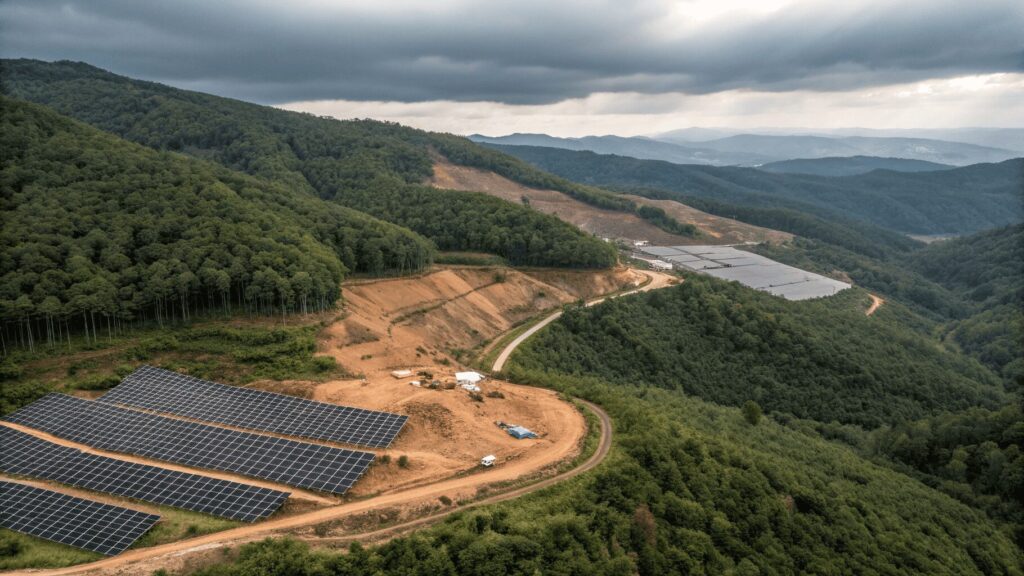
In fact, before becoming a lawyer, I was personally involved in megasolar development as a power generation business operator. When actually visiting project sites, frankly speaking, I often encountered landscapes that could only be described as “bizarre.” Mountains stripped of forests on a massive scale, with solar panels spread as far as the eye could see. And conflicts with neighboring residents were endless.
With such experience, my position on this regulatory strengthening leans from neutral toward supportive. This is not self-denial, but rather what I believe is a necessary process for the healthy development of the industry.
However, just because it’s a “predetermined course” doesn’t mean it’s unimportant. From a legal practitioner’s perspective, this package contains numerous legal issues that cannot be overlooked. Particularly for existing operators, serious problems directly affecting business continuity are lurking.
In this article, I will provide a detailed explanation of this Megasolar Countermeasure Package, drawing on both my real-world experience as a power generation business operator and my expertise as a lawyer.
Overall Framework of the Megasolar Countermeasure Package
Three-Pillar Structure
The countermeasure package decided this time is structured around the following three pillars:
First Pillar: Strengthening Legal Regulations Against Inappropriate Projects
- Review of environmental impact assessment scope under the Environmental Impact Assessment Act and Electric Utilities Act
- Strengthening regulations for forest land development permits under the Forest Act
- Review of the Act on Conservation of Endangered Species of Wild Fauna and Flora
- Administrative communication regarding the Cultural Properties Protection Act
- Expansion of Kushiro Wetlands National Park boundaries under the Natural Parks Act
- Strengthening safety regulations under the Electric Utilities Act
- Enhancing cybersecurity for solar power systems
- Promoting utilization of the Landscape Act
- Other measures including land use regulations, appropriate operation of related laws, and ensuring disposal/recycling of solar panels
Second Pillar: Strengthening Coordination with Local Initiatives
- Establishment of the “Renewable Energy Regional Coexistence Liaison Conference” (再エネ地域共生連絡会議)
- Promoting utilization of the Landscape Act (reiterated)
- Administrative communication regarding the Cultural Properties Protection Act (reiterated)
- Promoting coordination with local government environmental impact assessment ordinances
- Establishing a “cross-ministry renewable energy project monitoring system”
Third Pillar: Prioritizing Support for Community-Coexistent Models
- Review of FIT/FIP system support using renewable energy surcharges (considering abolition for commercial solar projects from FY2027 onward)
- Strengthening development and deployment of next-generation solar cells (perovskite, tandem types)
- Prioritizing deployment support for rooftop installations and other community-coexistent projects
- Clarifying desirable forms of agrivoltaic solar
- Responses in renewable energy procurement by government entities
- Promoting project consolidation among responsible entities that can earn regional trust
Background of the Ministerial Meeting
This meeting was chaired by Chief Cabinet Secretary Kihara, with attendance from Minister of Economy, Trade and Industry Akazawa, Minister of Internal Affairs and Communications Hayashi, Minister of Agriculture, Forestry and Fisheries Suzuki, Minister of Land, Infrastructure, Transport and Tourism Kaneko, and Minister of the Environment Ishihara.
During the meeting, Chief Cabinet Secretary Kihara stated, “Solar power generation projects have rapidly expanded over the past decade or so, and now account for approximately 10% of Japan’s total power generation. On the other hand, particularly for large-scale projects, cases raising various concerns regarding natural environment, safety, and landscape have been observed in some regions.” He emphasized that “coexistence with local communities and environmental considerations are fundamental prerequisites” for renewable energy deployment.
Relationship with the LDP Proposal
In fact, this countermeasure package largely aligns with the proposal published on December 18, 2025, by the Liberal Democratic Party’s joint committee. An article by Nikkei BP notes, “The published countermeasure package follows the content of the proposal published by the LDP’s joint committee on December 18, making it essentially a predetermined course.”
Additionally, regarding the abolition of FIP bidding, there had already been movement on December 16 at the Procurement Price Calculation Committee to “examine the necessity of support,” indicating that the policy decision process had been progressively advancing.
Why Is It Called a “Predetermined Course”?
It Was Already Anticipated Within the Industry
Problems surrounding megasolar have rapidly become social issues in recent years. Concerns have been raised nationwide about environmental destruction, landscape degradation, landslide disaster risks, and resident conflicts.
Therefore, it was already anticipated within the industry that the government would embark on some form of regulatory strengthening. Particularly since the start of the FIT (Feed-in Tariff) system in 2012, while solar power deployment rapidly expanded, inappropriate projects also became conspicuous.
The Meaning of “Predetermined Course” from a Lawyer’s Perspective
However, being a “predetermined course” does not mean it is legally unimportant. Rather, precisely because the policy direction has already solidified, it is necessary to accurately understand the practical impacts and prepare responses.
The following points are particularly important:
- Amendment Schedule and Implementation Timing: When will the new regulations apply?
- Impact on Existing Projects: Will they apply retroactively to already certified projects?
- Specific Requirements: What criteria will be used for regulation?
- Content of Penalties: What are the penalties for violations?
These are extremely practical issues directly related to business continuity and profitability for operators.
Strengthening Seven Laws: Detailed Analysis of Legal Issues
Environmental Impact Assessment Act & Electric Utilities Act: Expansion of Assessment Scope
Current System
Currently, under the Environmental Impact Assessment Act, environmental assessment is mandatory for all megasolar projects with connected output of 40MW or more, and for some megasolar projects of 30MW or more with significant environmental impact (as per 2020 government ordinance).
Direction of Reform
The countermeasure package states that it will “review the scale of solar power generation projects subject to environmental impact assessment under the Environmental Impact Assessment Act and Electric Utilities Act to promote environmental consideration by operators.”
Specifically, consideration is being given to expanding coverage to projects below 30MW.
Practical Impact
Environmental assessment requires complex procedures including preparation of methodology documents, preparatory documents, and evaluation documents, as well as public inspection and opinion solicitation. Procedures typically take 2-3 years, so if coverage is expanded, development periods for mid-scale projects will be significantly extended.
Additionally, conducting assessments requires fees paid to specialized consultants, increasing project costs.
Furthermore, it states that “after the review, the thinking behind the review will be communicated to local governments and necessary coordination will be undertaken.” Many municipalities already regulate through their own ordinances, and the national system reform may serve as an opportunity to expand the scope of such ordinances as well.
Forest Act: Strengthening Forest Land Development Permit System Regulations
Content of Reform
Regarding the Forest Act, the package states it will “strengthen regulations of the forest land development permit system, including penalties for permit condition violations and public disclosure of those who do not comply with orders.”
Specifically, under the revised Forest Act (scheduled to take effect in April 2026), the following measures will be implemented:
- New penalties for permit condition violations: Up to 3 years imprisonment or fines up to ¥3,000,000
- Public disclosure system for those who do not comply with orders: Prefectural governors will publicly disclose operators who do not comply with orders to halt development activities or restore sites to original condition
Practical Impact
Until now, effective sanctions for violations of forest land development permit conditions have been insufficient, and some operators have failed to comply with conditions after obtaining permits. With these new penalties, operators now face the risk of criminal liability.
Additionally, the public disclosure system creates reputational risk for operators. Particularly for listed companies or operators receiving financing from financial institutions, this could become a serious compliance issue.
It should be noted that since April 2023, the Forestry Agency has lowered the development scale threshold subject to regulation for forest land development for solar power equipment installation from over 1 hectare to over 0.5 hectares. Combined with this penalty strengthening, attention must be paid to the strengthened regulation of small-scale projects as well.
Electric Utilities Act: Strengthening Safety Regulations
Content of Reform
Regarding the Electric Utilities Act, the package states that “to prevent accidents caused by design deficiencies in solar power equipment, a system will be established whereby third-party organizations with civil engineering and construction expertise confirm compliance with technical standards for structures before construction for all photovoltaic power generation equipment of 10kW or more.”
This aims to submit legislation to the ordinary Diet session in Reiwa 8 (2026).
Practical Impact
Currently, for commercial solar power of 10kW or more and less than 2000kW, pre-use self-confirmation systems have been mandatory since 2023, but the new system will change to “a mechanism for third-party organizations to review compliance before construction.”
This will cover all solar equipment of 10kW or more, and since the number of low-voltage commercial solar projects (10kW or more, less than 50kW) is enormous, a rapid increase in the number of reviews is anticipated.
According to a Nikkei BP article, “while this becomes a new burden for power generation operators, the rapid increase in demand for reviewing safety and compliance of solar power plants could also develop into a new business.”
From the operator’s perspective, increased review costs and periods are unavoidable. Particularly during the period until third-party organization review systems are established, construction delays due to review backlogs are also a concern.
Act on Conservation of Endangered Species, Cultural Properties Protection Act, Natural Parks Act, Landscape Act
Act on Conservation of Endangered Species of Wild Fauna and Flora
To protect important habitats and growth areas of rare species, the package promotes establishment of habitat protection zones, and states it will “examine measures to ensure effectiveness when requesting responses from operators regarding development activities that may affect rare species conservation” (system reforms planned based on deliberation council summary results around summer 2026).
Cultural Properties Protection Act
To prevent development from proceeding without adequate confirmation of impacts on natural monuments, the package states it will “organize points to note when municipalities provide advice to operators regarding confirmation of impacts on natural monuments from construction work, and issue administrative communications to municipalities” (scheduled for implementation during FY2025).
Natural Parks Act
Regarding Kushiro Wetlands National Park, the package states it will “expand park boundaries to nearby areas with qualities worthy of national park status to strengthen conservation of wetland environments, and appropriately regulate development within park boundaries” (aiming for boundary expansion during FY2026).
Landscape Act
To enable municipalities to formulate landscape plans with clear landscape formation standards, the package states it will “revise Landscape Act operational guidelines and prepare and publish a Landscape Act utilization manual” (scheduled for implementation by around spring 2026).
Practical Impact
While these laws regulate solar power generation projects from different perspectives, what they have in common is that “impact assessment and coordination with municipalities at the initial project stage” becomes important.
Particularly regarding the Landscape Act, while implementation has varied by municipality until now, this operational guideline revision may strengthen landscape regulation nationwide.
Other Laws: Soil Contamination Countermeasures Act, Embankment Regulation Act, etc.
The countermeasure package states that “even for development that has already commenced, to ensure legal compliance and regional coexistence, regulations under various related laws including the Forest Act, Cultural Properties Protection Act, Soil Contamination Countermeasures Act, and Embankment Regulation Act will be fully mobilized and strictly enforced.”
This is a strong message that even for projects that have already commenced development, strict responses will be taken if there are violations of various laws.
The Greatest Focus: FIT/FIP System Abolition in FY2027
Ambiguity of “Including Consideration of Abolition”
The most noteworthy element in the countermeasure package is the statement that “for commercial solar (ground-mounted) from FY2027 onward, considering the state of cost reduction through technological progress and the direction of prioritizing support measures taking into account issues and characteristics of solar power generation, abolition of support will be considered.”
This wording leaves ambiguity in the following respects:
- Does “including consideration of abolition” mean abolition is presumed, or is abolition one of multiple options?
Media reports indicate that “discussions are proceeding in the direction of abolition”, but the package wording itself stops at “consideration.”
- Does “commercial solar from FY2027 onward” refer only to new projects, or does it include already certified projects?
On this point, a Nikkei BP article analyzes that “whether abolition of support measures is limited to new projects or applies retroactively to already certified projects is not clear, but inferring from the flow of discussions, it is considered to mean not providing new certifications and support.”
Additionally, since the package includes wording that “for FIT/FIP certified projects where violations of related laws are recognized, payment suspension measures will be promptly implemented, and the FIT/FIP system will continue to be strictly operated,” it is considered that among already certified projects, at least for operational projects, support through purchase will continue.
Impact on Already Certified Projects and Legal Predictability
Even if only new projects from FY2027 onward are targeted, there are important issues for already certified projects as well.
Risk of Payment Suspension for Legal Violations
The package states that “for FIT/FIP certified projects where violations of related laws are recognized, payment suspension measures will be promptly implemented.” As mentioned above, penalties will be imposed for Forest Act violations, and “strict responses” are stated for other laws as well.
In other words, even for already certified and operational projects, if any legal violations are discovered, there is a risk of purchase suspension.
Issue of Legal Predictability
The FIT/FIP system is designed to promote renewable energy investment by guaranteeing operators a purchase price for a certain period. Operators make substantial investments and develop long-term business plans based on this guarantee.
However, if support is terminated midway through the system or strict legal compliance is demanded, initial business plans may become untenable.
This is an important issue from the perspectives of legal stability and predictability. Of course, legal compliance is a natural obligation, but without clear standards for what level of violation leads to purchase suspension, operators cannot take appropriate measures.
Risks Faced by Operators
Due to FIT/FIP support abolition (or reduction), operators face the following risks:
- Suppression of new investment: For new projects from FY2027 onward, without FIT/FIP revenue guarantees, investment recovery prospects become unclear.
- Re-evaluation of existing projects: Even for already certified projects, thorough legal compliance is required, necessitating review of compliance systems.
- Financial institution responses: For projects with project financing, purchase price guarantees are prerequisite, so the impact of system changes needs to be discussed with financial institutions.
Renewable Energy Regional Coexistence Liaison Conference and National-Local Government Coordination
Significance of the New Establishment
The countermeasure package decides to establish the “Renewable Energy Regional Coexistence Liaison Conference” (再エネ地域共生連絡会議) to “build a new coordination framework including local government associations from the perspective of close coordination between national and local governments in implementing appropriate legal regulation of solar power generation projects” (aiming to launch within FY2025).
This conference will facilitate information sharing on:
- Results of comprehensive reviews of related laws and response policies
- Ordinances and extra-legal taxes
- Effective initiatives for projects that have commenced
- Examples of building mechanisms that benefit regions
- Advanced initiatives by municipalities
Expansion of RE G-Men
Until now, the “Related Law Violation Reporting System” and “RE G-Men” have only covered FIT/FIP certified projects, but this package states they will “add non-FIT/non-FIP projects to coverage and build a system ensuring that related laws are reliably complied with across all solar power generation in Japan” (to be included in FY2026 budget proposal and implemented from FY2026).
This means that even self-consumption solar power generation equipment not receiving FIT/FIP certification will be subject to legal compliance monitoring.
Advanced Municipal Initiatives
Many municipalities have already introduced their own ordinances and regulations. For example, initiatives include:
- Regulation through environmental impact assessment ordinances: Mandating environmental assessment at scales smaller than national assessment targets (40MW or more)
- Regulation through landscape ordinances: Restricting megasolar construction in landscape conservation areas
- Introduction of extra-legal taxes: Imposing original taxation on megasolar operators
- Stricter development permits: Strict operation of permits under the City Planning Act and Forest Act
Following this national movement, such municipal initiatives are expected to expand further.
Comparison with JFBA Opinion: Further Regulation Sought by Bar Associations
JFBA Opinion (August 21, 2025)
The Japan Federation of Bar Associations (JFBA) published on August 21, 2025, an “Opinion Calling for Further Legal Amendments to Prevent Disasters, Destruction of Natural Environment and Landscape, and Damage to Living Environment Accompanying Construction of Megasolar and Large-Scale Wind Power Plants.”
This opinion calls for more far-reaching regulations than what the government announced in this package.
Main Content Sought by JFBA
Strengthening Effectiveness of Resident Participation Procedures
Regarding explanation meetings to residents in surrounding areas mandated by the Act on Special Measures Concerning Promotion of Use of Renewable Energy Electricity, the opinion calls for revisions to the Explanation Meeting and Advance Notification Implementation Guidelines “to resolve resident anxieties and adequately reflect resident opinions in projects.”
Specifically, it calls for measures to enable broad resident participation and explicitly recognize the presence of experts. It also states that a system should be established for operators to consult with residents.
Strengthening FIT/FIP Certification Regulations
“To prevent entry and reckless development by operators who prioritize profits, do not comply with laws, and disregard impacts on natural and living environments and facility safety,” it calls for establishing requirements and regulations for FIT/FIP certification ID acquisition and power generation equipment transfers.
Additionally, “to prevent operators who have committed illegal acts in the past from repeating illegal acts,” it calls for establishing disqualification requirements for FIT/FIP certification.
Stricter Protected Forest Designation Removal
It states that strict review should be maintained for removal of protected forest designations for renewable energy projects, and opposes relaxing requirements.
Amendment of Environmental Impact Assessment Act
To make environmental impact assessment more effective, it calls for promptly advancing legal amendments including continuous public access to environmental impact assessment documents, assessment of cumulative impacts, expansion of covered projects, and introduction of an appeal system.
It particularly clarifies opposition to the government streamlining environmental assessment procedures.
Differences from Government Proposal
Compared to the JFBA opinion, the government’s countermeasure package is insufficient in the following respects:
- Resident Participation Procedures: The package does not specifically address strengthening resident participation procedures.
- Operator Disqualification Requirements: Mechanisms to exclude operators who have committed illegal acts in the past are not specified.
- Environmental Assessment Effectiveness: While expansion of coverage is under consideration, effectiveness enhancements (continuous document access, cumulative impact assessment, appeal system, etc.) are not addressed.
These points may become focal points in future legal reform discussions.
Practical Impacts and Response Measures
Checklist for Operators
Operators already conducting solar power generation projects, or considering entry, should confirm the following points:
Existing Projects (Already FIT/FIP Certified)
□ Reconfirm compliance status with related laws (Environmental Impact Assessment Act, Forest Act, Electric Utilities Act, Cultural Properties Protection Act, Landscape Act, etc.)
□ Confirm compliance with forest land development permit conditions (particularly Forest Act related)
□ Prepare for third-party organizations to confirm compliance with technical standards (Electric Utilities Act)
□ Check whether relationships with surrounding residents are good and whether unresolved conflicts exist
□ Confirm appropriate implementation of environmental monitoring
□ Confirm appropriate preparation of disposal/recycling plans
New Projects (Considering Development from FY2027 Onward)
□ Re-evaluate business viability assuming potential FIT/FIP support abolition
□ Consider community-coexistent deployment forms such as self-consumption and rooftop installation
□ Consider utilization of next-generation technologies such as perovskite solar cells
□ Anticipate procedure periods and costs assuming environmental assessment scope expansion
□ Anticipate costs and periods for third-party organization pre-construction reviews
□ Confirm municipal ordinances, landscape plans, etc. in advance
□ Establish careful dialogue opportunities with local residents
Municipal Responses
This package also has important implications for municipalities.
Participation in Renewable Energy Regional Coexistence Liaison Conference
Through the “Renewable Energy Regional Coexistence Liaison Conference” established by the national government, municipalities can learn advanced examples and effective regulatory methods. They can consider their own ordinances and regulations by referencing other municipalities’ initiatives.
Utilization of Positive Zoning
By designating “promotion zones” under the Act on Promotion of Global Warming Countermeasures, municipalities can clarify areas promoting renewable energy deployment. Conversely, by clarifying areas to be conserved, they can prevent inappropriate development.
Utilization of Landscape Act
This package plans revision of Landscape Act operational guidelines and preparation and publication of a Landscape Act utilization manual (by around spring 2026). By utilizing this to establish clear landscape formation standards in landscape plans, megasolar installation can be appropriately regulated.
Ordinance Enactment and Amendment
While many municipalities already have their own ordinances, this national movement provides a good opportunity to review ordinances or consider introducing new regulations.
Resident Rights Protection
For residents as well, this package may lead to strengthened rights protection.
Participation in Environmental Assessment
If environmental assessment coverage is expanded, it becomes possible to submit opinions on methodology documents, preparatory documents, and evaluation documents for more projects.
Regulation Based on Landscape Plans
If municipalities formulate landscape plans, opportunities for residents to express opinions on development that harms landscapes increase.
Utilization of Reporting Systems
Since the “Related Law Violation Reporting System” and “RE G-Men” are expanding to non-FIT/non-FIP projects, suspected legal violations can be reported.
Consideration of Legal Measures
For truly problematic projects, residents can consult lawyers and consider legal measures such as injunction lawsuits or damage compensation claims. However, since litigation takes time and costs, it is more practical to first utilize municipal and national systems.
Future Schedule and Outlook
Legal Amendment Schedule
The main policy implementation schedules listed in the countermeasure package are as follows:
During FY2025
- Issuance of administrative communication regarding Cultural Properties Protection Act
- Launch of Renewable Energy Regional Coexistence Liaison Conference
- Policy decision on FIT/FIP system (examination including abolition of support from FY2027 onward)
- Support for preliminary surveys for demand customers regarding next-generation solar cells (perovskite)
- Policy decision on prioritizing deployment support for community-coexistent solar power generation
Around Spring 2026
- Revision of Landscape Act operational guidelines and preparation and publication of Landscape Act utilization manual
April 2026
- Implementation of revised Forest Act (strengthening forest land development permit system regulations)
2026 Ordinary Diet Session
- Amendment of Environmental Impact Assessment Act enforcement order, etc. (to summarize examination results during next ordinary Diet session)
- Submission of Electric Utilities Act amendment bill (establishment of pre-construction review system by third-party organizations)
Around Summer 2026
- Deliberation council summary on Act on Conservation of Endangered Species (examination of necessary system reforms)
During FY2026
- Expansion of Kushiro Wetlands National Park boundaries
- Construction and implementation of cross-ministry renewable energy project monitoring system
Around March 2027
- Revision of Act on Promotion of Environmentally Considerate Contract basic policy (provisions to avoid procuring electricity from facilities violating laws)
FY2027
- Start of system operation after environmental assessment scope expansion (timing depends on legal amendment progress)
- Strengthening demonstration support for perovskite solar cells
- Development support for tandem solar cells
- Municipal perovskite solar cell deployment support (local fiscal measures)
FY2028
- Start of reporting on installation status of solar power generation equipment on roofs at factories, etc. (ministerial ordinance enforcement April 2027)
Future Outlook
This countermeasure package can be called the first step in comprehensive regulatory strengthening regarding megasolar. However, actual effects depend on legal amendment content and operation.
Accelerated Shift to Community-Coexistent Models
If FIT/FIP support for ground-mounted commercial solar is abolished (or reduced) from FY2027 onward, operators will be forced to shift to community-coexistent deployment forms such as rooftop installation, self-consumption, and agrivoltaic systems.
Additionally, since support for next-generation technologies such as perovskite solar cells is being strengthened, technological innovation is also expected to be promoted.
Municipal Role Becomes More Important
With establishment of the Renewable Energy Regional Coexistence Liaison Conference, coordination between national and local governments will be strengthened. It becomes more important for municipalities to use their own ordinances and landscape plans to implement regulations suited to regional circumstances.
Existing Operator Compliance Will Be Questioned
Even for already certified projects, there is risk of purchase suspension if related law violations exist. Operators need to reconstruct compliance systems and thoroughly comply with laws.
Increased Litigation Risk
While regulations are being strengthened, cases of residents filing lawsuits against existing projects may also increase. Operators should appropriately evaluate legal risks and consult lawyers when necessary.
Summary
The “Megasolar Countermeasure Package” decided by the government on December 23, 2025, is being characterized by the public as a “predetermined course” with “zero novelty,” but from a legal practice perspective, it contains numerous important issues.
Strengthening seven laws, reviewing FIT/FIP support abolition from FY2027, establishing the Renewable Energy Regional Coexistence Liaison Conference—these are significant changes directly affecting business continuity and profitability for operators.
From my own experience being involved in megasolar development as a power generation business operator, I know the on-the-ground reality. Many problems exist that must be resolved, including environmental destruction, landscape degradation, and resident conflicts. I believe this regulatory strengthening is a necessary process for healthy industry development.
However, regulatory strengthening alone is insufficient. As the JFBA opinion points out, more far-reaching responses are needed, such as strengthening effectiveness of resident participation procedures, establishing operator disqualification requirements, and improving environmental assessment effectiveness.
Additionally, balance between regulation and support is important. Solar power generation projects that achieve coexistence with regions and consider the environment should be actively supported. By prioritizing support for desirable deployment forms such as rooftop installation, self-consumption, and utilization of next-generation technologies, both renewable energy deployment and regional coexistence become possible.
As legal amendment specifics become clear going forward, practical impacts will also become more definite. Operators, municipalities, and residents are each required to take appropriate responses from their own positions.
As a lawyer, and as someone who has been involved in power generation projects, I intend to continue monitoring this issue and providing appropriate information and legal support going forward.
- Indonesia Tightens Corporate Procedures: Practical Implications of MOL Regulation 49/2025
- Low-Voltage Solar Power Legal Practice 2025-2026: Latest Trends in Development and Secondary Market Transactions for Lawyers - Subsidy Suspension Risks
関連記事
-
 [Column] [ESG Strategies for Business] Vol.36 Malaysia’s Packaging EPR Mandate and Single-Use Plastic Regulations—The Current State of the Plastics Sustainability Roadmap
 -
[Column] [ESG Strategies for Business] Vol.35 Amendments to Malaysia’s PDPA and Practical Responses for Japanese Companies—DPO Appointment, Data Breach Notification, and Cross-Border Data Transfer Guidelines
-
[Article] Investing in Japan’s Battery Storage Business: August 2026 Guide – Market Opportunities, Revenue Strategies, Regulation and Legal Practice
-
JETRO Publishes Report on Malaysia’s Carbon Market
-
[Column] Are Mega Solar Regulations Becoming Redundant? Reading the JFBA’s Model Ordinance on Renewable Energy Coordination from a Practical Standpoint
-
[Column] The Full Picture of the 2026 Amended Electricity Business Act and the Impact of New Decarbonization Rules on Corporate Practice
-
[Column] Issues Remaining After the Enactment of the Solar Panel Recycling Act: Cost Allocation, Delegated Legislation, Split Disposal, Reuse, and Logistics
-
[Column] [ESG Strategies for Business] Vol.34 The National Carbon Market Policy and the ETS Concept—How Will the Shift from the Voluntary to the Compliance Market Unfold?