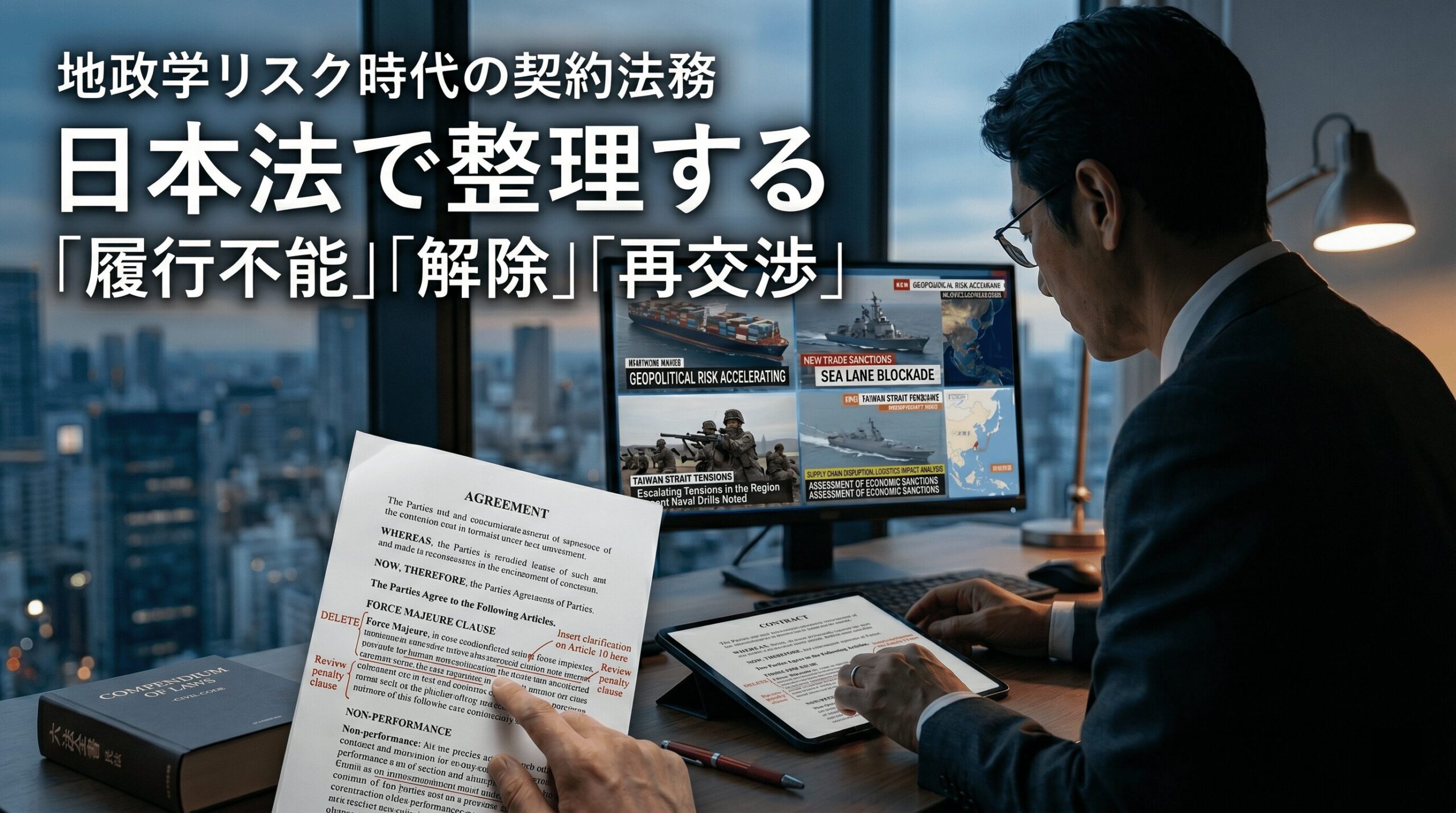
[Column] Contract Law in an Era of Geopolitical Risk | “Impossibility of Performance,” “Termination,” and “Renegotiation” Under Japanese Law
✅ Quick Summary
- 🌍 Geopolitical risk must be understood not as an international news issue, but as a contract performance risk.
- ⚖️ Under Japanese law, it is useful to break the analysis into four distinct questions: damages, performance claims, counter-performance, and termination.
- 📝 Rather than relying solely on a force majeure clause, it is important to design contracts that address causation, notice obligations, alternative measures, exit mechanisms for prolonged events, and dispute resolution.
- 🤝 In practice, it is more realistic to prepare contracts that facilitate renegotiation in advance, rather than relying entirely on the doctrine of changed circumstances.
✅ Audio summary of this post
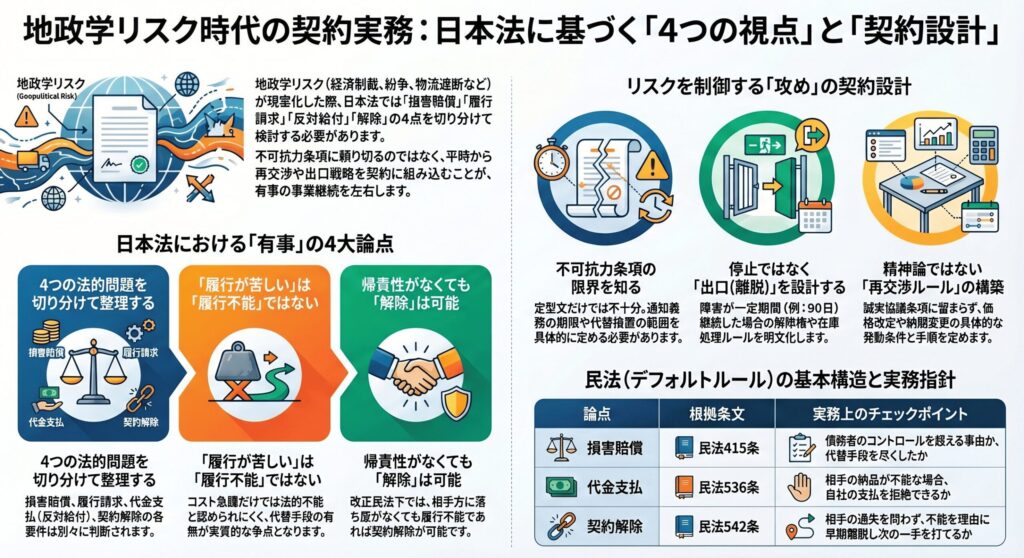
Table of Contents
Introduction
This article examines how geopolitical risks — such as a Taiwan contingency, tensions over the Strait of Hormuz, tit-for-tat economic sanctions, disruptions to maritime transport, and energy supply concerns — affect the contracting practices of Japanese businesses.
In recent years, there has been growing attention to the idea that “force majeure clauses should be reviewed.” While that is certainly an important point, in practice there are many situations where simply looking at the force majeure clause is not enough to reach a clear conclusion.
This is because the impact of geopolitical risk on contracts breaks down into multiple separate legal questions: whether liability for damages arises, whether performance can be demanded, whether counter-performance (such as payment) must still be made, and whether the contract can be terminated.
This article first establishes the basic structure under the Civil Code, then examines which aspects of contract drafting deserve closer attention.
Beyond “Force Majeure”: A Broader Framework
Four Questions to Ask First
When geopolitical risk materializes, legal and procurement teams should begin by identifying four key questions.
The first is whether liability for damages arises if a party fails to perform as agreed.
The second is whether performance can be demanded in the first place.
The third — perhaps the most pressing for business teams — is whether counter-performance (such as payment) must still be made even when the other party is unable to deliver under a bilateral contract.
The fourth is whether the contract can be exited through termination.
These four questions may appear similar, but they are legally distinct.
It is not uncommon in internal meetings to hear overly simplified conclusions such as “it’s force majeure, so everything is off” or “the other party isn’t at fault, so we can’t terminate.” These arguments typically arise from conflating these four questions.
“Difficulty of Performance” Is Not the Same as “Impossibility of Performance”
Another important distinction in the context of geopolitical risk is that “performance has become more difficult” and “performance has become legally impossible” are treated differently under Japanese law.
For example, suppose that soaring logistics and energy costs have severely eroded the profitability of a contract. The business team may feel that “performance under these terms is simply not feasible,” but from a legal standpoint, a mere increase in costs is generally not treated as rendering performance impossible.
On the other hand, if an export or import is prohibited by sanctions law, or if a port or strait is physically blockaded so that shipment becomes impossible, a finding of legal impossibility becomes more plausible.
This distinction is directly relevant to the analysis of damages, termination, and counter-performance discussed below.
In practice, it is important to concretely consider whether alternative means of transport (such as air freight) or alternative sources of supply are available, and to determine internally whether performance has truly become impossible or whether costs have merely increased.
The Difference Between Contracts With and Without Specific Clauses
The Civil Code operates as a set of default rules.
Where a contract contains force majeure clauses, price adjustment clauses, termination clauses for prolonged suspension, or good-faith negotiation clauses, the specific language of those provisions will substantially determine the practical outcome.
Conversely, where such clauses are thin or absent, greater reliance is placed on general principles of the Civil Code and on the relative bargaining power of the parties.
Contracts left with boilerplate provisions are, in our view, the most vulnerable when a crisis occurs.
Accordingly, this article proceeds by first identifying the default rules under the Civil Code, then turning to which provisions a well-drafted contract should address.
Four Key Issues Under the Civil Code
Damages — What Does Article 415 of the Civil Code Actually Examine?
Consider this scenario: heightened risks in the Strait of Hormuz prevent petroleum-derived raw materials from arriving as scheduled, and a supplier is unable to deliver to a buyer on time. Is the supplier liable for delay damages or lost profits?
Article 415, Paragraph 1 of the Civil Code provides that where an obligor fails to perform in accordance with the terms of the obligation, or where performance becomes impossible, the obligee may claim compensation for damage. However, the obligor is not liable where the non-performance “is attributable to grounds that are not imputable to the obligor in light of the contract and other sources of the obligation and common sense in transactions.”
Article 415, Paragraph 2 also allows the obligee to claim substitute compensatory damages where performance has become impossible. When restitution or substitute performance is no longer an option, it is worth noting that the measure of damages may shift from “delay damages” to “substitute compensatory damages.”
Whether the non-performance is imputable to the obligor is assessed in light of the contract and common sense in transactions — meaning that the question is not simply whether a force majeure event occurred, but whether fault is attributed having regard to the specific terms of the contract.
In the context of geopolitical risk, where sanctions or a port blockade are beyond the obligor’s control, this tends to work in favor of negating imputability. However, if alternative means of performance were available and the obligor failed to pursue them, the assessment may change.
In short, the mere occurrence of a geopolitical risk event does not automatically lead to exemption from liability. The substantive issue is how much the obligor could have done — or was expected to do — in light of the specific contract.
Performance Claims — What Does Article 412-2 of the Civil Code Mean?
Suppose a buyer wants to demand that a supplier deliver as contractually agreed. This is a separate question from whether damages are owed.
Article 412-2, Paragraph 1 of the Civil Code provides that where performance “is impossible in light of the contract and other sources of the obligation and common sense in transactions,” the obligee may not demand performance of the obligation.
Whereas Article 415 addresses whether the obligor is liable for damages, Article 412-2 addresses whether performance can be compelled in the first place. These two issues overlap, but they are legally distinct.
Where sanctions prevent an export license from being granted, there is a strong likelihood of a finding of legal impossibility. The same applies where a port blockade physically prevents shipment. On the other hand, where the normal logistics route has been disrupted but air freight is available as an alternative, it is difficult to characterize the situation as outright impossibility.
The practical importance of this issue lies in recognizing that “performance cannot be demanded” must be analyzed separately from “whether damages are owed” and “whether termination is available.” Conflating these issues tends to undermine sound decision-making within an organization.
Counter-Performance — Article 536 of the Civil Code and Risk Allocation in Bilateral Contracts
Suppose a company has not received the parts it ordered, yet it is being asked whether it still must pay for them. This is often the most pressing question for business operations teams.
Article 536, Paragraph 1 of the Civil Code provides that “where performance of an obligation has become impossible due to grounds not imputable to either party, the obligee may refuse to perform the counter-obligation.” This provision restructures the pre-amendment rules on risk allocation: rather than providing for the automatic extinction of the counter-performance obligation, it grants the obligee a right to refuse counter-performance.
Article 536, Paragraph 2 provides that counter-performance cannot be refused where the impossibility is attributable to the obligee, but this provision is rarely at the center of disputes arising from geopolitical risk.
In the context of geopolitical risk, the practical question is whether a buyer may refuse payment where a supplier becomes unable to deliver due to sanctions or a port blockade. Article 536 provides the starting point for this analysis, but where the contract separately addresses risk allocation or the timing of payment, those provisions take precedence.
Where only some of the goods cannot be delivered, another question arises: may the entire counter-performance be refused, or only a proportionate part? This is a point that frequently leads to misalignment between procurement, accounting, and legal teams, and is worth addressing proactively.
Termination — Article 542 and the Structure That Allows Termination Even Without Fault
Consider this scenario: a counterparty under a long-term supply contract has effectively become unable to perform due to prolonged sanctions, and although the counterparty is not at fault, the company wants to exit the contract and secure alternative supply. How should termination rights be assessed?
One of the most important features of the revised Civil Code is that, in certain circumstances, a contract may be terminated even where the obligor is not at fault.
Article 542, Paragraph 1, Item 1 of the Civil Code provides that where “all performance of the obligation has become impossible,” the obligee may immediately terminate the contract without first issuing a demand. The Ministry of Justice explanatory materials on the revision also state that the amendment makes termination available for breach of contract generally, even where the breach is due to circumstances not imputable to the obligor.
However, with respect to termination after notice (under Article 541 of the Civil Code), termination is not available where the non-performance is “minor in light of the contract and common sense in transactions.” In most geopolitical risk scenarios this requirement will be met, but caution is warranted before terminating immediately in cases involving only minor and temporary disruptions.
This is a critically important point in practice.
Some may assume that “since the other party is not at fault, we cannot terminate either,” but under Japanese law the requirements for damages and for termination are not identical. It is legally possible for liability for damages to be negated, yet termination to still be available.
In the geopolitical risk context, when there is no prospect of performance due to prolonged sanctions or a definitive disruption of supply chains, when and by what procedure a party can exit the contract is closely tied to securing alternative supply. Designing contracts so that termination leaves the party “free to take the next step” is one of the key objectives of contract law practice.
Practical Checklist: Contract Provisions to Review
Broader Force Majeure Definitions Are Not Always Better
Suppose a force majeure clause reads: “war, natural disaster, terrorism, and any other event beyond the reasonable control of the parties.” Would undeclared military exercises or a strait blockade be covered under “war”? Depending on the wording of the clause, this could become a serious point of dispute.
Boilerplate language does not necessarily work well in relation to geopolitical risk. The question of whether undeclared uses of force constitute “war” is a real interpretive issue that can arise in practice.
That said, it does not follow that force majeure events should be listed as broadly as possible. Particularly in common law jurisdictions, a detailed enumeration tends to be read as exhaustive, meaning that events not listed may be interpreted as falling outside the clause (Business & Law).
Moreover, force majeure clauses that require the event to be “unforeseeable” can create an internal contradiction: if specific events are already enumerated, they may be characterized as foreseeable, potentially undermining the very exemption the clause is designed to provide (Business & Law).
Another point that is often overlooked: force majeure clauses are primarily useful when the drafting party is acting as a supplier under the contract. Where the party is the payer, exemption from liability for monetary obligations is generally harder to obtain, and the practical value of a force majeure clause differs accordingly.
Causation and Notice Obligations — Occurrence of an Event Does Not Automatically Mean Exemption
Even if a geopolitical event occurs, exemption from liability is not automatic. Under a typical force majeure clause, a causal link between the force majeure event and the non-performance is required.
For example, even if a strait blockade cuts off a supplier’s usual shipping route, if alternative means such as air freight are available, it cannot be said that performance has “become impossible,” and exemption may not be granted.
Whether an upstream supply chain disruption can be claimed as the invoking party’s own force majeure also depends heavily on the wording of the clause. Without a specific provision extending force majeure to upstream supplier events, such a claim is likely to be difficult.
In practice, notice obligation clauses are frequently disputed. Most force majeure clauses condition the right to claim exemption on timely notification. Claims of exemption are often restricted where notice is delayed or incomplete.
It is advisable to specify in advance the notice deadline (e.g., “within X days of becoming aware of the event”), the method of notice, and the scope of information to be provided (the nature of the event, its impact, expected duration, and status of alternative measures being considered).
In practice, when a force majeure event occurs, quickly assess what has stopped and what cannot be replaced, and simultaneously notify the counterparty and create internal records. Emails, proof of logistics disruption, notices from suppliers, and official government announcements should be preserved as evidence from an early stage.
Preparing for Prolonged Events — Design “Exit Mechanisms,” Not Just “Suspension”
A troubling characteristic of geopolitical risk is that it tends to be medium- to long-term in nature. Tit-for-tat sanctions and supply chain fragmentation can persist for months or years.
Accordingly, it is not enough for a force majeure clause to authorize suspension or grant exemption — the contract must also address what happens if the situation continues for a certain period. Specific provisions to consider include:
- A right of termination where the force majeure situation continues beyond a specified period (e.g., 60 or 90 days)
- Where an exclusive supply obligation exists, a clause permitting the switch to alternative sources of supply during a prolonged suspension
- Transitional provisions addressing post-termination inventory disposal, repayment of advance payments, and return of molds, drawings, and design data
For example, where a contract prohibits procurement from any source other than a specific Taiwanese company for certain components, the company cannot shift to another supplier without first terminating the contract.
These are provisions that attract little attention in normal times, but in a protracted crisis, whether they exist or not can determine whether the business can continue to operate.
Dispute Resolution Clauses Are Not Just “The Last Clause to Read”
When geopolitical risk materializes, dispute resolution clauses take on sudden importance.
It is often assumed that agreeing to Japanese court jurisdiction is advantageous for Japanese companies, but where the counterparty is a Chinese company, there is no assurance of mutual recognition and enforcement of judgments between Japan and China — meaning that even a successful judgment in Japan may face serious obstacles when enforcing against assets in China.
Where the counterparty is a Taiwanese company, the absence of formal diplomatic relations between Japan and Taiwan may also create complications in serving process through the Ministry of Foreign Affairs.
For these reasons, arbitration is often preferred in cross-border transactions.
Dispute resolution clauses tend to be treated as boilerplate during contract review, but for contracts with counterparties in high geopolitical-risk jurisdictions, they deserve a thorough review covering governing law, choice of jurisdiction, and seat of arbitration.
Keeping Export Controls and Economic Sanctions Compliance in View
While this article does not go into depth on the topic, any contract review prompted by geopolitical risk must also address representations, warranties, and compliance obligations relating to export controls and economic sanctions.
U.S. OFAC regulations, EU sanctions, and Japan’s Foreign Exchange and Foreign Trade Act are all being tightened year by year, and the need to address at the contract level the verification of counterparties, final destinations, and end use; screening against sanctions lists; and compliance with re-export restrictions is growing.
Geopolitical risk management cannot overlook this dimension.
“Contracts That Enable Renegotiation” Are the Strongest in Practice
The Doctrine of Changed Circumstances Is Close to a Last Resort
Under Japanese law, the doctrine of changed circumstances (jijo henko no genri) modifies the binding force of a contract in exceptional cases where circumstances fundamentally and unforeseeably change after conclusion. However, this doctrine does not function as a broad safety net — research from the University of Tokyo Institute of Social Science describes it as a “last resort” that “in extremely exceptional cases releases the obligor from its contractual obligations.”
The Supreme Court has accepted the existence of the doctrine in principle, but cases where it has actually been applied to grant relief are understood to be extremely rare.
Accordingly, assuming that “we can invoke changed circumstances to modify the contract later” is, in our view, a practically risky approach.
Japanese Business Practice Relies on Post-Hoc Renegotiation and Contract Amendment
At the same time, the same research notes a tendency in Japanese business practice to address changed circumstances not by comprehensively writing them into the contract at the time of conclusion, but through “post-hoc responses via renegotiation and contract amendment after conclusion” (University of Tokyo Institute of Social Science).
This is consistent with the emphasis Japanese business relationships have traditionally placed on ongoing relationships and the principle of good faith.
However, “renegotiation can always sort things out” as a practical norm is a completely different proposition from “there is no need to put anything in the contract.”
If renegotiation is to be relied upon, it is safer to specify in the contract in advance when, by what trigger, and on what scope discussions will be held.
Good-Faith Negotiation Clauses Alone May Not Be Enough
Many Japanese company contracts contain only a provision to the effect that “any matters not provided for shall be resolved through good-faith consultation between the parties.”
Research from the University of Tokyo Institute of Social Science also notes that “in many cases, all that is provided is a good-faith negotiation clause requiring the parties to resolve matters through good-faith consultation.”
Good-faith negotiation clauses are themselves important, but in situations involving significant and potentially prolonged geopolitical impacts, they often fail to give enough shape to the content of discussions, and the parties tend to reach an impasse.
Concrete provisions to consider incorporating as renegotiation clauses include:
- Price revision consultations triggered by raw material or logistics cost changes exceeding a specified percentage
- Rules for discussions on extensions of delivery dates or adjustments to minimum purchase quantities
- Procedures for agreeing on the use of alternative specifications or alternative sources of supply
- A right of termination if no agreement is reached within a specified period after consultations begin
The goal is to design renegotiation clauses not as a philosophical commitment to “let’s talk,” but as concrete procedural rules — and that is the approach we believe is most effective in contract law practice in an era of geopolitical risk.
Summary
In an environment of heightened geopolitical risk, it is not sufficient to check only whether a force majeure clause exists.
Under Japanese law, the analysis must separate out damages (Civil Code Article 415), performance claims (Civil Code Article 412-2), counter-performance (Civil Code Article 536), and termination (Civil Code Article 542), and then consider, in each specific contract, how to design the definition of force majeure events, the proof of causation, notice obligations, obligations to seek alternative measures, termination rights upon prolonged disruption, dispute resolution, and renegotiation rules.
The Civil Code contains several structurally important points for geopolitical risk management: that termination may be available even where the obligor is not at fault; that counter-performance is treated as a right of refusal rather than automatic extinction; and that the assessment of exemption from liability for damages is made in light of “the contract and common sense in transactions.”
The role of legal teams is not only to assess after the fact whether a company is exempt from liability in a crisis — it is to design contracts in peacetime so that the company can take the next step even when a crisis occurs. We hope this article provides a useful framework for that purpose.
- [Column] FY2025 Enforcement Actions Under the Renewable Energy Special Measures Act | Strengthened Oversight and Practical Considerations
- [Column Introduction] [Representative's Blog] Three Essential Rules for Entering the Grid-Scale Battery Storage Business
関連記事
-
 [Article] Investing in Japan’s Battery Storage Business: August 2026 Guide – Market Opportunities, Revenue Strategies, Regulation and Legal Practice
 -
[Column] Are Mega Solar Regulations Becoming Redundant? Reading the JFBA’s Model Ordinance on Renewable Energy Coordination from a Practical Standpoint
-
[Column] The Full Picture of the 2026 Amended Electricity Business Act and the Impact of New Decarbonization Rules on Corporate Practice
-
[Column] Issues Remaining After the Enactment of the Solar Panel Recycling Act: Cost Allocation, Delegated Legislation, Split Disposal, Reuse, and Logistics
-
[Column] The “Institutional Design” of Community-Integrated Renewable Energy – Decoding the Conditions for Successful Projects from the 20 Good Echo Cases
-
[Column] Environmental Impact Assessment Threshold for Solar PV Lowered from “40MW to 20MW” – Tightening Mega Solar Regulations and Key Practical Points for Project Developers
-
[Column Introduction] [Representative’s Blog] Three Essential Rules for Entering the Grid-Scale Battery Storage Business
-
[Column] Cabinet Decision on the Bill for the Promotion of Recycling of Solar Panel Waste | Practical Considerations and the Full Scope of the Legal Framework in Preparation for the Era of Mass Disposal