[Column] Cabinet Decision on the Bill for the Promotion of Recycling of Solar Panel Waste | Practical Considerations and the Full Scope of the Legal Framework in Preparation for the Era of Mass Disposal
✅ Quick Summary
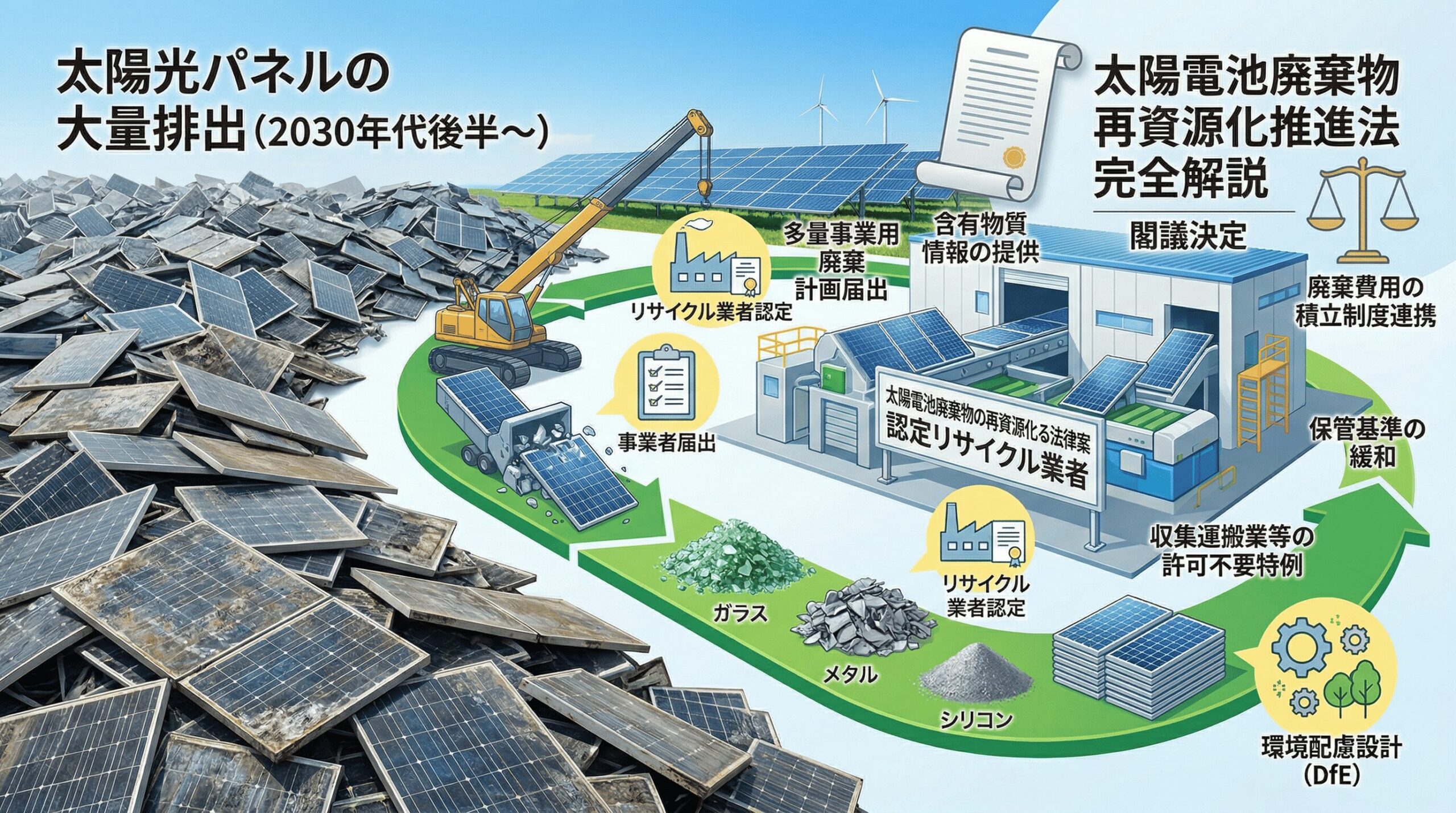
- This bill addresses the anticipated mass disposal of solar panels from the late 2030s onward (projected up to approximately 500,000 tons per year) by introducing measures to prevent the depletion of final disposal site capacity.
- Large-volume dischargers are required to submit a prior notification of a “Large-Scale Business Solar Battery Disposal Implementation Plan,” and the government may issue recommendations or orders to correct insufficient plans.
- Certified recycling businesses will benefit from a special exemption from the permit requirements under the Waste Management and Public Cleansing Act, along with special provisions for storage standards.
- Manufacturers and importers will be required to implement environmentally conscious design practices and to provide information on the substances contained in their products.
✅ Audio summary of this post
Table of Contents
Introduction
This article explains the “Bill for Promoting Recycling and Other Measures for Solar Battery Waste,” which was approved by the Cabinet on April 3, 2026.
We believe that the “exit strategy” for solar panels is not merely an environmental issue—it is a significant compliance risk for ongoing business operations.
As the panels that proliferated rapidly under the Feed-in Tariff (FIT) scheme approach the end of their useful lives, many practitioners in the field are concerned about future recycling costs and legal obligations.
In fact, government survey materials indicate that approximately 60% of solar power generation businesses (Ministry of the Environment reference materials) have not conducted any substantive consideration of recycling.
This article provides a detailed explanation of this new legal framework from a practical perspective that businesses are likely to face.
Background of the Legislation
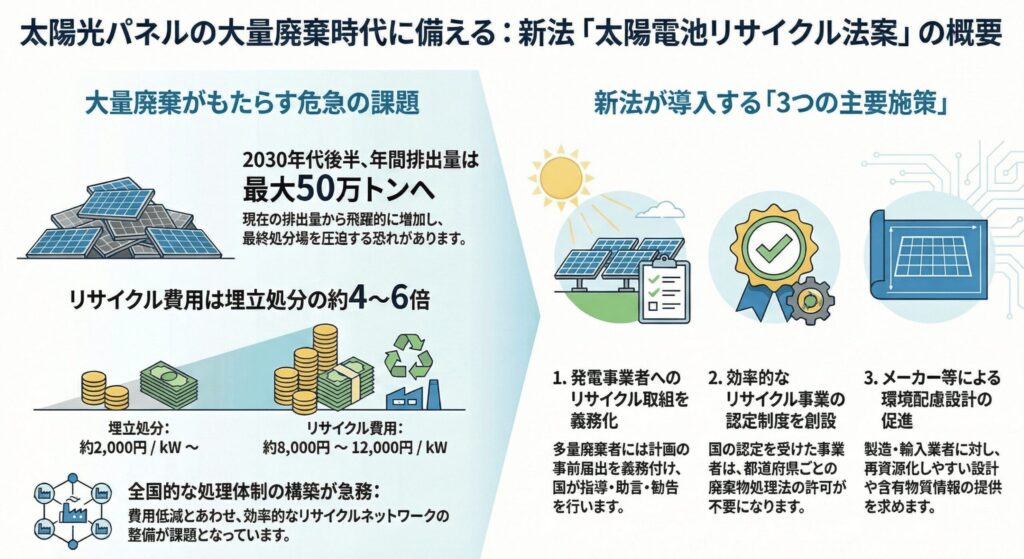
Japan’s solar panel waste volume is projected to increase significantly from the late 2030s onward, potentially reaching up to approximately 500,000 tons per year (Ministry of the Environment press release).
The purpose of this bill is to address the challenges that cannot be handled under the current system as this “era of mass disposal” approaches.
- The rapid increase in waste volume raises concerns about the depletion of remaining capacity at final disposal sites. If all of this waste were to be landfilled, there is a risk of disruption to the overall waste management system.
- At present, there is a significant cost disparity: landfill disposal costs approximately 2,000 yen/kW (Ministry of the Environment reference materials), while recycling costs approximately 8,000 to 12,000 yen/kW (Ministry of the Environment reference materials).
- Another major challenge is that the nationwide processing system needed for cost-efficient treatment is still under development.
In response to these challenges, regulations will be strengthened in stages in order to build a recycling infrastructure while containing overall social costs.
Overview of the Solar Battery Waste Recycling Act
This bill establishes a comprehensive framework to ensure the proper treatment of waste and the effective utilization of resources.
- The Minister of the Environment and the Minister of Economy, Trade and Industry will formulate basic policies for the comprehensive and planned promotion of recycling and other related measures.
- “Solar batteries” covered by the bill are defined as panel-shaped devices that use glass as a material and meet a weight threshold to be defined by cabinet order.
- Furthermore, coverage is limited to types designated by cabinet order as those for which recycling is technically and economically feasible and effective when the device becomes waste.
- The responsibilities of the national government, local governments, and solar battery waste generators are clearly defined in the legislation.
- The bill is also designed to work in conjunction with the reserve fund system for disposal costs for business-use solar power generation facilities (10 kW (Ministry of the Environment reference materials) or more) under the FIT/FIP scheme of the Act on Special Measures Concerning Procurement of Renewable Electric Energy by Operators of Electric Utilities.
[For Businesses] Regulations and Obligations for Large-Volume Dischargers
For businesses engaged in power generation, the most practically important point is the tightening of regulations at the time of disposal.
- Guidance and advice will be provided to those who intend to dispose of business-use solar batteries, based on criteria to be established by the competent ministers.
- “Large-scale business solar battery dischargers” that meet requirements defined by cabinet order are obligated to submit a “Large-Scale Business Solar Battery Disposal Implementation Plan” to the national government in advance before disposing of business-use solar batteries.
- After the submission is accepted, there is a restriction period: as a general rule, the discharger may not generate waste themselves or have others carry out construction or work to generate waste until 30 days (Ministry of the Environment press release) have elapsed from the date of acceptance.
- If the content of a submitted plan is found to be significantly insufficient in light of the established criteria, the competent ministers may issue recommendations and orders for plan revision.
Businesses planning large-scale facility upgrades or business closures will need to incorporate this advance notification and waiting period into their project schedules.
[For Recyclers] Certification System and Special Provisions
A new certified business plan system and legal special provisions will be introduced to promote the efficiency of recycling operations.
- Those who wish to engage in solar battery waste recycling and related businesses may prepare an implementation plan and apply for certification from the competent ministers.
- Certified businesses will be able to operate without obtaining individual prefectural permits required under the Waste Management and Public Cleansing Act.
- For solar battery waste classified as industrial waste, collection, transportation, and disposal may be carried out in accordance with the certified plan and standards defined by cabinet order, notwithstanding the provisions of the Waste Management and Public Cleansing Act.
- Special provisions will also be established under this act for ocean disposal standards under the Act on the Prevention of Marine Pollution and Maritime Disaster, for waste properly processed under this act.
- Registration and license tax applies to certification applications: 150,000 yen per application (Ministry of the Environment reference provisions) for new certifications of solar battery waste recycling business plans.
- For changes to a business plan such as expanding the collection area, the fee is 30,000 yen per application (Ministry of the Environment reference provisions).
“Upstream Measures” Required of Manufacturers and Distributors
Upstream measures at the design and manufacturing stages are also provided for, in order to reduce the burden at the disposal stage.
- Manufacturers and importers of solar batteries are encouraged to make efforts to implement environmentally conscious design—that is, to adopt innovations in design and in the types of raw materials used.
- Specific examples include extending product lifespan, reducing weight, designing for easy disassembly, and reducing the content of hazardous substances.
- Manufacturers and importers are required to take measures to provide information including labeling on the materials, components, and weights of the solar batteries they manufacture or import.
- Distributors are also required to make efforts to provide information on long-term use, reuse, and recycling.
Specific Recycling Methods and Financial Measures
To support the implementation of this bill, the national government will take financial measures to support the development of recycling technologies and the establishment of facilities.
It is expected that the primary processing method will recover glass—which accounts for approximately 60% (Ministry of the Environment reference materials) of a solar panel’s weight—as a resource.
Examples of specific methods are as follows.
- Thermal treatment (dedicated equipment): recovers flat glass; glass recovery rate approx. 90–95% (Ministry of the Environment reference materials); estimated capital cost: approx. 100 million yen (Ministry of the Environment reference materials) or more.
- Glass cutting (hot knife, etc.): recovers flat glass; glass recovery rate approx. 75–95% (Ministry of the Environment reference materials); estimated capital cost: approx. 100 million yen (Ministry of the Environment reference materials) or more.
- Glass crushing (blast method, etc.): recovers cullet glass; glass recovery rate approx. 60–90% (Ministry of the Environment reference materials); estimated capital cost: approx. 50–90 million yen (Ministry of the Environment reference materials).
- General-purpose shredder crushing: recovers cullet glass; glass recovery rate approx. 50% (Ministry of the Environment reference materials) or more.
The government has taken specific budgetary measures in the FY2026 budget proposal to support equipment introduction and technology development.
- Support for introduction of recycling equipment: part of 7.3 billion yen (Ministry of the Environment reference materials)
- Support for introduction of storage facilities: part of 6 billion yen (Ministry of the Environment reference materials)
- Technology demonstration for improving the value of recycled materials: part of 3.6 billion yen (Ministry of the Environment reference materials)
- Support for recycling technology development: part of 3.1 billion yen (Ministry of Economy, Trade and Industry reference materials)
- Demonstration of efficient collection and transportation: part of 1 billion yen (Ministry of the Environment reference materials)
Summary
With the cabinet approval of the “Bill for Promoting Recycling and Other Measures for Solar Battery Waste,” the legal framework for the era of mass disposal expected in the 2030s has been clarified.
Going forward, it will become increasingly difficult for power generation businesses to simply dispose of panels in the cheapest way possible. Planned and legally compliant responses that adhere to the statutory “criteria for judgment” will be essential.
It will be important to ensure thorough compliance and to build an exit strategy for your own business with a full understanding of the risks involved, including the prior notification obligation and the possibility of recommendations and orders.
We also believe it is necessary to continue monitoring the development of ministerial and cabinet ordinances, which will prescribe the detailed operational rules, from both legal and business management perspectives.
- Selected as one of "The Best Lawyers in Japan" of the 2027 Editions in Energy Law.
- [Column] FY2025 Enforcement Actions Under the Renewable Energy Special Measures Act | Strengthened Oversight and Practical Considerations
関連記事
-
 [Article] Investing in Japan’s Battery Storage Business: August 2026 Guide – Market Opportunities, Revenue Strategies, Regulation and Legal Practice
 -
[Column] Are Mega Solar Regulations Becoming Redundant? Reading the JFBA’s Model Ordinance on Renewable Energy Coordination from a Practical Standpoint
-
[Column] The Full Picture of the 2026 Amended Electricity Business Act and the Impact of New Decarbonization Rules on Corporate Practice
-
[Column] Issues Remaining After the Enactment of the Solar Panel Recycling Act: Cost Allocation, Delegated Legislation, Split Disposal, Reuse, and Logistics
-
[Column] The “Institutional Design” of Community-Integrated Renewable Energy – Decoding the Conditions for Successful Projects from the 20 Good Echo Cases
-
[Column] Environmental Impact Assessment Threshold for Solar PV Lowered from “40MW to 20MW” – Tightening Mega Solar Regulations and Key Practical Points for Project Developers
-
[Column Introduction] [Representative’s Blog] Three Essential Rules for Entering the Grid-Scale Battery Storage Business
-
[Column] FY2025 Enforcement Actions Under the Renewable Energy Special Measures Act | Strengthened Oversight and Practical Considerations