Low-Voltage Solar Power Legal Practice 2025-2026: Latest Trends in Development and Secondary Market Transactions for Lawyers – Subsidy Suspension Risks
✅ Key Takeaways
📌 Low-voltage solar (10-50kW) accounts for over 80% of all FIT certifications by number, and subsidy suspension measures for legal violations began in November 2024
📌 Violations of the Agricultural Land Act, Forest Act, and local ordinances are subject to subsidy suspension, making legal compliance verification the top priority in secondary market transactions
📌 Starting in FY2026, low-voltage resources can participate in the supply-demand adjustment market (VPP), creating new revenue opportunities through battery integration
📌 In the secondary market, designing representations and warranties and indemnity clauses is critical, requiring proper assessment of subsidy suspension risks in purchase agreements
Table of Contents
Introduction
This article explains the legal practice for development and secondary market transactions of low-voltage solar power generation (10kW or more and less than 50kW), focusing on the latest regulatory reforms from 2024 to 2026.
The amended Act on Special Measures Concerning Procurement of Electricity from Renewable Energy Sources (Renewable Energy Special Measures Act), which came into effect in April 2024, introduced measures to temporarily suspend FIT/FIP subsidies for solar power projects found to be in violation of related laws and regulations. On November 25, 2024, the first cases of suspension (19 projects) were announced.
This measure has significantly heightened the importance of legal compliance, and the role of legal due diligence (DD) by attorneys has become extremely critical.
Furthermore, low-voltage solar accounts for approximately 32% of all FIT certified capacity (by capacity) and over 80% by number of projects, with the secondary market estimated at several tens of billions of yen annually according to private sector estimates.
Additionally, starting in FY2026, low-voltage resources will be able to participate in the supply-demand adjustment market (VPP), creating new business opportunities.
This article explains the legal issues specific to low-voltage solar, clarifying the institutional differences from high-voltage and extra-high voltage systems, while presenting necessary numerical data and sources for practical application.
Fundamentals of the Low-Voltage Solar Market
Definition and Institutional Differences: Low-Voltage, High-Voltage, and Extra-High Voltage
Solar power generation facilities are classified into the following three categories based on output capacity according to the Electricity Business Act:
- Low-voltage: 10kW or more and less than 50kW (main focus of this article)
- High-voltage: 50kW or more and less than 2,000kW
- Extra-high voltage: 2,000kW or more
This classification is not merely a difference in scale; the applicable legal regulations and business environment differ significantly, making it extremely important in practice.
Comparison Table: Low-Voltage, High-Voltage, and Extra-High Voltage Systems
The following table summarizes the main institutional differences between low-voltage and high-voltage/extra-high voltage systems.
| Item | Low-Voltage (10-50kW) | High-Voltage (50-2,000kW) | Extra-High Voltage (>2,000kW) |
|---|---|---|---|
| FIT/FIP Selection | FIT available for FY2025 | FIP transition direction for FY2026+ (under consideration) | FIP/auction system |
| FY2025 FIT Price | 10 yen/kWh | 8.9 yen/kWh (<250kW) | Auction system |
| Grid Connection Cost | Hundreds of thousands to millions of yen | Millions to tens of millions of yen | Tens of millions of yen or more |
| Environmental Assessment | Not required | Generally not required | Required depending on scale |
| Safety Regulations | Small-scale electrical work facilities | Private electrical work facilities | Private electrical work facilities |
| Output Control | Unlimited/uncompensated (post-1/26/2015 applications) | Unlimited/uncompensated | Unlimited/uncompensated |
| Periodic Inspection | Once every 4 years or more | Annual inspection, etc. | Annual inspection, etc. |
(Sources: METI “FIT/FIP Guidebook 2025”, Electricity Business Act)
As evident from this table, low-voltage systems have smaller initial investment amounts and relatively lenient regulations compared to high-voltage and extra-high voltage systems. Therefore, they are considered more accessible for individual investors and small to medium-sized enterprises.
Market Size and Investment Trends for Low-Voltage Solar
The following data indicates the scale of the low-voltage solar market:
- By Capacity: Approximately 32% of all FIT certified capacity
- By Number: Low-voltage accounts for over 80% of all FIT certifications
- Secondary Market: Estimated at several tens of billions of yen annually according to private research institutions
Low-voltage systems have relatively small initial investment amounts (millions to tens of millions of yen), making them accessible to individual investors and small to medium-sized enterprises. In contrast, high-voltage and extra-high voltage systems require investments of hundreds of millions of yen, with institutional investors and business corporations as the main participants.
Particularly in the secondary market, transactions of low-voltage projects are becoming increasingly active, and market expansion is expected to continue.
Major Regulatory Reforms 2024-2026
Introduction of Subsidy Suspension Measures (Enacted April 2024, First Implementation November 2024)
The amended Renewable Energy Special Measures Act, which came into effect on April 1, 2024, introduced measures to temporarily suspend FIT/FIP subsidies for solar power projects found to be in violation of related laws and regulations.
This regulatory reform is considered to have dramatically increased the importance of legal compliance in solar power generation projects.
- First Implementation: November 25, 2024 – Temporary subsidy suspension for 19 solar power projects
- Applicable Laws: Agricultural Land Act, Forest Act, local ordinances, Electricity Business Act, etc.
- Impact: Once a violation is confirmed, subsidies are suspended until rectification
This measure has further increased the importance of due diligence (DD) in secondary market transactions. Legal compliance verification is no longer optional but an essential legal practice.
In practice, particular attention should be paid to the following:
- Presence or absence of agricultural land conversion permits under the Agricultural Land Act
- Presence or absence of forest development permits under the Forest Act
- Compliance with local ordinances (holding resident briefings, maintaining setback distances, etc.)
- Consistency between documents submitted for business plan certification and actual conditions
FY2025 FIT Certification Application Deadline and Purchase Prices
The key deadlines and prices for FY2025 FIT certification are as follows:
- Application Deadline: October 10, 2025 (Friday) 5:00 PM (for 10kW or more and less than 50kW)
- Purchase Price: 10 yen/kWh (ground-mounted low-voltage)
- Comparison with High-Voltage: High-voltage under 250kW is 8.9 yen/kWh
Applications submitted after this deadline will be subject to the following year’s prices, which can significantly impact project profitability. For developers, meeting this deadline is extremely important.
Additionally, the low-voltage purchase price of 10 yen/kWh is set slightly higher than the high-voltage price of 8.9 yen/kWh, likely intended to encourage small-scale operator participation.
Introduction of Initial Investment Support Scheme (Starting October 2025)
An initial investment support scheme for residential solar (under 10kW) with battery installation requirements will be introduced.
- Target: Residential solar under 10kW + battery storage
- Purchase Price: 24 yen/kWh for the first 4 years, 8.3 yen/kWh from year 5 onwards
- Start Date: October 2025
- Purpose: Promote battery adoption to stabilize the renewable energy grid
While this scheme targets residential systems under 10kW, different from the low-voltage commercial systems (10-50kW) primarily discussed in this article, it may influence the future development of the low-voltage VPP market in terms of promoting battery-integrated models.
Low-Voltage VPP Market Opening (FY2026 Start)
Starting in FY2026, low-voltage resources (10-50kW) will be able to participate in the supply-demand adjustment market. This represents an important regulatory reform providing new revenue opportunities for low-voltage solar operators.
- Start Date: FY2026
- Target: Low-voltage solar + battery VPP resources
- Participation Method: Participation in supply-demand adjustment market via aggregators
- Battery Cost Estimate: Approximately 7.5 to 10 million yen for 50kWh scale
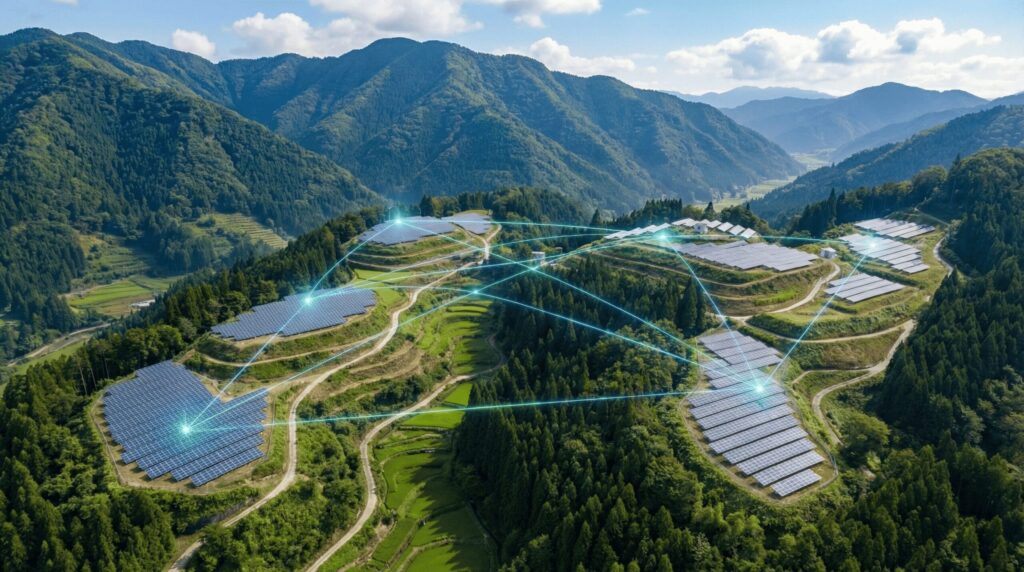
VPP (Virtual Power Plant) is a system that bundles distributed small-scale power generation facilities and batteries using IoT technology to function as if they were a single power plant. For low-voltage solar operators, this creates the possibility of generating income from the supply-demand adjustment market in addition to FIT electricity sales revenue, with expectations for improved profitability.
However, careful consideration of the payback period is necessary due to the high initial investment in batteries.
Discussion on FIP Transition for 50kW and Above
The government is considering transitioning solar systems of 50kW and above to FIP (Feed-in Premium) from FY2026 onwards. However, this is not a formal decision, and low-voltage systems (10-50kW) are expected to remain eligible for FIT selection for the time being.
The main differences between FIP and FIT are as follows:
- FIT: Full volume purchase at fixed price
- FIP: Purchase at market price plus premium
With FIP, operators face increased income volatility risk due to market price linkage, but there is also potential for increased income when market prices are high.
For low-voltage operators, the prospect of continuing FIT selection is significant in terms of maintaining stable business operations.
(Source: METI “Policy Measures Regarding FIP System”)
Legal Practice in the Development Phase
Legal Requirements for Business Plan Certification
To receive FIT/FIP system benefits, business plan certification based on the Renewable Energy Special Measures Act is required.
Main requirements for business plan certification:
- Equipment Specifications: Specifications for solar panels, power conditioners, etc.
- Maintenance Plan: Periodic inspection at least once every 4 years
- Regional Coexistence: Environmental considerations, resident briefings, etc.
- Legal Compliance: Compliance with Agricultural Land Act, Forest Act, local ordinances, etc.
Particularly since the introduction of subsidy suspension measures in November 2024, the importance of legal compliance has increased dramatically. If the documents submitted for business plan certification differ from actual conditions, this may be subject to subsidy suspension.
Regarding periodic inspection obligations, low-voltage systems require inspections at least once every 4 years, while high-voltage and extra-high voltage systems require annual inspections, showing that requirements differ by scale.
(Sources: Renewable Energy Special Measures Act Enforcement Regulations, Business Plan Development Guidelines)
Legal Practice for Land-Related Issues
In solar power project development, land-related legal issues are among the most complex and important considerations. Particularly since the Agricultural Land Act and Forest Act are explicitly listed as laws subject to subsidy suspension measures, compliance with these laws is extremely important.
Agricultural Land Conversion Permits (Agricultural Land Act Articles 4 and 5)
When installing solar power generation equipment on agricultural land, a conversion permit based on the Agricultural Land Act is required.
- Permit Authority: Prefectural governor or Minister of Agriculture, Forestry and Fisheries (for over 4 hectares)
- Standard Processing Period: Approximately 2-4 months
- Procedures: Article 4 (self-conversion) or Article 5 (conversion with rights transfer)
Agricultural land is classified as follows based on agricultural productivity and regional positioning:
Agricultural Land Classification and Conversion Eligibility
| Classification | Conversion Eligibility | Remarks |
|---|---|---|
| Grade A Agricultural Land | Generally not permitted | Agricultural land with particularly favorable farming conditions |
| Grade 1 Agricultural Land | Generally not permitted | Agrivoltaics (solar sharing) allows temporary conversion for 3 years |
| Grade 2 Agricultural Land | Permitted if no alternative land | Agricultural land near urban areas |
| Grade 3 Agricultural Land | Generally permitted | Agricultural land within urban areas or areas with significant urbanization trends |
In practice, agrivoltaics (solar sharing) on Grade 1 agricultural land requires obtaining a temporary conversion permit (typically 3 years) and continuing farming operations. If farming is abandoned, the permit may be revoked and become subject to subsidy suspension.
The standard processing period for agricultural land conversion permits is approximately 2-4 months, but this varies by region and project complexity, requiring generous schedule planning.
Forest Development Permits (Forest Act)
When installing solar power generation equipment in forests, a forest development permit based on the Forest Act is required.
- Target: Forest development exceeding 1 hectare
- Permit Criteria: Reviewed from disaster prevention, flood prevention, and environmental conservation perspectives
- Permit Authority: Prefectural governor
Forest development permit reviews particularly emphasize the following:
- Prevention of soil runoff or collapse
- Flood prevention
- Water resource security
- Environmental conservation
Forests have public functions such as water source cultivation and landslide prevention, so development regulations are often considered more stringent than for agricultural land.
Local Ordinances
Many local governments have established their own ordinances for solar power facility installation. These ordinances may impose stricter regulations than national laws based on local circumstances.
Typical Regulatory Content
- Setback Distance: Maintaining setback distance of 50m or more from residences and roads
- Resident Briefings: Mandatory pre-installation briefings for nearby residents
- Landscape Preservation: Installation restrictions based on landscape ordinances
- Notification Requirements: Pre-installation notifications or permits
Violations of local ordinances are explicitly subject to subsidy suspension measures, making it essential to verify and comply with the relevant local government ordinances before development.
In practice, local ordinances are frequently revised, so confirming the latest information is important. If there are unclear points regarding ordinance interpretation, it is recommended to consult with the local government department in advance.
Land Contract Practice
Land use contracts for solar power projects mainly take the following three forms:
Lease Agreements
The most common form of land use.
Example Contract Terms
- Contract Period: 20-30 years (aligned with FIT period)
- Rent Level: Approximately 2-3% of fixed asset tax assessment value as a guideline
- Rent Revision: Revision clauses through consultation every 5 years are common
- Restoration Obligations: Equipment removal and site restoration obligations upon contract termination
- Early Termination: Presence or absence of operator-side early termination clauses
- Collateral Provision: Consent for providing land lease rights as collateral to financial institutions
In practice, restoration cost burden often becomes an issue in lease agreements, so clearly defining the scope of restoration and cost burden at contract signing is important. Some contracts also include restoration cost reserves as a condition.
Purchase Agreements
Form of purchasing the land.
Example Contract Terms
- Purchase Price: Determined based on market value or nearby transaction examples
- Non-conformity Liability: Scope and period of seller liability for land defects
- Conditions Precedent: Often conditional on FIT certification acquisition, grid connection approval, etc.
- Ownership Transfer Timing: Upon payment or condition fulfillment
With purchase agreements, while initial investment increases, long-term profitability may improve as rent burden is eliminated. However, consideration of land use after FIT period termination is also necessary.
Superficies Rights Agreements
Form of establishing superficies rights on land.
Example Contract Terms
- Period: 20-30 years
- Ground Rent: Similar to lease agreements
- Opposition Power: Third-party opposition requirements secured through registration
- Transfer Collateral: Can establish transfer collateral of superficies rights to financial institutions
Superficies rights are real rights and can be opposed to third parties through registration, providing more stable rights relationships than lease rights. When receiving financing from financial institutions, superficies establishment may be required.
Legal Issues in Grid Connection Contracts
To connect solar power generation facilities to the power grid, grid connection contracts with general transmission and distribution operators are required.
Connection Obligation and Construction Cost Burden
Based on the Electricity Business Act, general transmission and distribution operators have connection obligations. However, construction costs for connection are borne by power generation operators.
Construction Cost Burden Guidelines
- Low-Voltage: Hundreds of thousands to millions of yen
- High-Voltage: Millions to tens of millions of yen
- Extra-High Voltage: Tens of millions of yen or more
Construction cost burdens vary greatly depending on the grid connection conditions (capacity, distance, etc.). It is important to consult with general transmission and distribution operators during the development phase to understand estimated costs.
Output Control Rules
With the large-scale introduction of renewable energy, output control may be implemented during periods of low electricity demand.
Output Control Rules
- Post-January 26, 2015 Applications: Unlimited/uncompensated
- Pre-January 25, 2015 Applications: Output control up to 360 hours or 30 days per year (uncompensated)
Kyushu Area Output Control Results
The FY2024 output control rate in Kyushu is projected at approximately 6.1-6.2%. In practice, output control has been implemented multiple times throughout the year, having a certain impact on project profitability.
Output control rules are determined by the application date regardless of low-voltage, high-voltage, or extra-high voltage systems. In secondary market transactions, it is important to verify the target project’s application date and appropriately assess output control risks.
Grid Connection Timing and Delay Risks
Grid connection construction completion timing depends on the construction schedule of general transmission and distribution operators. Construction delays risk FIT certification expiration or inability to apply the planned fiscal year’s purchase price.
Contractually, establishing delay penalty clauses is often difficult, so setting generous development schedules is important.
Key Points of EPC and O&M Contracts
Construction and operation of solar power generation facilities require EPC (Engineering, Procurement, Construction) contracts and O&M (Operation & Maintenance) contracts.
EPC Contracts
EPC contracts comprehensively cover design, procurement, and construction of facilities.
Main Contract Provisions
- Payment Method: Lump-sum (turnkey) method is common
- Completion Deadline: Penalty clauses for delays
- Performance Guarantees:
- Solar Panels: 25-year output guarantee (e.g., 80% or more after 25 years)
- Power Conditioners: 10-year product warranty
- Defect Liability Period: Generally 2 years after delivery
- Force Majeure Clauses: Treatment of delays/damages due to natural disasters, etc.
- Security Deposits: Contract security deposits, defect liability security deposits
In practice, completion deadline delay risks are important in EPC contracts. Delays may prevent application of the planned fiscal year’s FIT price, so appropriate penalty clause settings are necessary.
Additionally, clearly specifying performance guarantee details (guarantee values, measurement methods, compensation methods) in contracts is important.
O&M Contracts
O&M contracts delegate facility operation and maintenance.
Main Contract Content
- Contract Period: Typically 5-20 years
- Scope of Work:
- Periodic inspection (at least once every 4 years)
- Routine inspection
- Cleaning (panel washing, etc.)
- Weeding/snow removal
- Monitoring (remote monitoring systems)
- Malfunction response
- Costs:
- Low-Voltage: Approximately 100,000-150,000 yen annually
- High-Voltage: Approximately 500,000-2,000,000 yen annually
- Insurance: Facility liability insurance enrollment obligation
O&M contracts are essential for stable power generation operations. Particularly, periodic inspection obligations are requirements for business plan certification, with certification revocation risks for non-compliance.
In secondary market transactions, existing O&M contract contents (scope of work, costs, contract periods, etc.) are verified, with contract succession or new contract signing as needed.
Legal Practice in the Secondary Market
Secondary Market Overview
The secondary market for low-voltage solar has been rapidly expanding in recent years.
Market Characteristics
- Market Size: Estimated at several tens of billions of yen annually according to private research institutions
- Transaction Parties: Diversification from individual investors to small/medium enterprises, investment funds, and institutional investors
- Transaction Prices: Vary significantly based on remaining FIT period, generation performance, location, etc.
Background factors for secondary market expansion are considered to include:
- Over 10 years since FIT system initiation, with increasing operators considering sales
- Deepening investor understanding of renewable energy investment, maturing buyer market
- Increased demand for renewable energy investment providing stable income in low-interest environment
Conversely, with subsidy suspension measures starting in November 2024, legal compliance verification has become extremely important in secondary market transactions.
Due Diligence (DD) Practice
In secondary market transactions, DD is the most important process for buyers. Particularly with the introduction of subsidy suspension measures, the importance of legal DD has increased dramatically.
Legal DD
Legal DD verifies the following matters:
Priority Verification Items
- FIT/FIP Certification Validity:
- Verification of certification number
- Consistency between certification content and actual conditions
- Necessity of change certification
- Agricultural Land Conversion Permit Status:
- Verification of original permit document
- Compliance with permit conditions
- For agrivoltaics, continuation of farming operations
- Forest Development Permit Status:
- Verification of original permit document
- Compliance with permit conditions
- Local Ordinance Compliance:
- Notification/permit acquisition status
- Resident briefing implementation status
- Compliance with setback distance regulations, etc.
- Land Title Verification:
- Verification of property registry
- Verification of land contract details
- Verification of rent payment status
- Disputes with Nearby Residents:
- Presence of complaints/claims
- Presence of litigation/mediation
- Records of resident briefings
If legal violations subject to subsidy suspension measures are discovered, this becomes grounds for transaction cancellation or price reduction negotiations. Even minor violations require consideration of the time and cost needed for rectification.
Technical DD
Technical DD verifies equipment condition and generation performance.
Verification Items
- Generation Performance:
- Monthly generation volume for past 3-5 years
- Analysis of variance from expected generation
- Output control history
- Equipment Deterioration:
- Solar panel damage/contamination
- Power conditioner operational status
- Rack corrosion/deformation
- Electrical wiring deterioration
- O&M Contract Performance:
- Periodic inspection implementation records
- Cleaning/weeding implementation status
- Malfunction response records
- Insurance Enrollment Status:
- Facility liability insurance enrollment
- Movable property comprehensive insurance enrollment
- Profit insurance enrollment
Technical DD generally involves cooperation with experts (technical consultants). Particularly, generation performance analysis directly impacts future revenue projections, requiring careful consideration.
Financial DD
Financial DD verifies business profitability and cost structure.
Verification Items
- Electricity Sales Revenue History:
- Monthly electricity sales revenue trends
- Verification of purchase price
- Revenue reduction due to output control
- Operating Cost Reasonableness:
- O&M costs
- Land rent
- Insurance premiums
- Public charges (fixed asset tax, etc.)
- Remaining FIT Period:
- Verification of remaining period
- Business plan after FIT termination
Financial DD results directly impact transaction price calculation. Particularly if operating costs are higher than expected or generation performance falls short of expectations, this becomes grounds for price reduction negotiations.
Scheme Selection
Secondary market transactions mainly have the following three schemes:
| Scheme | Merits | Demerits | Application |
|---|---|---|---|
| Business Transfer | Can select assets/liabilities | Contract succession procedures are complex, permit reacquisition may be necessary | When transferring only specific power plants |
| Stock Transfer | Relatively simple procedures, no permit succession needed | Off-balance sheet debt risks | Transfer of SPC engaged only in power generation |
| Asset Sale | Simple and clear | FIT certification change procedures required | Small-scale projects |
Business Transfer Characteristics
Business transfers individually specify assets/liabilities to transfer. Therefore, there are merits of not inheriting unnecessary assets or off-balance sheet debts, but contract succession procedures (EPC, O&M, land contracts, etc.) are required, making procedures complex.
Stock Transfer Characteristics
Stock transfers involve transferring shares of companies engaged in power generation. Permits and contracts are inherited as-is, making procedures relatively simple, but there are risks of inheriting off-balance sheet debts not discovered in DD. Therefore, representations and warranties and indemnity clauses are particularly important in stock transfers.
Asset Sale Characteristics
Asset sales are the simplest form of individually buying and selling power generation equipment and land use rights. However, FIT certification operator change procedures are required.
Important Contract Provisions in Purchase Agreements
The following provisions are particularly important in secondary market transaction purchase agreements:
Representations and Warranties
Provisions where the seller represents and warrants to the buyer that certain facts are true and accurate.
Typical Representation and Warranty Matters
- FIT Certification Validity:
- FIT certification validly exists and has not been revoked or suspended
- Certification content is consistent with actual conditions
- Legal Compliance:
- Compliance with Agricultural Land Act, Forest Act, local ordinances, etc.
- No violations subject to subsidy suspension measures
- No Disputes:
- No disputes with nearby residents, landowners, or administrative agencies
- No pending litigation/mediation/arbitration
- Contract Validity:
- Land contracts, EPC contracts, O&M contracts validly exist
- No contract violations
- Equipment Condition:
- Equipment operates normally
- No material defects
Indemnity Provisions
Provisions where the seller compensates the buyer when representations and warranties are breached or specific risks materialize.
Compensation Targets
- Subsidy Suspension Risk: Lost profits when legal violations are discovered and subsidies are suspended
- Permit Defects: Costs incurred when defects are found in agricultural land conversion permits, etc., requiring rectification
- Off-Balance Sheet Debts: Liabilities discovered that were not found in DD
- Litigation Risks: Disputes with nearby residents, etc., that materialize
Compensation Limits
- Cap Amount: Generally 10-30% of purchase price
- Period: Approximately 1-3 years post-closing
Indemnity clause design is one of the most important negotiation points in transactions. Sellers want to limit risks while buyers seek sufficient compensation, requiring coordination of both parties’ interests.
Conditions Precedent
Provisions defining conditions prerequisite to closing (transaction execution).
Typical Conditions Precedent
- DD Results Satisfaction: No material issues discovered
- Permit Succession: Necessary permits are legally succeeded
- Third-Party Consent Acquisition: Consent from landowners, financial institutions, etc.
- Contract Succession Completion: EPC, O&M, etc., contract succession procedures completed
If conditions precedent are not fulfilled, buyers can cancel the transaction.
Post-Closing Obligations
Provisions defining obligations that sellers and buyers must fulfill after closing.
Typical Post-Closing Obligations
- Contract Succession Procedures: Name changes for EPC, O&M, land contracts, etc.
- FIT Certification Change Notification: Operator change notification (notification to Agency for Natural Resources and Energy)
- Handover: Equipment delivery, document delivery, business handover
- Cooperation Obligation: Seller obligation to cooperate within scope necessary for buyer’s business operations
Pricing and Valuation Methods
In secondary market transactions, pricing generally uses DCF (Discounted Cash Flow) method.
Basic DCF Method Concept
Calculate business value by discounting future cash flows (electricity sales revenue – operating costs) to present value.
Pricing Consideration Factors
- Remaining FIT Period: Longer remaining period increases business value
- Purchase Price: Higher purchase price increases business value
- Generation Performance: Performance exceeding expectations increases business value
- Output Control Risk: Business value decreases in areas with high output control
- Operating Costs: O&M costs, land rent, insurance premiums, public charges, etc.
- Subsidy Suspension Risk: Business value decreases significantly if legal violation risks exist
Since November 2024, subsidy suspension risk has become an extremely important factor in pricing. If DD suggests the possibility of legal violations, this risk must be quantified and reflected in pricing.
Additionally, the possibility of business continuation after FIT termination (self-consumption, bilateral PPA, etc.) may also impact pricing.
New Business Models and Future Prospects
Entry into Low-Voltage VPP
The ability for low-voltage resources to participate in the supply-demand adjustment market starting in FY2026 represents a major business opportunity for low-voltage solar operations.
VPP Business Overview
VPP (Virtual Power Plant) is a system that bundles distributed small-scale power generation facilities and batteries using IoT technology for remote control, functioning as if they were a single power plant.
Low-Voltage VPP Business Model
- Battery Integration: Integrating batteries with low-voltage solar
- Aggregator Contracts: Contracting with VPP operators (aggregators)
- Supply-Demand Adjustment Market Participation: Participating in supply-demand adjustment market via aggregators
- Revenue: FIT electricity sales revenue + supply-demand adjustment revenue
Battery Costs
Initial investment of approximately 7.5-10 million yen for 50kWh scale batteries is required. However, battery prices are declining annually, with expectations for further cost reductions.
Legal Issues
- Aggregator Contracts: Revenue sharing, control authority, data usage, etc., provisions
- Grid Connection Changes: Grid connection change procedures accompanying battery additions
- FIT Certification Changes: Necessity of certification changes accompanying battery additions
VPP business is still pre-implementation with some details unclear, but is expected as a new revenue source for low-voltage solar operations.
(Source: METI “Further Utilization of Distributed Resources in Supply-Demand Adjustment Market”)
Low-Voltage Bulk Transactions
“Bulk transactions” bundling multiple low-voltage projects as portfolios for bulk sales to institutional investors are increasing.
Bulk Transaction Merits
- Diversified Investment: Risk reduction through diversification across multiple projects
- Scale Benefits: Transaction cost reduction through large-scale transactions
- Institutional Investor Access: Meeting institutional investor investment criteria as large-scale projects
Bulk Transaction Challenges
- DD Workload: Increased DD workload due to large number of projects
- Management Complexity: Need to manage multiple locations and contract parties
Bulk transactions require standardized DD processes and efficient management systems.
Self-Consumption and Bilateral PPA After FIT Termination
Self-consumption conversion and PPA (Power Purchase Agreement) with companies are attracting attention as exit strategies after FIT period termination.
Self-Consumption Model
- Target: Power plants adjacent to factories, commercial facilities, etc.
- Merits: Electricity purchase cost reduction, environmental value utilization
- Challenges: Matching consumption and generation volumes
Bilateral PPA Model
- Target: Direct contracts with companies to supply renewable energy electricity
- Merits: Securing stable income after FIT termination
- Challenges: Contract negotiation, supply-demand management
Business continuation after FIT termination is a factor that increases the long-term investment value of low-voltage solar. In secondary market transactions, post-FIT business plans may also impact pricing.
Trouble Cases and Preventive Measures
Typical Trouble Cases
The following troubles occur in low-voltage solar operations:
Agricultural Land Conversion Permit Not Obtained
Case: Installing power generation equipment without obtaining agricultural land conversion permit
Result:
- Subsidy suspension as Agricultural Land Act violation
- Administrative guidance (rectification order)
- Possibility of criminal penalties (imprisonment up to 3 years or fine up to 3 million yen)
This case becomes subject to subsidy suspension measures after November 2024, creating an extremely serious situation for operators.
Farming Abandonment
Case: Abandoning farming in agrivoltaic (solar sharing) operations
Result:
- Temporary conversion permit revocation
- Subsidy suspension as Agricultural Land Act violation
Agrivoltaics premised on coexisting agriculture and power generation, with permit revocation when farming is abandoned.
Local Ordinance Violations
Case: Installing without holding resident briefings
Result:
- Subsidy suspension as ordinance violation
- Escalating disputes with residents
- Operational suspension risk
Local ordinances vary by region, requiring mandatory verification before development.
Disputes with Landowners
Case: Disputes over rent non-payment, restoration cost burden
Result:
- Land contract termination
- Loss of land use rights
- Forced equipment removal
Land contracts are fundamental to operations, requiring maintenance of good relationships with landowners.
Nearby Resident Troubles
Case: Disputes with nearby residents over reflected light, noise, landscape issues
Result:
- Resident lawsuits (injunction claims, damage compensation claims)
- Operational suspension risk
- Business value decline
Nearby troubles can seriously impact business operations, making resident briefings during development important.
Preventive Measures and Risk Management
The following measures can prevent the above troubles:
Thorough Legal Investigation
Measures:
- Pre-investigation of legal regulations for development sites
- Verification of Agricultural Land Act, Forest Act, local ordinance applicability
- Understanding necessary permit acquisition timing and procedures
Pre-Consultation with Local Government Offices
Measures:
- Consulting with local government departments before development
- Verifying permit acquisition prospects
- Understanding standard processing periods and reflecting in schedules
Implementation and Record Preservation of Resident Briefings
Measures:
- Holding pre-briefings for nearby residents
- Recording and preserving briefing content as meeting minutes
- Sincerely responding to resident concerns
Resident briefings are often mandated by local ordinances and are also effective for preventing nearby troubles.
Thorough Due Diligence
Measures:
- Thorough legal DD, technical DD, financial DD in secondary market transactions
- Focused verification of subsidy suspension risks
- Utilizing experts (attorneys, technical consultants)
Issues discovered in DD become grounds for transaction cancellation or price reduction negotiations.
Appropriate Representation and Warranty/Indemnity Clause Design
Measures:
- Making subsidy suspension risks subject to compensation in purchase agreements
- Clearly stipulating compensation caps and periods
- Appropriately allocating risk burdens between sellers and buyers
Indemnity clauses are the last line of defense against risk materialization.
Conclusion
Low-voltage solar power generation (10kW or more and less than 50kW) accounts for over 80% of all FIT certifications by number, with the secondary market estimated at several tens of billions of yen annually, representing an important market. With subsidy suspension measures starting in November 2024, the importance of legal compliance has further increased, and the role of legal due diligence by attorneys is considered extremely important.
The FY2025 FIT certification application deadline is October 10, 2025, 5:00 PM, with a purchase price of 10 yen/kWh. Additionally, starting in FY2026, low-voltage resource participation in the supply-demand adjustment market (VPP) becomes possible, expanding new business opportunities.
In the development phase, compliance with related laws including the Agricultural Land Act, Forest Act, and local ordinances is essential, while in secondary market transactions, legal DD design of representations and warranties and indemnity clauses is important. Particularly, subsidy suspension risks must be appropriately assessed and reflected in purchase agreements.
Low-voltage and high-voltage/extra-high voltage systems have significantly different institutional treatment. Low-voltage is relatively accessible for entry, while high-voltage and extra-high voltage require large-scale investment for institutional investors. Moving forward, business models utilizing new systems such as low-voltage VPP and initial investment support schemes are expected.
Our firm provides comprehensive legal support from development through secondary market transactions to VPP participation, with attorneys specialized in renewable energy and ESG fields. Please feel free to contact us with any questions or consultation needs.
- Japan's Megasolar Countermeasure Package: A Lawyer's Comprehensive Analysis — The True Nature of the "Predetermined Course" and Seven Key Legal Issues from a Developer's Perspective
- Complete Guide to FIP Transition in FY2026: Legal Procedures and Contract Practices for Solar Power Systems Over 50kW
関連記事
-
 [Seminar Announcement] “Why Did That Renewable Energy Project Fail?” hosted by Kinyu Zaimu Kenkyukai
 -
[Column Writing]【Kin’yū Hōmu Jijō】No. 2276 Young Southeast Asia and Leaders Getting Old
-
[Column Writing]【ESG Strategies for Business】Vol. 29 Protection of Foreign Workers and Countermeasures Against Forced Labor (1): International Regulations and Malaysia’s Response
-
Complete Guide to FIP Transition in FY2026: Legal Procedures and Contract Practices for Solar Power Systems Over 50kW
-
Japan’s Megasolar Countermeasure Package: A Lawyer’s Comprehensive Analysis — The True Nature of the “Predetermined Course” and Seven Key Legal Issues from a Developer’s Perspective
-
Indonesia Tightens Corporate Procedures: Practical Implications of MOL Regulation 49/2025
-
2026: A Historic Turning Point in Japan’s Energy Policy – A Comprehensive Guide to Seven Major System Changes Affecting Businesses
-
Legal Issues in Sustainable Finance for 2026: Transition Finance and Green Bond Practice