[Column] FY2025 Enforcement Actions Under the Renewable Energy Special Measures Act | Strengthened Oversight and Practical Considerations
✅ Quick Summary
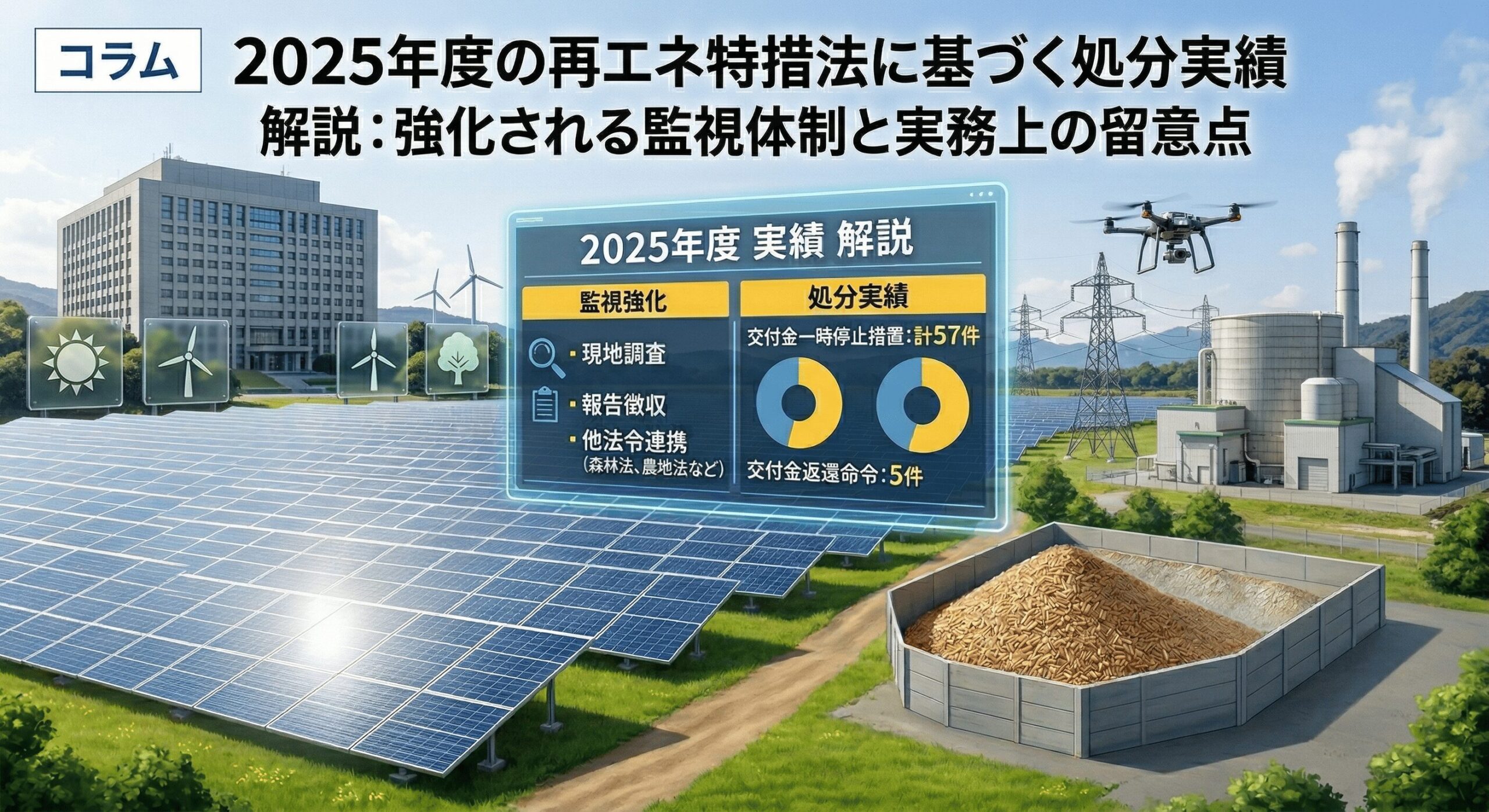
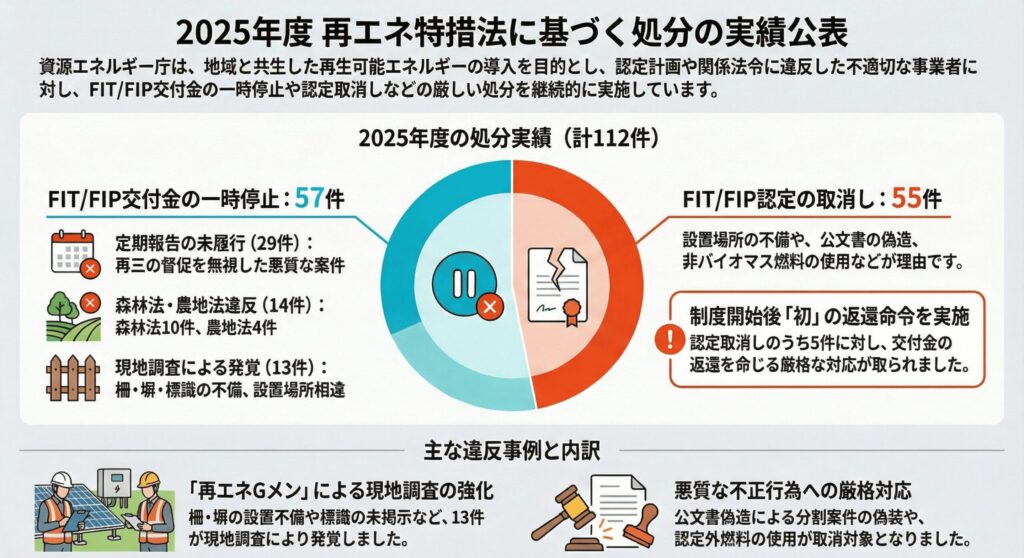
- 📢 In FY2025, enforcement actions under Japan’s Renewable Energy Act totaled 57 cases of FIT/FIP subsidy suspension and 55 cases of FIT/FIP certification revocation.
- ⚠️ Among the revocation cases, 5 resulted in repayment orders for FIT/FIP subsidies — the first such orders since the scheme’s inception — marking the application of a highly effective financial penalty.
- ⚖️ Strict enforcement was applied for violations of related laws such as the Forest Act and Agricultural Land Act, as well as for document forgery and improper use of non-biomass fuel.
✅ Audio summary of this post
Table of Contents
Introduction
This article explains the enforcement record for FY2025 under Japan’s Renewable Energy Act (Act on Special Measures Concerning Procurement of Renewable Electric Energy by Operators of Electric Utilities).
As amendments emphasizing community coexistence have come into effect, regulatory scrutiny and enforcement have become more stringent than ever before.
While international frameworks increasingly demand ESG-related regulatory compliance and transparency, Japan’s enforcement environment has similarly intensified.
To continue operating renewable energy businesses appropriately, it is essential to learn from the latest enforcement cases to understand what types of conduct become subject to penalties.
Many operators may feel that they are committed to legal compliance, yet are still uncertain whether any practical pitfalls remain.
This article analyzes the latest enforcement cases from a specialist perspective and outlines the responses operators should take.
Overview of FY2025 Enforcement Actions
According to a news release published by the Agency for Natural Resources and Energy on April 6, 2026, enforcement actions taken against improper renewable energy businesses during the period from April 2025 to March 2026 were carried out with an exceptionally firm stance.
Specifically, FIT/FIP subsidy suspensions totaled 57 cases, and FIT/FIP certification revocations totaled 55 cases.
Of particular note is the fact that 5 of the revocation cases were accompanied by repayment orders for FIT/FIP subsidies under the Renewable Energy Act — the first time such orders have been issued.
This is seen as a clear shift away from the previous approach centered on administrative guidance, toward legally effective enforcement that carries genuine financial consequences.
Breakdown and Trends in Subsidy Suspension Measures
The 57 subsidy suspension cases break down as follows.
- Cases identified through on-site inspections by the Ministry of Economy, Trade and Industry (so-called “Renewable Energy Inspectors”) where improvements were not made — including deficiencies in fencing or fence installation, failure to post required signage, and installation at locations other than those specified in the certified plan — accounted for 13 cases.
- Violations of the Forest Act: 10 cases.
- Violations of the Electricity Business Act: 1 case.
- Violations of the Agricultural Land Act: 4 cases.
- Non-fulfillment of periodic reporting obligations under the Renewable Energy Act — particularly egregious cases such as complete failure to submit periodic reports despite repeated reminders — accounted for 29 cases.
The 10 Forest Act violations include 9 solar power generation projects announced on May 19, 2025, where development was conducted without obtaining the required permit under the Forest Act or in violation of conditions attached to a forest development permit.
Notably, procedural “failure to submit periodic reports” accounted for nearly half of all cases — a point of critical practical importance.
This strongly suggests that procedural inaction, not just physical equipment deficiencies, can constitute a fatal legal risk to continued operations.
Analysis of Specific Certification Revocation Cases
Based on materials published by the Agency for Natural Resources and Energy, we analyze notable violations that resulted in certification revocation.
Use of Non-Biomass Fuel
D-POWER Co., Ltd. (D-POWER Tsu Power Plant), JPX Sogo Kenkyusho Co., Ltd. (Joso City, Ibaraki Biomass Power Plant), Osaka Seibyo Co., Ltd. (Mizunami City Suijo Biomass Power Plant), and Venart Co., Ltd. (Hyogo Green Biomass Farm) — all four companies had their certifications revoked due to the use of non-biomass fuel.
Repayment orders were issued to these operators pursuant to Article 15-11, Paragraph 1 of the Renewable Energy Act.
These repayment orders have a severe impact on project cash flows and call for a fundamental reassessment of business risk models.
Document Forgery and Concealment of Project Splitting
Kusuri no Aoki Co., Ltd. (multiple store locations) had its certification revoked for submitting forged documents.
IPR Co., Ltd. (Tajima Minami No. 1 Power Plant) received a severe penalty for forging and submitting official documents to disguise the fact that the project constituted a split case.
Irregularities in Installation Location and Transmission Lines
Blue Power Inawashiro LLC was found to have failed to construct the transmission line specified in the certified plan and was determined to have effectively circumvented relocation restrictions.
Additionally, BCS Energy Co., Ltd. (multiple projects in Akita Happou Numata) and Succeed Co., Ltd. (Tajima 811 Power Plant) had their certifications revoked for installing generation facilities at locations other than those specified in their certified plans.
These cases reaffirm that strict compliance with the content of the certified plan as approved by the national government is an absolute prerequisite for business operations.
The Importance of Compliance with Related Laws and Future Practical Responses
The amended Renewable Energy Act, which came into force in April 2024, introduced a new measure — from the perspective of community coexistence — to suspend FIT/FIP subsidies for operators who violate related laws, with the aim of encouraging early resolution of violations.
As an example, of the 9 cases where this measure was applied on April 2, 2024 for Forest Act violations, 4 cases were lifted after it was confirmed that the violations had been remedied.
However, for the remaining 5 cases where violations continued, requests for reporting under the Renewable Energy Act were implemented to monitor the status of remediation efforts.
This demonstrates that how quickly corrective measures are taken after a violation is discovered can determine whether or not a business can be maintained.
The regulatory authorities have explicitly stated their intention to continue responding strictly — in cooperation with relevant ministries and local governments — to operators found to be in violation of related laws, through measures such as FIT/FIP subsidy suspensions.
Summary
Looking back at FY2025 enforcement results, the regulatory monitoring network has become extremely dense through on-site inspections (“Renewable Energy Inspectors”) and coordination with other laws and agencies.
In particular, the fact that repayment orders — a financial sanction — have begun to be applied with genuine effect serves as a powerful deterrent against improper business operations.
My own view is that compliance with the law is a matter of course if operators are to benefit from the FIT scheme, and that revocation is unavoidable if compliance cannot be maintained.
Having been involved in many renewable energy projects in my capacity as an attorney, I am firmly convinced that strict adherence to the certified plan and thorough fulfillment of periodic reporting obligations are the greatest legal defenses available. Renewable energy operators must continue to build business operations that are transparent and accountable going forward.
- [Column] Cabinet Decision on the Bill for the Promotion of Recycling of Solar Panel Waste | Practical Considerations and the Full Scope of the Legal Framework in Preparation for the Era of Mass Disposal
- [Column] Contract Law in an Era of Geopolitical Risk | "Impossibility of Performance," "Termination," and "Renegotiation" Under Japanese Law
関連記事
-
 [Article] Investing in Japan’s Battery Storage Business: August 2026 Guide – Market Opportunities, Revenue Strategies, Regulation and Legal Practice
 -
[Column] Are Mega Solar Regulations Becoming Redundant? Reading the JFBA’s Model Ordinance on Renewable Energy Coordination from a Practical Standpoint
-
[Column] The Full Picture of the 2026 Amended Electricity Business Act and the Impact of New Decarbonization Rules on Corporate Practice
-
[Column] Issues Remaining After the Enactment of the Solar Panel Recycling Act: Cost Allocation, Delegated Legislation, Split Disposal, Reuse, and Logistics
-
[Column] The “Institutional Design” of Community-Integrated Renewable Energy – Decoding the Conditions for Successful Projects from the 20 Good Echo Cases
-
[Column] Environmental Impact Assessment Threshold for Solar PV Lowered from “40MW to 20MW” – Tightening Mega Solar Regulations and Key Practical Points for Project Developers
-
[Column Introduction] [Representative’s Blog] Three Essential Rules for Entering the Grid-Scale Battery Storage Business
-
[Column] Cabinet Decision on the Bill for the Promotion of Recycling of Solar Panel Waste | Practical Considerations and the Full Scope of the Legal Framework in Preparation for the Era of Mass Disposal