[Article] Investing in Japan’s Battery Storage Business: August 2026 Guide – Market Opportunities, Revenue Strategies, Regulation and Legal Practice
Information as of August 21, 2026
Table of Contents
About the Author
Mitsuru “Mitch” Misawa — Attorney-at-Law, Borderless Business Law Office
Mitsuru advises investors, developers and financial institutions on renewable energy, grid-scale battery storage and ESG matters.
Alongside domestic Japanese work, he handles cross-border matters across ASEAN.
Third-Party Recognition
- Recognized in The Best Lawyers in Japan™ for Energy Law in the 2026 and 2027 editions (profile). Best Lawyers recognition is based on a peer-review survey of lawyers practising in the same region and practice area.
- Borderless Business Law Office was named a finalist in two categories at the ALB Japan Law Awards 2026, presented by Asian Legal Business: Rising Law Firm of the Year and Transactional Boutique Law Firm of the Year.
About This Guide
This guide sets out the full picture of battery storage investment in Japan – grid connection, revenue markets, permits, contracting practice and FEFTA compliance – based on primary sources.
On project finance, the analysis draws on experience gained on both the fund side and the sponsor side, and addresses the issues from both lender and sponsor perspectives.
✅ In Brief
- 📈 Grid connection study applications reached a record high in FY2025. Applications across all power sources totaled 28,965, approximately double the previous year’s 14,391. Battery storage accounted for 24,862 applications, or 86% of the total (source: OCCTO, “Compilation of Information on Grid Access Operations for Power Generation Facilities, etc. (Applications Received and Responses Issued in FY2025)”).
- 💰 Revenue is generally built on three layers: the wholesale electricity market, the balancing market and the capacity market. The Long-Term Decarbonization Power Source Auction provides a framework for earning capacity revenue for, in principle, 20 years. In return, however, successful bidders must refund 95%, 90% or 85% of “other-market profit,” depending on its level.
- ⚖️ Entry discipline was clearly tightened in 2026. The cap on the number of grid connection studies per applicant, which took effect on August 1, 2026, and measures addressing grid congestion on the charging side have changed the assumptions underlying project development.
- 🌏 Foreign investors must consider the Foreign Exchange and Foreign Trade Act (FEFTA). Within the electricity business, the three categories treated as core sectors are general transmission and distribution businesses, transmission businesses, and power generation businesses owning power plants with a maximum output of at least 50 MW. An acquisition of shares or equity interests in an unlisted special purpose company (SPC) by a foreign investor may constitute an inward direct investment regardless of the percentage acquired, although the need for prior notification must be assessed separately.
- ⚠️ Success depends on coordinating grid connection and site acquisition. If the validity period of the grid connection study response and the timing for securing land rights are not aligned, the mismatch can directly result in losses.
Part I: Business Strategy and Market Analysis
Introduction – Why Japan’s Battery Storage Market, and Why Now?
This article provides a comprehensive overview of investment in Japan’s grid-scale battery storage business from both business-strategy and legal-practice perspectives.
It updates our earlier article, “Investing in Japan’s Battery Storage Business: 2025 Guide – Market Opportunities, Revenue Strategies, Regulation and Legal Practice”.
The Numbers Show a Market at a Turning Point
The trend in grid connection applications clearly shows that Japan’s battery storage market has reached a turning point.
In FY2025, 28,965 grid connection study applications were received across all power sources, approximately double the previous year’s 14,391 and the highest number on record (source: OCCTO announcement dated June 24, 2026).
Battery storage accounted for 24,862 applications, or 86% of the total.
The previous year’s figures were 9,544 applications and 66% of the total. Battery storage applications therefore increased approximately 2.6-fold, while their share rose by 20 percentage points.
In FY2023, by comparison, there were 6,725 grid connection study applications in total, of which battery storage accounted for only approximately 24%.
In just two years, grid connection applications have shifted from a market led by solar power to one led by battery storage.
Price Volatility as a Source of Revenue
One factor behind this change is the increasing volatility of electricity prices as renewable energy deployment expands.
Wholesale electricity prices tend to fall substantially during daylight hours, when solar generation is concentrated, and rise from the evening into the night as available supply tightens.
These intraday price differences are the source of battery storage arbitrage revenue.
The Japanese government has designated batteries as strategic goods in pursuit of carbon neutrality by 2050 and is supporting both the development of the industry and wider deployment.
Definition of Grid-Scale Battery Storage and Two Principal Models
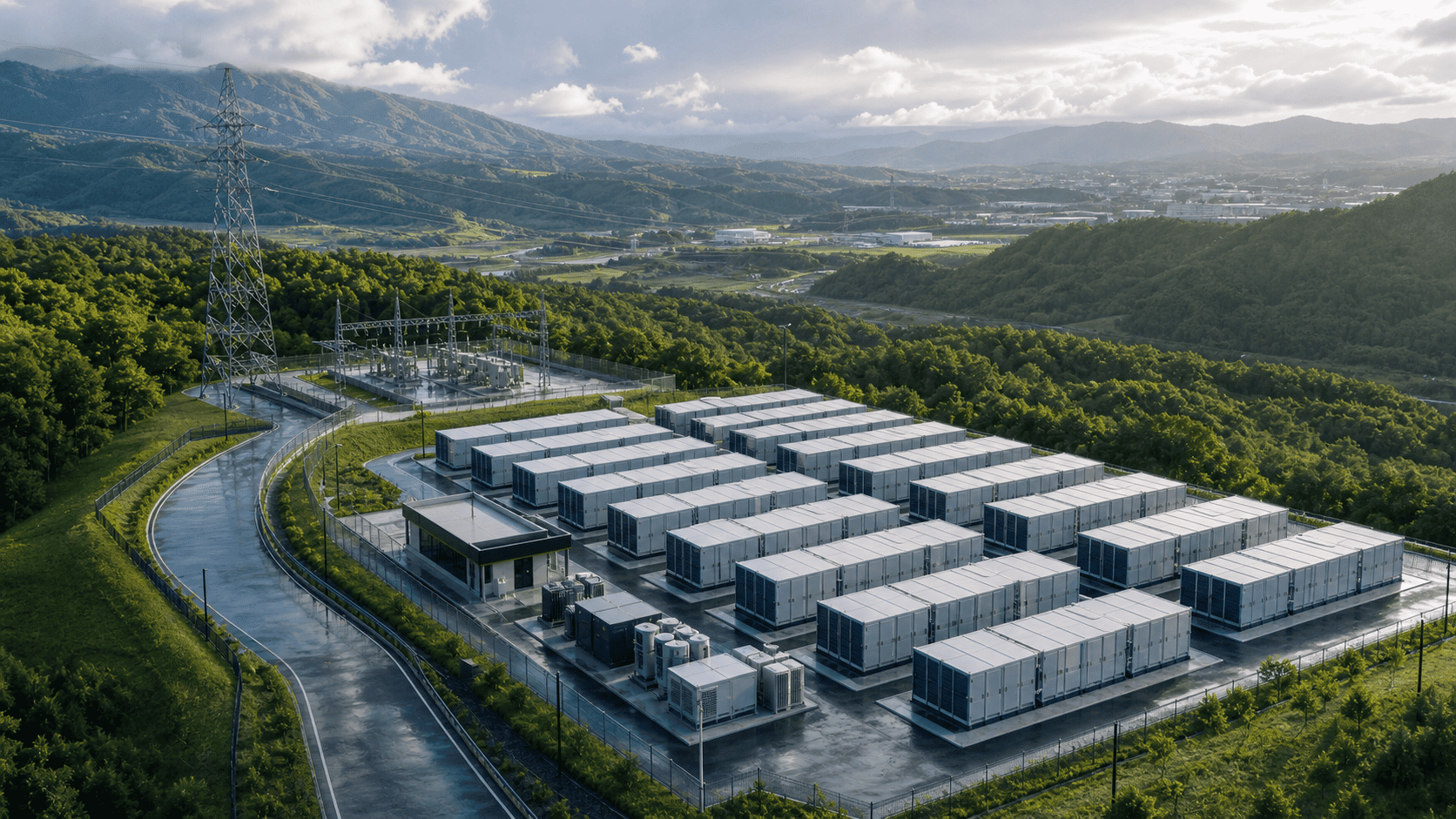
For purposes of this article, a grid-scale battery energy storage system (BESS) means a large battery storage facility connected directly to the power grid and used to support system-wide supply-demand balancing and stability.
Unlike residential batteries or electric-vehicle batteries, BESS projects can broadly be divided into two models in practice.
Front-of-meter model (direct grid connection)
The facility connects directly to the network of a general transmission and distribution utility and is principally used for wholesale electricity trading and the provision of balancing services to grid operators.
The objective is to maximize market revenue.
Behind-the-meter or co-located model (co-located with renewable generation)
The battery is installed alongside a solar or wind power facility, principally to reduce curtailment and imbalance costs.
This can help stabilize the renewable generator’s revenue.
Three Revenue Markets
A BESS business is generally structured to earn revenue from three principal markets:
- Wholesale electricity market (JEPX): arbitrage by charging when prices are low and discharging when prices are high
- Balancing market: compensation for frequency control and other grid-balancing services
- Capacity market and Long-Term Decarbonization Power Source Auction: capacity revenue for securing future supply capability
The ability to combine multiple revenue sources rather than relying on a single market is one of the attractions for international investors.
Opportunities and Challenges for International Investors
Japan may be attractive as an investment destination for the following reasons:
- Policy predictability: a mature legal framework in an advanced economy
- Technical capability: a sophisticated technology base in batteries and grid control
- Relative openness to foreign capital: comparatively limited foreign investment restrictions in the energy sector
- Developed financing market: extensive renewable-energy financing experience among major financial institutions
Investors must also address several challenges:
- Regulatory complexity: different rules and participation requirements for each of the three markets
- Language and business-practice barriers: almost all procedures are conducted in Japanese
- Complex grid connection process: a substantial period may be required between the connection study and physical interconnection
- Tighter entry discipline: caps on the number of connection studies and other controls were introduced in 2026
Appropriate local partners and specialized legal support are essential to address these issues.
The following sections examine the market environment, revenue structures, regulatory framework and practical legal issues relevant to an investment decision.
Market Environment and Business Opportunities
Rapid Growth in Connection Applications – and What Lies Behind It
As noted above, FY2025 saw a record number of grid connection study applications.
Factors cited as contributing to the increase include:
- expansion of the battery storage allocation under the Long-Term Decarbonization Power Source Auction
- expansion of subsidy programs
- greater revenue opportunities resulting from increased electricity-price volatility
- an increase in speculative applications intended to reserve connection positions for later resale
It is important not to treat the application numbers at face value as a direct measure of market growth.
A material proportion of the applications is believed to be speculative, and the percentage that ultimately reaches commercial operation will be considerably lower.
This is the context in which the following controls were introduced.
Tighter Entry Discipline – Two Changes in 2026
Cap on grid connection studies per applicant (effective August 1, 2026)
Following deliberations by the national government’s Subcommittee on Large-Scale Integration of Renewable Energy and Next-Generation Electricity Networks, a cap was imposed on the number of grid connection studies for grid-scale batteries that may be pending for a single applicant. The new rules took effect on August 1, 2026 (source: TEPCO Power Grid, “Measures to Introduce a Cap on the Number of Grid Connection Studies per Applicant for Grid-Scale Batteries (High Voltage and Extra-High Voltage),” July 24, 2026).
Within the TEPCO Power Grid service area, the cap is 11 applications.
The cap applies while an application is pending from submission of the grid connection study application until issuance of the study response. Applications accepted by July 31, 2026 continue to be processed even if the applicant exceeded the cap. For later applications, however, any application above the cap will not proceed even to document review.
Once the number of pending applications falls below the cap, the applicant may submit a new application.
In practice, developers must shift from managing the sheer number of projects in their pipelines to managing pipeline turnover.
Some market participants have discussed spreading applications among group companies. Whether this would be regarded as circumvention of the cap must be checked against the FAQs published by the relevant general transmission and distribution utility and the Agency for Natural Resources and Energy (sources: Common FAQ of the General Transmission and Distribution Utilities and Agency for Natural Resources and Energy, Grid Access FAQ).
This article does not recommend any particular means of avoiding the rules.
Other measures intended to prevent speculative reservations
Further measures are being developed, including higher deposits, earlier finalization of construction-cost contributions, and submission of project implementation plans and documents evidencing land rights.
Because the details may differ among general transmission and distribution utilities, investors should consult OCCTO’s “Grid Access Process for Power Generation Facilities, etc.” and the latest publications of the utility serving the project area before starting a project.
Grid Congestion on the Charging Side
Grid congestion on the charging side is an issue specific to battery storage.
Conventional generating facilities send electricity in one direction, from the power plant to the grid. A battery, however, draws electricity from the grid while charging, and this requires distribution lines to be managed for bidirectional power flow.
Two measures under discussion are:
- N-1 charging-stop equipment: equipment that automatically stops charging upon a grid contingency
- Application of non-firm connection to charging: allowing earlier connection on the condition that charging may be curtailed during grid congestion
The term “N-1 generation curtailment” should be distinguished from these measures.
N-1 generation curtailment is a framework under which effective utilization of existing network capacity is increased on the premise that generation will be curtailed immediately if a single grid circuit is lost.
N-1 charging-stop equipment applies the same principle to a battery’s charging load.
Investment models must account for two principal effects:
- the capital cost of installing N-1 charging-stop equipment
- the risk of lower utilization and revenue when charging is curtailed
Equipment cost and curtailment frequency vary significantly according to the project and network conditions and must be estimated based on the connection study response and project-specific discussions.
Regional Market Characteristics and Investment Opportunities
Japan’s battery storage market varies materially by region, and investment strategies must be tailored accordingly.
Kyushu – a region where daytime-evening price spreads are more likely to arise
Kyushu has a high share of solar generation, and output curtailment has become a regular occurrence.
Wholesale prices may fall during the day and rise later in the evening, creating opportunities for intraday price spreads.
Arbitrage opportunities may therefore arise, although network constraints, curtailment conditions and connection terms must be assessed for each project.
Hokkaido and Tohoku – compatibility with wind generation
These regions have abundant wind and solar resources, but transfer capacity to Honshu is constrained.
Opportunities include co-location with large wind projects and the grid value created by relieving transmission congestion.
Investors should consider the risk of substantial construction-cost contributions and measures to address reduced battery performance in cold winter conditions.
Kanto and Kansai – proximity to major load centers
These regions contain major electricity demand centers and concentrations of data centers, factories and logistics facilities.
Potential applications include off-site battery projects linked to direct power purchase agreements, peak shifting and business-continuity support.
Investors should consider high land costs and the application of the City Planning Act and Building Standards Act.
Principal Market Participants and Competitive Conditions
Participants in Japan’s BESS market include:
- General trading companies: increasingly pursuing large investment programs and integrated development and operation
- Electricity utility groups: developing large projects through subsidiaries, including projects co-located with renewable generation
- Renewable-energy developers: adding batteries to existing solar and wind projects to mitigate curtailment
- Foreign manufacturers: European, US, Chinese and Korean manufacturers increasingly participating both as equipment suppliers and project investors
- Funds and other investors: infrastructure and private-equity investment is increasing, with particular interest in long-term capacity revenue under the Long-Term Decarbonization Power Source Auction
The competitive environment is characterized by:
- delays in grid interconnection procedures, which have effectively created a first-mover advantage
- intensifying competition for suitable sites with available grid capacity
- shortages of personnel among engineering, procurement and construction (EPC) contractors and operation and maintenance (O&M) providers
The cap introduced in August 2026 directly constrains this first-come, first-served dynamic. Competition is therefore beginning to shift from application volume toward project quality.
Revenue Structures and Business Models
Understanding the revenue structure of a BESS business is one of the most important elements of an investment decision.
Revenue and Cost Overview
Revenue
| Market | Source of revenue | Timing of price determination | Volatility |
|---|---|---|---|
| Wholesale electricity market (JEPX) | Charge-discharge price spread (arbitrage) | Day ahead | High |
| Balancing market | ΔkW availability payments plus kWh payments for energy actually activated | Day ahead or weekly | Medium |
| Capacity market | Compensation for capacity (kW) available four years later | Four years in advance | Medium |
| Long-Term Decarbonization Power Source Auction | Capacity revenue for, in principle, 20 years | At auction award | Low |
Costs
- CAPEX: battery units, power conditioning system (PCS), balance of system (BOS), grid interconnection works, N-1 charging-stop equipment and site acquisition
- OPEX: O&M expenses, insurance premiums, land rent and network charges
- Electricity procurement cost: cost of electricity purchased for charging (market price × charging volume)
Three Business Models
Depending on their risk tolerance and return targets, investors will generally choose among three models.
1. Full merchant model – high risk, high return
This model seeks to maximize revenue from market-price fluctuations by trading freely across all three markets.
It offers no long-term fixed revenue, and operating strategy may be adjusted flexibly as market conditions change.
The model provides the greatest operational flexibility and may generate high returns when market prices are favorable. Conversely, revenue may fall materially when prices decline, and lenders may impose more stringent financing terms, including higher debt service coverage ratio requirements.
It is most suited to funds with a higher risk tolerance and to trading companies or utilities with market-operation expertise.
2. Long-Term Decarbonization Power Source Auction model – long-term capacity revenue
Under this model, the project succeeds in the auction and secures capacity revenue for, in principle, 20 years.
Successful projects are, however, subject to a mechanism requiring a portion of “other-market profit” from the wholesale electricity market, balancing market and other sources to be refunded after the fact.
The refund rate is 85%, 90% or 95%, depending on the level of other-market profit. It is therefore not always a uniform 90%.
The greater predictability of revenue may facilitate project finance, but the project cannot retain the full upside when prices rise and must assume a long-term commitment.
Capacity revenue is not unconditional. Assessment penalties apply for failure to satisfy performance requirements, and economic penalties may apply on termination (source: OCCTO, “Long-Term Decarbonization Power Source Auction – Capacity Agreement Terms”).
The model is suited to infrastructure funds, pension funds and other investors seeking stable long-term revenue.
3. Tolling model – greater visibility through fixed fees
Under a long-term tolling agreement with an electricity retailer or other counterparty, the operator grants the counterparty operating rights over the battery in return for a fixed tolling fee.
The counterparty assumes market risk, producing highly predictable project revenue. Profitability may nevertheless be lower depending on the fee level, and the project assumes the counterparty’s credit risk.
This model is suited to investors without market-operation expertise or those that place the highest priority on revenue stability.
Hybrid Models as a Practical Solution
Projects increasingly combine elements of the three models:
- Long-term auction plus full merchant: allocate part of the capacity to the long-term auction and operate the remainder on a merchant basis
- Tolling plus long-term auction: after a successful auction bid, delegate operating rights under a tolling arrangement
The optimal combination will depend on the investor’s risk tolerance, operating capability and financing policy.
Grid Interconnection – the Gateway to the Project
Grid Access Process
To connect a generating facility or battery to the grid, the project must enter into a connection agreement with one of Japan’s ten general transmission and distribution utilities, such as TEPCO Power Grid or Kansai Transmission and Distribution.
The process is generally as follows.
1. Grid connection study application
The utility assesses technical feasibility and provides an estimate of connection works costs.
As a general rule, a response is issued within three months after the application is accepted, although the period may be extended depending on the project and the volume of applications.
The response addresses whether connection is feasible, estimated works costs and required technical specifications.
For applications submitted on or after August 1, 2026, the per-applicant cap described above applies from this stage.
2. Connection agreement application
This stage begins the process toward a binding connection agreement.
Required documents, deposits and other conditions must be confirmed for the specific project and the applicable utility. The period required varies by project.
3. Finalization of the construction-cost contribution
The amount is finalized after detailed engineering.
Because the final amount may differ from the preliminary estimate, project feasibility analysis should allow for a reasonable range of variation.
If reinforcement works are required, cost-allocation rules involving other connection projects may apply.
4. Execution of the connection agreement and commencement of works
The period to completion varies significantly according to whether network reinforcement is required, the scale of the works and other connection conditions.
International investors should note that:
- all procedures are conducted in Japanese
- the grid connection study response is not legally binding and is only a study result
- Japanese technical standards may differ from overseas standards
Available Capacity and the First-Come, First-Served Rule
Japan’s grid connection process follows a first-come, first-served rule, and connection priority is allocated according to the order in which grid connection study applications are accepted.
The acceptance time is recorded strictly. If multiple applications concern the same connection point, the earlier applicant receives priority.
If a project ahead in the queue withdraws, priority passes to the next applicant.
The practical limitation of publicly available grid-capacity maps is therefore critical.
Capacity information published on utility websites is indicative only. Actual connection feasibility is determined only through a project-specific connection study.
Even if a distribution line appears to have capacity, constraints may exist higher in the network at a substation or on a backbone transmission line.
Available capacity is also continuously being taken up by other applicants.
For international investors, the fact that much of this information is available only in Japanese creates an additional barrier.
English-language information is limited, making information gathering through local partners and legal counsel essential.
Part II, Hypothetical Case Study 1, examines the risks of acquiring a site in reliance on an available-capacity map.
Wholesale Electricity Market and Arbitrage Strategy
How the JEPX Spot Market Works
The spot market operated by the Japan Electric Power Exchange (JEPX) trades electricity for the following day in 30-minute intervals, or 48 settlement periods per day.
It uses a blind, single-price auction. Buyers and sellers submit prices, and transactions clear at the price at which supply and demand intersect.
Bids are submitted in increments of JPY 0.01 per kWh, and the market has a floor price of JPY 0.01 per kWh.
Negative prices are not permitted under the current rules (source: JEPX, “Electricity Trading Overview”).
Because the price cap and other permissible-price rules may change, actual bidding strategies should be based on the latest JEPX Trading Guide.
Calculating Arbitrage Revenue – Applying Efficiency Correctly
One of the principal sources of battery revenue is intraday arbitrage.
Round-trip efficiency is frequently mishandled in financial models.
For this example, an 85% round-trip efficiency means that charging 10,000 kWh from the grid produces 8,500 kWh available for discharge.
The cost of electricity purchased for charging applies to the full charging volume. Applying efficiency to the entire price spread therefore overstates revenue.
On these assumptions, the formula is:
Daily revenue = discharge price × (charging volume × round-trip efficiency) – charging price × charging volume – transaction costs
For example:
- charging price at noon: JPY 2/kWh
- discharging price at 7:00 p.m.: JPY 25/kWh
- charging volume: 10,000 kWh
- round-trip efficiency: 85% (8,500 kWh available for discharge)
Discharge revenue is 8,500 kWh × JPY 25 = JPY 212,500.
Charging cost is 10,000 kWh × JPY 2 = JPY 20,000.
Daily revenue is therefore JPY 212,500 – JPY 20,000 = JPY 192,500.
Using the formula “(25 – 2) × 10,000 × 0.85 = JPY 195,500” would incorrectly apply efficiency to charging cost and overstate revenue by JPY 3,000.
The daily difference may appear small, but depending on the assumed number of operating days, it may result in a material discrepancy over the life of the project.
This simplified example isolates the market-price spread. It does not include wheeling charges, including generation-side network charges, opportunity costs arising from combined participation in the balancing market, or auxiliary power consumption.
Annual projections must also account for seasonal variation—price spreads tend to be greater in summer and winter and narrower in spring and autumn—and the charging curtailment described below.
Market-Price Forecasting Risk
Because arbitrage revenue depends entirely on market prices, long-term price forecasting is central to an investment decision.
Principal drivers include:
- Renewable deployment: greater solar and wind penetration tends to lower daytime prices
- Thermal-generation availability: retirements and mothballing may put upward pressure on nighttime prices
- Nuclear restarts: additional baseload generation may reduce price volatility
- Changes in electricity demand: growth in data centers and other loads may increase prices
- Weather: extreme heat and cold may cause price spikes
Three risks require particular attention:
- further nuclear restarts may reduce price volatility
- large-scale deployment of batteries may itself compress price spreads as the market matures
- market-design reforms may alter the price-formation mechanism
The third risk is particularly important.
As discussed below, balancing-market price caps are being reduced in stages, and regulatory changes now have a direct impact on revenue.
Investors should conduct price forecasts and stress tests under multiple scenarios.
Capacity Market and Long-Term Decarbonization Power Source Auction
Capacity Market Framework and the Role of Battery Storage
The capacity market secures electricity supply capability, measured in kW, four years in advance. The first main auction was conducted in FY2020.
The market is intended both to mitigate the risk of future supply shortages and to provide generators with greater visibility over investment recovery.
The method for calculating the capacity accredited to a battery as supply capability, and the coefficients used in that calculation, are specified in the auction rules and related documents for each auction.
Before bidding, investors should check the latest OCCTO auction rules, including the applicable continuous-discharge-duration requirements.
Clearing prices can fluctuate substantially
Capacity-market clearing prices have varied widely with supply and demand.
The first auction, conducted in FY2020 for delivery in FY2024, cleared at JPY 14,137/kW. In the second auction, conducted in FY2021 for delivery in FY2025, prices fell substantially: JPY 3,495/kW in Tohoku, Tokyo, Chubu, Hokuriku, Kansai, Chugoku and Shikoku, and JPY 5,242/kW in Hokkaido and Kyushu.
In the most recent sixth auction, conducted in FY2025 for delivery in FY2029, the area prices were as follows. The results were published on January 20, 2026 and corrected on January 23 (source: Agency for Natural Resources and Energy, 110th Meeting of the System Review Working Group, Material 3-1, “Capacity Market Main Auction Results (Delivery Year: FY2029)”).
| Area | Area price |
|---|---|
| Hokkaido | JPY 14,972/kW |
| Tohoku and Tokyo | JPY 15,111/kW |
| Chubu, Hokuriku, Kansai, Chugoku and Shikoku | JPY 12,388/kW |
| Kyushu | JPY 15,112/kW |
After taking transitional measures into account, the total clearing value was approximately JPY 2.2094 trillion, a record high and approximately 19% above the fifth auction’s JPY 1.8506 trillion.
The overall average unit price after transitional measures was also a record high, at approximately JPY 13,303/kW.
For the first time other than in the inaugural auction, prices exceeded the reference price in every area.
Toward the seventh auction (delivery year FY2030)
The target procurement volume and the approach to price caps and floors for the seventh main auction are under discussion.
These are proposals under consideration and not final figures.
When developing a bidding strategy, investors should confirm the final parameters in the latest publications of the Agency for Natural Resources and Energy’s System Review Working Group and the OCCTO capacity market website.
The scale of this price volatility is a key risk for any business model that relies exclusively on the capacity market.
Long-Term Decarbonization Power Source Auction
The Long-Term Decarbonization Power Source Auction is a framework under which new investment in decarbonized power sources, including batteries, may secure capacity revenue for, in principle, 20 years.
Eligible investments include new battery storage, renewable-energy and nuclear projects. The support period is generally 20 years, and the contract price is determined through bidding.
Refund of other-market profit
A successful battery project is subject to an ex-post mechanism requiring a portion of “other-market profit” arising from the wholesale electricity market, balancing market and other sources to be refunded.
The refund is calculated in three bands. Other-market profit up to the capital cost included in the bid price is refunded at 95%; the portion above the difference between the contract price and the main-auction price is refunded at 85%; and the intermediate band is refunded at 90% (source: Article 28 of OCCTO, “Long-Term Decarbonization Power Source Auction – Capacity Agreement Terms”).
The arrangement therefore cannot be reduced to a simple rule that 90% of market revenue is always refunded and 10% retained.
Award results and the fourth auction
In the second auction, conducted in FY2024, battery storage awards totaled 1.37 GW across 27 projects.
Of this amount, 961 MW had a continuous operating duration of at least three but less than six hours, and 409 MW had a duration of at least six hours.
Bids totaled approximately 6.956 GW, so only about 20% of the capacity bid was awarded, demonstrating intense competition.
For the fourth auction, to be conducted in FY2026, a procurement volume of 6 GW has been indicated (source: Agency for Natural Resources and Energy, “Long-Term Decarbonization Power Source Auction,” Material 7-3, May 13, 2026).
The stated policy is to secure a total of 39–55 GW over the seven years beginning with the fourth auction, with annual procurement volumes of approximately 5.5–8 GW.
Discussions continue on stricter evaluation of decarbonization, including lifecycle CO2 emissions, and on the scope of eligible power sources.
Capacity Market or Long-Term Auction?
| Item | Capacity market | Long-Term Decarbonization Power Source Auction |
|---|---|---|
| Contract period | One year | In principle, 20 years |
| Revenue stability | Low; price varies each year | High; capacity revenue for, in principle, 20 years |
| Retention of market revenue | 100% | A portion of other-market profit; refund rates of 85%, 90% and 95% apply |
| Upside | High when prices rise | Limited by the refund obligation |
| Downside | High when prices fall | Relatively limited due to long-term capacity revenue |
| Financing | Relatively difficult | Relatively easier |
The long-term auction may suit conservative investors such as infrastructure funds, while the capacity market or a full merchant model may suit trading companies, utilities and investors with greater risk tolerance.
A hybrid structure in which part of the capacity enters the long-term auction and the remainder operates on a merchant basis may also be attractive in practice.
Balancing Market – the Most Rapidly Changing Regulatory Area
Balancing Market Fundamentals
In the balancing market, general transmission and distribution utilities procure balancing capacity to maintain grid frequency and balance electricity supply and demand.
Balancing services have two components of value:
- ΔkW: compensation for making adjustable capacity available
- kWh: compensation for the energy actually delivered in response to dispatch instructions
ΔkW refers to securing in advance, for each settlement period, a resource with the required capability in a state in which its output can be adjusted at the time of actual supply and demand (source: EPRX, “Guide to the Balancing Market,” 2nd ed., March 13, 2026).
Batteries are well suited to this market because they can provide both downward adjustment through charging and upward adjustment through discharging, and they respond rapidly.
Five Product Categories and Their Requirements
The balancing market has five product categories:
| Product | Dispatch interval | Response time | Duration | Function |
|---|---|---|---|---|
| Primary reserve | Local autonomous control | Within 10 seconds* | At least five minutes* | Governor-free (GF) |
| Secondary reserve 1 | 0.5 seconds to several tens of seconds | Within five minutes | 30 minutes | Load-frequency control (LFC) |
| Secondary reserve 2 | Several seconds to several minutes / five minutes | Within five minutes | 30 minutes | Economic load dispatch control (EDC) |
| Tertiary reserve 1 | Several seconds to several minutes / five minutes | Within 15 minutes | 30 minutes | EDC |
| Tertiary reserve 2 | 30 minutes | Within 60 minutes | 30 minutes | Renewable forecasting error |
*For offline monitoring, the response time is within 30 seconds and no duration is specified.
(Source: EPRX, “Guide to the Balancing Market,” 2nd ed., March 13, 2026, p. 11.)
Primary reserve corresponds to the GF function, and Secondary Reserve 1 corresponds to LFC.
Secondary Reserve 2 and Tertiary Reserve 1 both correspond to EDC, although Secondary Reserve 2 is designed to respond more quickly and Tertiary Reserve 1 more slowly.
Tertiary Reserve 2 addresses renewable-generation forecast error up to gate closure and therefore has longer dispatch and response intervals than the other products.
Primary Reserve through Tertiary Reserve 1 are traded in the “combined market,” while Tertiary Reserve 2 is traded separately.
Combined products moved to day-ahead trading in FY2026.
Staged Reduction of Price Caps – a Direct Effect on Revenue Forecasts
The reduction of ΔkW price caps has been the most significant balancing-market issue since 2025.
Previous levels
The caps were JPY 7.21/ΔkW per 30 minutes for standalone Secondary Reserve 2 and Tertiary Reserve 1, and JPY 19.51/ΔkW per 30 minutes for standalone Primary Reserve and Secondary Reserve 1 and all combined products (source: Agency for Natural Resources and Energy, 108th Meeting of the System Review Working Group, Material 4, “Balancing Market,” October 29, 2025).
The higher caps for Primary Reserve, Secondary Reserve 1 and combined products reflected the uncertainty involved in weekly procurement and the importance placed on securing the required volume even at somewhat higher procurement cost.
Direction of reduction
At the 108th meeting on October 29, 2025, the secretariat proposed a cap of JPY 7.21/ΔkW per 30 minutes, equivalent to JPY 14.42/ΔkW-hour, for all products from Primary Reserve through Tertiary Reserve 1, whether standalone or combined. The proposal reflected concern that reducing procurement volumes had not produced sufficient competition and that many awards remained at the cap.
Following further deliberation, the caps have instead been reduced in stages.
For combined products, Primary Reserve and Secondary Reserve 1, the cap fell from JPY 19.51 to JPY 15.00/ΔkW per 30 minutes for delivery from March 14, 2026. JPY 10.00/ΔkW per 30 minutes will apply “for the time being” for delivery from September 1, 2026.
The cap for Secondary Reserve 2 and Tertiary Reserve 1 remains JPY 7.21/ΔkW per 30 minutes, while Tertiary Reserve 2 remains uncapped (source: EPRX, “ΔkW Price Caps in the Balancing Market,” July 30, 2026).
The JPY 10.00 cap was adopted following deliberation by the fourth Electricity Stability Working Group. The JPY 7.21 level discussed at the 108th System Review Working Group meeting is not, as of the date of this article, a finalized future price. Because EPRX changes the URL of its cap table whenever it is revised, practitioners should check the latest version on the EPRX website.
Tertiary Reserve 2 has no price cap
This point is frequently misunderstood.
Under the procurement-volume reduction-coefficient mechanism for Tertiary Reserve 2, if bids fall short, the market size contracts at the next update. The risk of unnecessary cost increases is therefore considered limited, and the policy remains not to impose a cap.
Procurement volumes
For the combined market, procurement through the market and negotiated contracts is capped at an amount equivalent to one standard deviation. The difference from the required three-standard-deviation volume is to be procured through use of available capacity and other resources.
Investment implications
A lower cap directly reduces the maximum balancing-market revenue available to a battery.
Batteries have a high proportion of fixed costs. A shorter depreciation period increases current-year depreciation expense, which in turn increases the fixed-cost recovery amount under the balancing-market guidelines and tends to raise bid prices.
The lower cap may therefore affect batteries more heavily than thermal or pumped-storage generation.
Balancing-market revenue should be forecast conservatively.
Always confirm the latest caps in publications from EPRX and the Agency for Natural Resources and Energy’s System Review Working Group and Electricity Stability Working Group.
Working with an Aggregator
A battery may participate directly in the balancing market, but participation through an aggregator is common in practice.
A generation resource with contracted receiving capacity of at least 1,000 kW bids individually; a resource below 1,000 kW is aggregated for bidding.
An aggregator can execute market transactions, combine multiple resources and assist with technical compliance.
The three principal contractual issues are the revenue-sharing ratio, the scope of operating-instruction rights and allocation of penalties. Part II addresses these issues in more detail.
FIT and FIP Programs for Co-Located Renewable Projects
Standalone Batteries Are Not Eligible for FIT or FIP
When a battery is installed alongside a renewable generating facility, the relationship with Japan’s feed-in tariff (FIT) and feed-in premium (FIP) programs must be assessed.
FIT guarantees purchase at a fixed price. FIP adds a premium to the market price.
A standalone battery is not eligible under either program.
FIT and FIP Must Be Considered Separately
The treatment of a co-located battery is not the same under FIT and FIP.
A battery co-located with an FIP-certified generating facility may charge both from the generating facility and from the grid.
The measure initially applied to FIP facilities newly certified from FY2024. From April 2025, grid charging was also permitted for FIP facilities newly certified in FY2023 or earlier, including facilities converted from FIT to FIP. Electricity discharged from the battery remains eligible for the FIP premium to the extent attributable to the certified generating facility (source: Agency for Natural Resources and Energy, “Promoting Use of the FIP Program and Co-Located Batteries to Make Renewables a Main Power Source,” November 6, 2025, p. 9).
For purposes of calculating the FIP premium, a mechanism distinguishes electricity originating from the certified generating facility from electricity originating from the grid.
The prescribed formula allocates discharged electricity in proportion to the share of charging energy supplied by the certified generating facility and the grid.
Metering, equipment configuration and operating design must therefore be confirmed in advance.
Investors should also note that generation-side network charges are treated separately for existing FIP co-located batteries certified in FY2023 or earlier.
For batteries co-located with FIT-certified facilities, treatment may vary depending on the certification date, equipment configuration and nature of the change. This article does not make a blanket statement as to whether grid charging or market trading is permitted. The current certification rules and publications of the competent authority should be reviewed for each project.
Investment Decision
The principal choice is between:
- a renewable co-location model, taking account of the applicable FIT or FIP framework and the resulting metering and operational constraints
- a directly grid-connected full merchant model that prioritizes operational flexibility
The decision requires an integrated assessment of curtailment frequency in the relevant region, the FIT or FIP price and projected market prices.
In FIT and FIP projects, practical issues may arise concerning consistency between the name of the certified operator and the name used in notifications and other filings under the Electricity Business Act.
Where an SPC is used, the naming and ownership structure should be settled at an early stage.
Using Subsidy Programs
Overview
Both the national government and local governments offer subsidies for battery deployment.
National programs are principally administered by the Sustainable Open Innovation Initiative (SII). Several programs funded by the FY2025 supplementary budget are open in parallel.
Programs relevant to grid-scale batteries include:
- FY2025 Supplementary Budget Program Supporting the Deployment of Grid-Scale Battery Storage Systems, etc. (SII)
- FY2025 Supplementary Budget Program Supporting the Deployment of Battery Storage Systems Co-Located with Renewable Generation, etc. (SII)
- FY2025 Supplementary Budget Program Supporting the Deployment of Large-Scale Commercial and Industrial Battery Storage Systems, etc. (SII)
Because the program names are similar, applicants should first determine which program applies to their project.
Separate programs are also offered by the Tokyo Metropolitan Government and other local governments, as well as under Ministry of the Environment decarbonization initiatives.
Subsidy Rates, Caps and Eligibility Requirements
Subsidy rates, maximum amounts, application categories and mandatory conditions are specified in the guidelines for each call and may be revised.
This article does not state particular figures. Any investment analysis should identify the applicable version and page of the official application guidelines and verify the original text.
Subsidy rates directly affect project feasibility and should not be based on hearsay or secondary sources.
Practical Points for Applications
- Cash flow: even after selection, time may pass before the formal grant decision, and the funding plan must allow for this delay
- Repayment: disposal of subsidized property within a prescribed period or discontinuation of the project may trigger repayment
- Tax treatment: qualifying equipment acquired with a subsidy may be eligible for reduction entry accounting
- Overlap with other programs: combining support with prior supplementary-budget programs may be restricted
- Project-entity requirements: registration or notification as a specified electricity supplier or power generation business may be required
Applicants are becoming more diverse. Projects are no longer dominated by solar generators and now include electricity retailers, large consumers such as factories and data centers, and renewable-energy developers.
Their objectives differ: retailers seek balancing capacity and business-continuity support; consumers seek lower electricity costs and decarbonization; and renewable developers seek to reduce curtailment and respond to the FIP framework.
Part II: Project Development and Legal Strategy
Practical Steps in Project Development
The success of a battery storage project depends heavily on how grid connection and site acquisition are coordinated at an early stage.
This section describes a practical development process and lessons drawn from simplified hypothetical cases illustrating risks that may arise in practice.
Why Coordination Between Grid and Site Is Critical
One of the greatest challenges for investors is coordinating the timing of grid connection and site acquisition.
The typical dilemma is as follows:
| Approach | Resulting risk |
|---|---|
| Secure the site first | The grid has no available capacity, connection proves impossible and the acquisition cost is wasted |
| Secure the grid position first | The investor cannot secure the site before the connection study response expires, and the connection position is lost |
Managing the two workstreams in parallel is essential.
As explained in Part I, published available-capacity maps provide only indicative distribution-level information and do not reflect constraints higher in the network.
Buying land merely because a map appears favorable is itself a material risk.
Recommended Development Process
Phase 1: Preliminary investigation
- identify three to five candidate sites
- make an informal inquiry to the applicable general transmission and distribution utility concerning available grid capacity
- approach landowners and enter into confidentiality arrangements where appropriate
Phase 2: Grid connection study application, in parallel with Phase 1
- apply for a connection study for the leading site
- enter into a conditional land-sale reservation agreement or option agreement with the landowner, with the definitive acquisition conditional on a satisfactory connection outcome
Since August 2026, the cap on pending connection studies per applicant has made the former practice of applying simultaneously for every candidate site impracticable.
Prioritizing the sites on which to use the limited application slots has therefore become part of the development strategy itself.
Phase 3: Connection study period
- the general transmission and distribution utility conducts its technical assessment
- the investor simultaneously conducts site due diligence, including title and permitting risk
- the utility issues its connection study response
Phase 4: Full development or withdrawal decision
- if connection is feasible, execute the definitive land sale agreement and apply for a connection agreement
- if connection is not feasible, terminate the reservation arrangement, with landowner compensation structured to minimize loss
Using an Option Agreement
Subject, of course, to the landowner’s agreement, an acquisition option may limit the investor’s risk.
The investor pays an option fee in return for the right to purchase the land within a specified period.
If grid connection proves infeasible, the investor can avoid proceeding to the definitive acquisition and limit its loss.
The landowner benefits by receiving the option fee and gaining a degree of visibility over a possible sale during the option period.
International investors should note that:
- Japanese civil law does not prescribe a single statutory form for this type of option, so the agreement must define the rights in detail
- even where the investor requests an English-language agreement, the agreement is often governed by Japanese law and designates the Japanese version as controlling
- for agricultural land, permission under the Agricultural Land Act is generally obtained at the definitive-contract stage rather than when the option is granted
Demonstrating Genuine Intent to Develop
A material proportion of the surge in connection study applications consists of speculative projects, and the regulatory direction is toward filtering them out.
For an investor genuinely pursuing development, the following measures may be useful:
- Early submission of a project implementation plan: voluntarily submit a detailed plan with the connection study application
- Evidence of land rights: attach a land-sale reservation agreement or landowner consent
- Clear funding plan: provide sponsor financial statements or a financing commitment letter
- Community engagement: retain records of advance explanations to the municipality and local residents
This article uses “project implementation plan” consistently as the name of the relevant document.
Site Acquisition in Practice
Site Requirements
Essential conditions
- Proximity to the grid: close to a substation or distribution line to limit interconnection costs
- Sufficient area: calculated according to the selected equipment specification, including battery units, PCS, transformation equipment, maintenance access and required separation distances
- Level terrain: reduces site-development costs
- Access roads: sufficient width and load-bearing capacity for delivery of large containers
Preferred conditions
- Zoning: industrial or quasi-industrial zoning; residential proximity increases community-opposition risk
- Low disaster risk: outside projected flood-inundation and landslide hazard areas
- Existing infrastructure: water, sewerage and communications
Five Methods of Finding Sites
1. Real-estate broker networks
Provide local brokers with the site criteria and collect property information.
Brokerage fees are subject to the caps under the Real Estate Brokerage Act.
2. Publicly owned land
Acquire under a public offering or tender, or lease on a long-term basis, idle municipal land such as former school sites or unsold industrial-park lots.
3. Conversion of agricultural land
Category 2 or Category 3 agricultural land that is not prime agricultural land may potentially be converted with permission.
Advance consultation with the local agricultural committee is essential.
4. Former solar project sites
An existing solar site may be repurposed for battery storage after the FIT period ends.
Because the site is already interconnected, it may be possible in some cases to carry forward elements of its connection arrangement.
5. Direct approach to landowners
Identify landowners through the real estate registry and negotiate directly.
Negotiations become more complex where land is co-owned or inheritance registration remains incomplete.
Land Acquisition by Foreign Investors
As a general rule, Japan does not restrict land transactions solely because the purchaser is foreign.
Notification or other requirements may nevertheless apply to acquisition or use of land near important facilities, on remote border islands or in other designated areas.
Because direct acquisition by a foreign corporation may lengthen the registration process, foreign investors commonly establish a Japanese subsidiary or SPC to acquire the site.
FEFTA considerations are discussed below under “Legal Regulations for International Investors.”
Legal Due-Diligence Checklist
Real estate registry review
- Ownership: confirm that the registered owner is the seller
- Co-ownership: obtain the consent of every co-owner
- Mortgages and revolving mortgages: confirm that they can be released at closing, including the seller’s ability to repay the secured debt
- Superficies and leases: identify any third-party right to use the property
- Easements: identify access and other rights benefiting neighboring land
- Attachments and provisional attachments: identify enforcement arising from tax arrears or other liabilities
Problems that cannot be identified from the registry alone include land for which inheritance registration remains incomplete because the registered owner has died, and cases in which a co-owner lives overseas and cannot be contacted.
Physical site inspection
- Boundaries: confirm boundary markers; obtain a survey and boundary confirmation if necessary
- Current use: compare the registered land category with actual use
- Encroachments: identify buildings, trees or other items crossing the boundary
- Subsurface materials: investigate industrial waste, former foundations and other buried materials
- Access road: confirm whether the frontage road is public or private and whether it is sufficiently wide
Municipal investigation
Confirm the following with the municipal planning division, agricultural committee, building-control division and other relevant offices:
- Zoning: whether battery storage is permitted
- Building coverage and floor-area ratios: restrictions if battery containers are treated as buildings
- Agricultural-land classification: whether conversion permission may be obtained
- Development permission: whether the scale and nature of development require permission
- Disaster risk: flood-inundation and landslide hazard designations
- Cultural property: whether an archaeological survey is required
Municipal investigations and counter services are conducted in Japanese.
Because local practice varies significantly, engaging a Japanese administrative scrivener or law firm is often practical.
Agricultural Land Conversion, the Forest Act, the City Planning Act and the Building Standards Act
Agricultural Land Conversion Risk
Many potential renewable-energy and battery sites in Japan are agricultural land, and obtaining conversion permission is often one of the largest obstacles to development.
Agricultural land categories and conversion difficulty
Agricultural land is divided into five categories under the location criteria, with different levels of difficulty for conversion.
| Category | Overview | Conversion permission |
|---|---|---|
| Land within an agricultural-use district | Agricultural land in an area designated for agricultural use under an agricultural-promotion plan | Generally prohibited; prior removal from the agricultural-use district is required |
| Class A agricultural land | Land with particularly favorable farming conditions in an urbanization-control area | Generally prohibited |
| Category 1 agricultural land | Land with favorable farming conditions | Generally prohibited |
| Category 2 agricultural land | Land in an area expected to urbanize, among other classifications | Permitted only if no alternative site is available or another exception applies |
| Category 3 agricultural land | Land located within an urbanized area, among other classifications | Generally permitted |
Whether a candidate site lies within an agricultural-use district should be checked at the outset.
Conversion of land within such a district requires a procedure to remove the land from the district before an agricultural conversion application can be made, potentially having a substantial effect on the project schedule.
Practical conversion process
- Step 1: advance consultation with the agricultural committee – confirm classification, explain the proposed conversion and identify required documents
- Step 2: prepare the application – including the project implementation plan, financing plan, land-use plan and required consents
- Step 3: review by the agricultural committee and other authorities – review of the land classification, location criteria and general criteria
- Step 4: post-permission procedures – implement the conversion in accordance with the conditions and complete required notifications and registration
The time required depends on the land classification, application and local practice and should be confirmed during advance consultation.
Typical grounds for refusal
- the site is Category 1 agricultural land forming part of a coherent area of agricultural use
- a suitable alternative site is considered available
- the financing or business plan is inadequate and the project is not considered feasible
- neighboring farmers or the local community strongly oppose the project
Practical advice for international investors
The Agricultural Land Act does not expressly prohibit direct acquisition of agricultural land by a foreign corporation.
A foreign corporate applicant should nevertheless allow for additional administrative work, including:
- Japanese translations and other supporting materials for its constitutional documents, certificate of status, financial statements and similar records
- potentially burdensome post-permission reporting, including construction-progress and completion reports
Forest Act
Development exceeding the applicable threshold in privately owned forest covered by a regional forest plan requires prefectural permission under the Forest Act.
The threshold generally exceeds one hectare, but since April 1, 2023, development exceeding 0.5 hectare for the installation of solar generation equipment has required permission (source: Forestry Agency, “Forest Land Development Permission System”).
Whether a standalone battery project is treated as installation of solar generation equipment or as another activity subject to the one-hectare threshold may depend on the project configuration. The developer should consult the relevant municipality or prefecture in advance.
The review period also varies by project and local practice.
An environmental impact assessment may be required where the development exceeds the relevant scale.
The budget should also allow for coordination with the forestry cooperative and disposal of felled timber.
City Planning Act
Development permission is required for certain development activities within a city planning area.
Even in an urbanization-promotion area, development above the applicable threshold requires permission. The threshold may differ under local ordinances and must be checked for each candidate site. In an urbanization-control area, development is generally restricted, and the developer must confirm whether the project falls within a permitted category.
The review will address plans for roads, drainage and other public facilities, disaster-prevention measures and consents from interested rights holders.
The required period varies with project scale, consultation items and local practice.
Building Standards Act
Whether a building confirmation is required depends on whether the battery container constitutes a “building.”
A container fixed to a concrete foundation is more likely to be treated as a building, although local authorities may take different views.
If it is a building, a confirmation application is required, together with structural calculations and documentation of compliance with fire-safety requirements.
The review period varies depending on the building classification, scope of review and practice of the relevant confirmation and inspection body.
Many developers adopt designs intended not to constitute a building. Because some authorities apply a strict approach, early confirmation is essential.
Practical Lessons from Hypothetical Cases
The following simplified cases illustrate risks that may arise in practice. They do not describe any particular actual project.
Hypothetical Case 1: Misjudging Grid Connection
Scenario
An investor reviewed an available-capacity map, concluded that sufficient capacity existed and acquired the site before applying for a grid connection study.
The study later revealed insufficient capacity higher in the network at the substation level. The utility estimated substantial reinforcement costs, destroying the project’s economics.
The acquired land became a stranded asset.
Lesson
Published capacity maps show distribution-level information and do not reflect all constraints at substations and higher levels of the network.
The investor should complete a connection study and understand estimated construction costs before acquiring the land.
Possible mitigation
The investor may apply for the connection study first, reserve the site through an option agreement and proceed to the definitive acquisition only after reviewing the response.
Hypothetical Case 2: Failure to Obtain Agricultural Conversion Permission
Scenario
An investor acquired land believing it to be Category 2 agricultural land. The agricultural committee later classified it as Category 1 and refused conversion permission.
The investor was forced to resell the property as agricultural land at a substantial loss.
Lesson
Agricultural-land classification is not determined by the description in the real estate registry. It is determined by the agricultural committee.
Advance consultation should take place before the land is acquired.
Possible mitigation
The sale agreement may include a condition precedent that the sale takes effect only if conversion permission is obtained, with any deposit before permission kept to a minimum.
Hypothetical Case 3: Construction Delay Caused by a Boundary Dispute
Scenario
After the site was acquired and construction preparations began, an adjoining owner disputed the boundary.
Surveying and boundary confirmation took a substantial period, delaying construction. The project missed its required commercial-operation deadline under the Long-Term Decarbonization Power Source Auction and incurred a penalty.
Lesson
Before acquisition, confirm that the boundary has been settled through a confirmed survey plan and acknowledgments from adjoining owners.
Possible mitigation
The sale agreement should require the seller to establish the boundary and, where it is unclear, to bear the cost of surveying and confirmation.
The agreement should also provide termination rights and appropriate consequences if the boundary cannot be confirmed.
Hypothetical Case 4: Local Community Opposition
Scenario
A project near a residential area faced local opposition immediately before construction, based on concerns over fire risk and visual impact.
Local organizations petitioned the municipality, which urged a cautious approach. Despite repeated community meetings, the developer was unable to secure understanding and ultimately abandoned the project.
Lesson
A site near a residential area may carry substantial social-acceptance risk even where the project is technically and legally feasible.
Advance engagement with local residents may be advisable even when it is not a legal requirement.
Possible mitigation
Site selection should provide reasonable separation from residences, and engagement with neighborhood associations and the municipality should begin during planning.
Community-benefit measures, such as a disaster-prevention agreement or local employment, may also be effective.
Hypothetical Case 5: Discovery of Soil Contamination
Scenario
After acquiring a former industrial site and beginning construction, the project discovered hazardous substances during foundation works.
Remediation under the Soil Contamination Countermeasures Act became necessary and materially weakened the project’s economics.
Lesson
Former factories and service stations carry elevated soil-contamination risk. Before acquisition, the investor should conduct a Phase I historical review and, where appropriate, a Phase II intrusive investigation.
Possible mitigation
The sale agreement should expressly address the seller’s non-conformity liability if contamination is discovered.
The parties may also agree that the seller bears investigation costs or that those costs are deducted from the purchase price.
Negotiating Principal Project Agreements and Allocating Risk
A battery storage project requires agreements with multiple counterparties.
The following sections outline key negotiation points, approaches to risk allocation and provisions of particular importance to international investors.
Land Sale Agreement
Price
In practice, price is commonly based on an appraisal, comparable local transactions or the fixed-asset tax valuation.
Negotiation approaches may include seeking a lower price to reflect grid connection uncertainty, proposing staged rather than lump-sum payment, and making the sale conditional so that the deposit is returned if the conditions are not satisfied.
Conditions precedent and termination conditions
A battery project should consider conditions precedent such as the following.
These sample provisions are illustrative only and must be adapted to the specific circumstances.
Article [●] (Conditions Precedent)
This Agreement shall become effective only when all of the following conditions have been satisfied:
- the Buyer has received the grid connection study response from the relevant general transmission and distribution utility and determined that connection is feasible;
- agricultural land conversion permission or development permission, as applicable, has been obtained; and
- the Project has been awarded a contract in the Long-Term Decarbonization Power Source Auction or capacity market, as applicable.
Representations and warranties
The seller may be required to represent and warrant that:
- Good title: it holds full title free of third-party rights and encumbrances
- Confirmed boundaries: the boundaries with adjoining land have been established
- Legal compliance: the property does not violate the Building Standards Act, City Planning Act or other applicable law
- Environmental condition: there is no soil contamination, buried material, asbestos or similar issue
- No disputes: no litigation or dispute relates to the property
Remedies for breach may include termination, damages and a claim for cure.
Liability for non-conformity
The 2020 Civil Code amendments replaced the former concept of statutory warranty against defects with liability for non-conformity with the contract.
Article [●] (Liability for Non-Conformity)
- If, after delivery, the Property is found not to conform to this Agreement, the Buyer may require the Seller to cure the non-conformity within a reasonable period.
- If the non-conformity is material and cannot be cured, or cure would require excessive cost, the Buyer may terminate this Agreement and claim repayment of the purchase price and damages.
- Liability under this Article may be pursued only for [●] years after delivery.
The seller will generally seek a shorter claim period and the buyer a longer one. A period of approximately one to two years is a common practical compromise.
Points for international investors
Japanese land sale agreements differ structurally from English-language sale agreements.
It is customary to pay part of the price as a deposit. For a prescribed period, the buyer may withdraw by forfeiting the deposit, while the seller may withdraw by paying twice the deposit.
Even if an English translation is prepared, the agreement should expressly state that the Japanese version prevails.
Land Lease and Superficies Agreements
Term
A battery project is generally expected to operate for at least 20 years, so the land-use arrangement must also be long term.
Options under Japanese law include an ordinary land lease under the Act on Land and Building Leases, with a term of at least 30 years and renewal rights; a fixed-term land lease under that Act, with a term of at least 50 years, no renewal and use limited to ownership of a building; a lease under the Civil Code for up to 50 years, renewable; and a superficies right.
Strictly speaking, the Act on Land and Building Leases does not apply where the battery is not a “building.” In practice, however, contracts are often structured by reference to that Act.
An initial term of 20–30 years, with renewal by agreement, is common.
Rent and adjustment
Rent is often set by reference to a percentage of land value. The agreement may provide for consultation on an adjustment every three years or another interval, taking account of taxes and public charges, local market rent and inflation.
It should also state that mediation or litigation may follow if the parties cannot agree.
Restrictions on early termination
A land lease should restrict unilateral termination by the landlord.
Article [●] (Restriction on Early Termination)
- The Lessor may not terminate this Agreement before expiry unless the Lessee is at least three months in arrears or commits a material breach.
- If the Lessor terminates in breach of the preceding paragraph, it shall pay the Lessee liquidated damages equal to the rent for the remaining term.
Restoration
Removal of the equipment and restoration of the site are generally required at the end of the term. A flexible clause may nevertheless be useful because the landowner may wish to retain the equipment for reletting to another operator.
Battery Supply Agreement (BSA)
Contract structure
The project owner may contract directly with the battery manufacturer or purchase through an EPC contractor under a subcontracting structure.
The latter structure is common where foreign-made batteries are used.
Performance warranties
The agreement should state guaranteed values for:
- Storage capacity (kWh): guaranteed capacity relative to nominal capacity
- Output (kW): guaranteed output relative to nominal output
- Round-trip efficiency: guaranteed efficiency
- Response time: response speed required for frequency control
- Cycle life: retained capacity after a specified number of cycles
In practice, warranties are defined by both time and cycle count.
Article [●] (Performance Warranty)
The Supplier warrants that, until the earlier of [●] years after delivery and [●] cumulative cycles, the Battery will satisfy the following requirements:
- storage capacity: at least [●]% of initial capacity; and
- output: at least [●]% of nominal output.
The manufacturer will generally seek a shorter warranty period and lower cycle limit, while the customer will seek the opposite.
For a project expected to participate in the balancing market or conduct high-frequency arbitrage, confirm that the expected number of cycles does not exceed the warranty coverage.
Remedies for performance shortfalls
Possible remedies include repair, replacement, damages and price reduction. Because lost profit is difficult to quantify, many agreements limit remedies principally to repair or replacement and cap damages.
Transfer of title and risk
For international transactions, title and risk are commonly addressed by reference to Incoterms.
In domestic transactions, transfer may occur on dispatch from the factory, delivery to site or acceptance. Transfer on successful acceptance is preferable because the owner takes title only after confirming quality.
Risk should also transfer on acceptance, leaving the supplier responsible for loss or damage and replacement before that time.
Insurance should provide uninterrupted coverage: the supplier carries cargo insurance during transportation, construction insurance applies after installation and before acceptance, and the owner carries property insurance after acceptance.
EPC Agreement – Managing Interfaces
Because an EPC project involves multiple contractors and suppliers, clearly allocating responsibility at each interface is critical.
Typical responsibility gaps
- Battery-PCS connection failure: the battery manufacturer attributes the issue to the PCS, while the PCS manufacturer attributes it to the battery, delaying diagnosis and commercial operation
- Failure between interconnection equipment and the PCS: the works contractor alleges incorrect PCS settings, while the PCS supplier alleges unclear grid specifications
- Boundary between civil and electrical works: responsibility for foundations, conduits and cabling is unclear
Interface responsibility matrix
Attach a matrix identifying primary responsibility, cooperation duties and witness obligations for each item of equipment and each stage of work.
For battery supply, PCS supply, battery-PCS connection, foundations, cabling, grid interconnection works and integrated testing, one company should be identified as the party with primary responsibility.
Regular interface meetings
During construction, hold monthly meetings to review progress, interface issues, change instructions, specification changes and the following month’s program.
Integrated testing
In addition to factory acceptance testing (FAT) for individual subsystems, conduct site acceptance testing (SAT) of the integrated system.
Principal items include charge-discharge testing, operation of grid-protection systems, SCADA communications, emergency-stop functions and continuous operation at rated output.
Making successful integrated testing a condition of EPC completion and handover substantially reduces interface risk.
Aggregation Services Agreement
Designing operating discretion
The agreement must define the extent to which the aggregator controls charging and discharging.
- Full delegation: the aggregator makes all charging and discharging decisions and is entrusted with maximizing revenue
- Consultative model: the owner decides major policies, such as which markets to enter, while the aggregator gives daily instructions
- Hybrid model: part of the capacity is delegated to the aggregator and the owner operates the remainder
Given the complexity of Japan’s electricity market, full delegation may be practical for an international investor.
Aggregator selection—creditworthiness, track record and technical capability—then becomes critical.
Fee structure
Structures include a fixed tolling fee, a performance-based revenue share and a hybrid of the two. The hybrid model is the most common in practice.
The aggregator and owner will generally begin with different preferred sharing ratios, and the final split is negotiated according to project scale and operating complexity.
Allocation of penalties
Failure to respond to a balancing instruction may result in a penalty.
Article [●] (Allocation of Penalties)
- The Aggregator shall bear a penalty resulting from a matter attributable to it, including system failure or an erroneous instruction.
- The Owner shall bear a penalty resulting from failure of the battery equipment.
- The allocation of a penalty resulting from force majeure, including a natural disaster or grid-side incident, shall be separately agreed.
Automatically allocating the third category to the owner may create unexpected exposure. The clause should be designed after confirming the extent of coverage under the O&M agreement and insurance.
O&M Agreement
Availability guarantee
The O&M provider may be required to guarantee a minimum availability level.
Article [●] (Availability Guarantee)
- The O&M Provider shall maintain the Battery so that its annual availability is at least [●]%.
- If availability falls below [●]%, the O&M Provider shall pay compensation calculated in accordance with the agreed formula.
The agreement should define availability and exclude scheduled outages instructed by the owner, outages caused by grid incidents and outages caused by force majeure.
Degradation
Batteries degrade over time, and responsibility for degradation must be clearly allocated.
The agreement should preserve the right to claim replacement under the manufacturer’s warranty if capacity falls below the applicable threshold, and to claim damages if degradation results from improper operation or maintenance by the O&M provider.
Market-Price Risk and the Future Business Environment
Scenario Analysis in Practice
Stress testing under multiple scenarios is essential to an investment decision.
- Upside scenario: renewable deployment accelerates, nuclear restarts stall and thermal generation retires more rapidly
- Base scenario: current trends continue and some nuclear plants restart
- Downside scenario: nuclear restarts advance and large-scale battery deployment compresses price spreads
For each scenario, calculate internal rate of return (IRR), net present value (NPV) and payback period.
When placing numerical assumptions on price volatility or returns, the model must expressly state the assumptions, including unit CAPEX, utilization, cycle count, frequency of charging curtailment and the applicable balancing-market cap.
A return figure without its assumptions cannot support an investment decision.
This is particularly important from 2026 onward, as balancing-market price caps are being reduced in stages. Extrapolating historical returns into the future without adjustment is risky.
Four Factors That May Change the Business Environment
Growth in data-center demand
Advances in AI and digital transformation are increasing electricity demand from data centers.
Because data centers require stable, around-the-clock supply, they increase nighttime demand and may put upward pressure on nighttime prices.
This may expand battery revenue opportunities.
Retirement of thermal generation
Carbon-neutrality policies are driving retirement and mothballing, particularly of coal-fired generation.
Thermal plants also provide flexibility. Their decline may contribute both to evening and nighttime price spikes caused by tighter supply and to scarcity of balancing capacity, increasing the value of batteries.
Market reform – possible simultaneous kWh and ΔkW market
The wholesale electricity market for kWh and balancing market for ΔkW currently operate separately. Government committees are discussing a transition to an integrated market.
If implemented, consolidation may reduce transaction costs and improve the efficiency and transparency of price formation.
No implementation date has been finalized, so medium- and long-term business plans should test more than one assumption.
Technology and price competition
Next-generation technologies such as solid-state and sodium-ion batteries are moving toward commercialization.
Investment plans should account for the risk that existing lithium-ion projects become relatively less competitive.
Lower-priced products from Chinese and Korean manufacturers are also gaining market share, requiring investors to weigh lower CAPEX against quality and warranty risk.
Before selecting a lower-cost product, confirm whether the O&M structure and insurance adequately address those risks.
Legal Regulations for International Investors
FEFTA and Inward Direct Investment – a Frequently Overlooked Issue
When a foreign investor acquires an interest in a Japanese project SPC, the inward direct investment rules under the Foreign Exchange and Foreign Trade Act (FEFTA) apply.
This area is frequently misunderstood, and a failure to make a required filing may have significant adverse consequences.
Designated-sector and core-sector status must be assessed for the particular electricity business
Under FEFTA, certain businesses are designated sectors, and those considered especially important to national security are classified as core sectors.
Within the electricity business, the three core-sector categories under the Electricity Business Act are: (1) general transmission and distribution businesses; (2) transmission businesses; and (3) power generation businesses that own a power plant with a maximum output of at least 50 MW (source: Public Notice Designating Core Sectors, Appended Table 17).
The list is exhaustive. Distribution businesses, specified transmission and distribution businesses, electricity retailers and specified electricity suppliers are not included as core sectors.
For grid-scale batteries, the 2022 amendment to the Electricity Business Act classified a business discharging electricity from a grid-scale battery exceeding 10 MW as a “power generation business” (source: Agency for Natural Resources and Energy, “Promoting Use of the FIP Program and Co-Located Batteries to Make Renewables a Main Power Source,” November 6, 2025, p. 16).
Whether an SPC owning and operating a grid-scale battery falls within a core sector therefore depends on its business classification under the Electricity Business Act and the maximum output of its equipment.
A project below 50 MW may fall within a designated sector without falling within a core sector.
Because business classification and measurement of capacity may vary with project structure, the conclusion must be confirmed case by case.
Core-sector status also makes the requirements for relying on the prior-notification exemption more stringent. Whether an investment constitutes inward direct investment and whether prior notification is required are separate questions.
Thresholds
The basic thresholds relevant to prior-notification analysis are:
- Acquisition of shares in a listed company: the threshold is 1%
- Acquisition of shares or equity interests in an unlisted company: the acquisition may constitute inward direct investment regardless of the percentage acquired
A project SPC is generally unlisted, so the analysis cannot begin and end with the question of what percentage may be acquired without concern.
A 10% threshold formerly applied to listed companies, but it is not the current standard.
Structuring an investment on outdated information may lead directly to a filing failure.
Practical approach
Before finalizing the structure, investors should confirm:
- whether the investor is a “foreign investor” under FEFTA, including a foreign corporation, non-resident individual or Japanese company in which such persons hold the prescribed voting rights
- whether the target business falls within a designated or core sector
- whether prior notification is required, an exemption is available, or a post-closing report is sufficient
- the filing requirements for indirect investment, transfers of interests and additional investment
For further information, consult the Ministry of Finance, “Overview of the Inward Direct Investment Screening System” and the Bank of Japan’s “FEFTA Q&A on Inward Direct Investment and Specified Acquisitions.” Where the answer is uncertain, obtain project-specific advice.
This section provides general information only and does not determine the filing requirements for any particular project.
Consistency of Names in FIT and FIP Certification
In projects co-located with renewable generation, practical issues may arise concerning consistency between the name of the certified operator under the Act on Special Measures Concerning Promotion of Utilization of Electricity from Renewable Energy Sources and names used in notifications and other filings under the Electricity Business Act.
When establishing an SPC, transferring shares or transferring a business, the parties must align any certification-name change procedure with the substantive ownership and operating arrangements.
Economic Security and Supply Chains
Control equipment connected to the power grid may raise security issues under subsidy requirements, government procurement rules and the framework governing critical infrastructure.
If hardware manufactured in a particular country is selected, the sponsor should be able to explain the decision to lenders and other stakeholders from this perspective as well.
The Importance of Legal Support – How Our Firm Can Assist
Why Specialized Legal Support Is Necessary
As this article has shown, investing in Japan’s battery storage business involves an interaction among:
- Complex regulation: three revenue markets, the grid interconnection framework and the FIT/FIP programs
- Rapid change: connection-study caps, balancing-market price caps and other assumptions may change over a short period
- Numerous agreements: land, BSA, EPC, O&M, aggregation and finance agreements
- Complex permitting: agricultural conversion, development permission, building confirmation and other administrative procedures
- Language and business-practice barriers: procedures are conducted in Japanese and reflect Japanese commercial practice
These issues are particularly difficult for an international investor to navigate alone.
Our Services
Based on our practical experience in renewable-energy and battery-storage projects, our firm assists both Japanese and international investors in the following areas.
Where a matter falls outside the areas that we can handle independently, we work with affiliated specialists.
Investment evaluation
- research and analysis of the regulatory environment
- evaluation of market conditions and revenue models
- investment-structure advice, including SPC formation, FEFTA compliance and identification of tax issues; tax filings and tax representation are handled in cooperation with affiliated tax accountants
- legal and site due diligence
Development
- support for grid interconnection procedures and discussions with general transmission and distribution utilities
- site-acquisition negotiations and drafting of agreements
- permitting support, including analysis of requirements and support for administrative consultations concerning agricultural conversion and development permission; application documents are prepared with affiliated administrative scriveners as appropriate
- community relations, including resident meetings and coordination with municipalities
Contract negotiation
- bilingual Japanese-English review and drafting of project agreements
- land sale and lease agreements, BSAs, EPC agreements and O&M agreements
- aggregation agreements and power purchase agreements
- financing agreements, including project finance and subordinated facilities
- participation in negotiations and strategic advice
Operations
- contract management and compliance
- dispute resolution, including litigation, mediation and arbitration
- restructuring, including contract revision and business reorganization
- project acquisitions and disposals
Support for International Investors
Bilingual capability
We conduct meetings and correspondence in English, translate agreements between Japanese and English, and prepare English-language reports.
Bridging legal and commercial cultures
We explain Japanese practices such as deposits, seal certificates and advance consensus-building, and advise on negotiation styles.
Connections across Asia
Through our network of law firms in Asia, we assist with cross-border transactions between Japan and other Asian jurisdictions.
Project finance support
We coordinate with Japanese and international financial institutions, negotiate term sheets, review facility agreements and structure sponsor-support arrangements.
The lawyers responsible for these matters have worked on project finance transactions for both funds and project companies and can advise from both lender and sponsor perspectives.
How to Engage Us
At the initial consultation, we discuss the proposed investment and principal issues, provide an overview of the Japanese market, and explain our services and fees.
After engagement, we form a project team, confirm the investment schedule and allocation of responsibilities at a kick-off meeting, and provide regular progress reports.
As a general approach, preliminary investigations are handled on a fixed-fee basis, while development and contract work is billed by time.
Conclusion
This article has provided a comprehensive overview of investment in Japan’s battery storage business, from business strategy to legal practice.
The principal points as of late August 2026 are summarized below.
Market reality
Grid connection study applications reached a record 28,965 in FY2025, of which 86% concerned battery storage.
Because the figure includes speculative applications, it should not be treated as a direct measure of market size.
Revenue structure
Projects combine the wholesale electricity market, balancing market and capacity market with the Long-Term Decarbonization Power Source Auction.
An arbitrage model should expressly define round-trip efficiency and whether charging or discharging volume is the reference quantity. The example in this article applies round-trip efficiency to grid charging volume to calculate the energy available for discharge.
Changing regulatory environment
Two developments in 2026 directly affected revenue and project development assumptions: the cap on grid connection studies per applicant, effective August 1, and the staged reduction of balancing-market price caps.
Historical revenue should not be extrapolated into the future without adjustment.
Development practice
Coordinating grid connection with site acquisition is critical.
Hypothetical Case 1 demonstrates the risk of acquiring land in reliance on an available-capacity map.
Because application slots are capped, selecting the candidate sites on which to use those slots is now part of the development strategy itself.
Contract strategy
Careful interface management and allocation of risk are essential.
In particular, confirm that the cycle assumptions in the performance warranty align with actual operation, including balancing-market participation and high-frequency arbitrage.
Points for international investors
Within the electricity business, the three core-sector categories are general transmission and distribution businesses, transmission businesses, and power generation businesses owning power plants with a maximum output of at least 50 MW. An investment in an unlisted SPC may constitute inward direct investment regardless of the percentage acquired. Whether prior notification is required must be assessed in light of the target SPC’s business classification and equipment capacity.
An investment should not be structured on the outdated assumption that “up to 10% is safe.”
Japan’s battery storage market is expected to continue growing, supported by government policy and the broader need to achieve carbon neutrality by 2050.
At the same time, investors must address a complex regulatory environment, an intricate grid connection process and the tighter entry discipline that became prominent in 2026.
Success requires an accurate understanding of these issues and appropriately designed risk-management measures.
For international investors in particular, working with legal counsel familiar with Japanese regulation and business practice can be central to both the investment decision and execution of the project.
Please contact us if you would like to discuss an investment in Japan’s battery storage business.
Disclaimer
This article is based on information published on or before August 21, 2026.
Please confirm the latest information both at the time of publication and whenever the article is subsequently consulted.
Laws and regulatory programs may change. In particular, balancing-market price caps, capacity-market auction results, subsidy guidelines and the practices of general transmission and distribution utilities concerning connection studies may be revised over a short period.
Before making a specific investment decision, confirm the latest position in the primary sources cited in this article.
This article is provided for general information only and does not constitute legal advice concerning any particular project.
It does not recommend any method of avoiding regulatory requirements.
Obtain professional advice for each individual project.
Principal Sources
Grid access and connection studies
- OCCTO, “Compilation of Information on Grid Access Operations for Power Generation Facilities, etc. (Applications Received and Responses Issued in FY2025),” published June 24, 2026
- OCCTO, “Compilation of Information on Grid Access Operations for Power Generation Facilities, etc. (Applications Received and Responses Issued in FY2024),” June 2025
- OCCTO, “Grid Access Process for Power Generation Facilities, etc.”
Cap on connection studies per applicant
- TEPCO Power Grid, “Measures to Introduce a Cap on the Number of Grid Connection Studies per Applicant for Grid-Scale Batteries (High Voltage and Extra-High Voltage),” July 24, 2026
- Common FAQ of the General Transmission and Distribution Utilities, including the Agency for Natural Resources and Energy FAQ
- Agency for Natural Resources and Energy, Grid Access FAQ
- Agency for Natural Resources and Energy, Subcommittee on Large-Scale Integration of Renewable Energy and Next-Generation Electricity Networks
Capacity market
- Agency for Natural Resources and Energy, 110th Meeting of the System Review Working Group, Material 3-1, “Capacity Market Main Auction Results (Delivery Year: FY2029),” January 20, 2026, corrected January 23
- OCCTO, “Publication of Capacity Market Main Auction Results (Delivery Year: FY2029)”
- Agency for Natural Resources and Energy, System Review Working Group
Long-Term Decarbonization Power Source Auction
- OCCTO, “Long-Term Decarbonization Power Source Auction – Capacity Agreement Terms”
- Agency for Natural Resources and Energy, “Long-Term Decarbonization Power Source Auction,” Material 7-3, May 13, 2026
- Agency for Natural Resources and Energy, “Long-Term Decarbonization Power Source Auction,” Material 4-1, July 14, 2026
FIT and FIP
Land-use regulation
Balancing market
- EPRX, “Guide to the Balancing Market,” 2nd ed., March 13, 2026
- EPRX, “ΔkW Price Caps in the Balancing Market,” published July 30, 2026
- Agency for Natural Resources and Energy, 108th Meeting of the System Review Working Group, Material 4, “Balancing Market,” October 29, 2025
- Agency for Natural Resources and Energy, Electricity Stability Working Group
- Electric Power Reserve Exchange (EPRX)
Wholesale electricity market
Subsidies
- SII, FY2025 Supplementary Budget Program Supporting the Deployment of Grid-Scale Battery Storage Systems, etc.
- SII, FY2025 Supplementary Budget Program Supporting the Deployment of Battery Storage Systems Co-Located with Renewable Generation, etc.
- SII, FY2025 Supplementary Budget Program Supporting the Deployment of Large-Scale Commercial and Industrial Battery Storage Systems, etc.
FEFTA
- Public Notice Designating Business Sectors under Article 3-2(3) of the Order on Inward Direct Investment, etc. (Public Notice Designating Core Sectors)
- Ministry of Finance, “Overview of the Inward Direct Investment Screening System”
- Bank of Japan, “FEFTA Q&A on Inward Direct Investment and Specified Acquisitions”
- JETRO Publishes Report on Malaysia's Carbon Market
- [Column] [ESG Strategies for Business] Vol.35 Amendments to Malaysia's PDPA and Practical Responses for Japanese Companies—DPO Appointment, Data Breach Notification, and Cross-Border Data Transfer Guidelines
関連記事
-
 [Column] [ESG Strategies for Business] Vol.36 Malaysia’s Packaging EPR Mandate and Single-Use Plastic Regulations—The Current State of the Plastics Sustainability Roadmap
 -
[Column] [ESG Strategies for Business] Vol.35 Amendments to Malaysia’s PDPA and Practical Responses for Japanese Companies—DPO Appointment, Data Breach Notification, and Cross-Border Data Transfer Guidelines
-
JETRO Publishes Report on Malaysia’s Carbon Market
-
[Column] Are Mega Solar Regulations Becoming Redundant? Reading the JFBA’s Model Ordinance on Renewable Energy Coordination from a Practical Standpoint
-
[Column] The Full Picture of the 2026 Amended Electricity Business Act and the Impact of New Decarbonization Rules on Corporate Practice
-
[Column] Issues Remaining After the Enactment of the Solar Panel Recycling Act: Cost Allocation, Delegated Legislation, Split Disposal, Reuse, and Logistics
-
[Column] [ESG Strategies for Business] Vol.34 The National Carbon Market Policy and the ETS Concept—How Will the Shift from the Voluntary to the Compliance Market Unfold?
-
[Column] [ESG Strategies for Business] Vol.33 Malaysia’s Decarbonization Policy: The Current Landscape—NETR, the National Emissions Trading Policy, and the Latest on the CCUS Act