[Column] Issues Remaining After the Enactment of the Solar Panel Recycling Act: Cost Allocation, Delegated Legislation, Split Disposal, Reuse, and Logistics

✅ In a nutshell
- 📌 The new act on solar cell waste was enacted on May 29, 2026 and promulgated on June 5 (Act No. 33 of 2026). However, it will come into force on a date to be specified by Cabinet Order, within a period not exceeding one year and six months from the date of promulgation, and the details of practical operation remain delegated to Cabinet Orders and competent ministerial ordinances.
- 💰 Government materials indicate that landfill disposal costs are approximately JPY 2,000/kW, whereas recycling costs range from approximately JPY 8,000 to 12,000/kW. This cost gap is considered a major obstacle to implementing the system.
- ⚠️ The supplementary resolution of the House of Councillors Committee on the Environment calls on the government to examine cost allocation in light of extended producer responsibility, promote long-term use and reuse, prevent regulatory circumvention through split disposal, and review the system approximately three years after enforcement. The framework should therefore not be regarded as settled simply because the act has been enacted.
- 🚚 On June 19, 2026, the Ministry of the Environment selected three demonstration projects for collection and transportation, including intermediate consolidation, hub facilities, and the use of existing logistics networks. Going forward, not only “legal compliance” but also “how to build a system capable of actually transporting the panels” is likely to become important.
Table of Contents
Introduction
Following my previous article explaining the Solar Panel Recycling Act at the bill stage, this article addresses the practical issues that have come into view following the act’s enactment.
While the previous article was meaningful as an overview as of April 2026, the act has since been enacted, and the Diet deliberations and supplementary resolution are now available. I therefore believe we have entered a phase in which the discussion should shift from “introducing the system” to “what should be prepared before enforcement” (House of Councillors information on the enacted act).
The formal title is the Act on Promotion of Recycling of Solar Cell Waste (Act No. 33 of 2026).
The purpose of this act is to address the significant increase in solar cell waste by curbing the disposal of solar cells and promoting volume reduction through recycling of solar cell waste (e-Gov Law Search).
What warrants attention here, however, is that the enactment of the act is not synonymous with the practical rules having been fully finalized.
Key elements — including the applicable weight requirements, the threshold for large-volume dischargers, the assessment criteria, and exceptions to notification — remain delegated to Cabinet Orders and competent ministerial ordinances. In practical terms, it would be premature to assume that “the act has been enacted, so we now know the rules” (text of the enacted act).
In my own practice on renewable energy matters, I have frequently seen issues arise later concerning who bears the costs, who acts as the disposing party, who maintains the evidence, and who assumes responsibility on site — rather than the text of the system itself.
From that perspective, this article rigorously identifies what can be confirmed from primary sources, while adding practical considerations.
First, Let Us Confirm Where We Stand
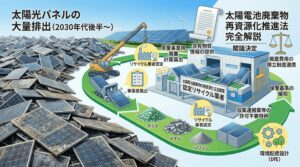
According to government materials, the volume of end-of-life solar panels discharged is expected to increase markedly from the latter half of the 2030s onward, reaching up to approximately 500,000 tons per year (Ministry of the Environment press release, Ministry of the Environment explanatory materials).
Meanwhile, Ministry of the Environment materials indicate that while landfill disposal costs approximately JPY 2,000/kW, recycling costs are distributed in the range of approximately JPY 8,000 to 12,000/kW, suggesting that this cost differential strongly influences current practice.
Against this backdrop, the new act adopts a framework combining a notification system for large-volume dischargers, a certified recycling operator system, and the promotion of information provision and environmentally conscious design by manufacturers and distributors (METI Cabinet decision materials, e-Gov Law Search).
Furthermore, Article 1 of the Supplementary Provisions stipulates that the act shall come into force on a date to be specified by Cabinet Order, within a period not exceeding one year and six months from the date of promulgation, while providing that Article 2 of the Supplementary Provisions (preparatory acts) and Articles 5 through 7 of the Supplementary Provisions shall come into force on the date of promulgation.
Article 2 of the Supplementary Provisions permits preparatory acts — including consultation with relevant administrative organs for the formulation of the basic policy and applications for and granting of certification as a certified recycling operator — to be carried out prior to the date of enforcement.
This point is easily overlooked but is important in practice.
In other words, the system is designed on the premise that prospective certified recycling operators will begin preparing their applications before enforcement, rather than simply waiting for the act to take effect.
Issue 1: Cost Allocation Remains at the Core of the System
What I consider most important is, after all, cost allocation.
The enacted act is structured to regulate those who intend to dispose of large volumes of business-use solar cells, primarily through a planning notification requirement. However, the question of to what extent and by whom the costs are ultimately to be borne does not appear to have been fully resolved as a matter of system design.
Legislative research materials of the House of Councillors indicate that, during the deliberation process, the approach of imposing recycling costs on manufacturers and importers was also under consideration (House of Councillors research materials, House of Councillors research materials).
Moreover, the supplementary resolution of the House of Councillors Committee on the Environment (Item 2) calls on the government to examine the manner of bearing the costs required for dismantling and removing solar power generation facilities and for recycling solar cell waste — including the possibility of imposing costs on manufacturers based on extended producer responsibility — and to take the necessary measures (supplementary resolution of the House of Councillors Committee on the Environment).
In addition, Item 2 also calls for due consideration to avoid further burdens on the public, such as pass-through to electricity charges, as far as possible in advance of the mass disposal of solar cells. Future reviews of the system are therefore likely to address not merely the allocation of costs among the parties, but also the ultimate party to whom costs are passed through.
In practical terms, at least two points should be kept in mind.
First, the dismantling, removal, and recycling costs assumed under existing contracts may not necessarily match actual future costs.
Second, even parties on whom no direct statutory obligation is currently imposed may be affected by future reviews of the system.
For long-term contracts, it would therefore be prudent to expressly provide for renegotiation clauses upon regulatory change, rules on the allocation of cost increases, the authority to choose between reuse and recycling, and the identity of the decision-maker at the time of dismantling.
Issue 2: Do Not Consider the New Act Separately from the FIT/FIP Decommissioning Reserve System
This point is also quite important in practice.
The Ministry of the Environment’s explanatory materials indicate that the new act is intended to develop the necessary environment in coordination with the decommissioning cost reserve system for business-use solar power generation facilities (10kW or more) under the FIT/FIP schemes established by the Act on Special Measures Concerning Procurement of Electricity from Renewable Energy Sources (Ministry of the Environment explanatory materials).
Accordingly, power generation operators should not regard compliance with the new act merely as “a new recycling regulation,” but should instead review the relationship between the funds secured under the existing reserve system and the dismantling, removal, and recycling costs actually required.
A common misunderstanding here is to equate the existence of a reserve system with adequate preparation for the end-of-life phase.
The reserve constitutes only part of the funding arrangement. In many cases, separate consideration will be required as to who is to file the notification as the disposing party and when, who is to prepare the treatment plan, who is to select the certified operator, and who is to bear any shortfall in costs.
In particular, in third-party ownership models, PPAs, leases, trusts, and fund-held projects, the entity making the reserve contributions and the entity responsible for actual disposal operations on site may not coincide.
For this reason, I believe it is essential in practice not to conflate funding arrangements with legal responsibility.
Issue 3: The Identity of the Disposing Party Should Be Clarified Early in Contractual Practice
The enacted act is designed to impose notification obligations on those who intend to dispose of large volumes of business-use solar cells. In actual projects, however, it may not be intuitively clear who constitutes a “person who intends to dispose”, depending on the contractual relationships.
In particular, in projects where the facility owner, landowner, operations contractor, PPA provider, maintenance manager, and party ordering the dismantling work are all different entities, the allocation of roles may function smoothly in normal times, yet responsibility tends to be shifted from one party to another once the end-of-life phase arrives.
What can be stated clearly from primary sources is that the Ministry of the Environment’s guidelines provide that, where dismantling and removal work is ordered, the owner must receive a waste treatment plan from the prime contractor and confirm it in advance (Ministry of the Environment Guidelines, 3rd Edition).
The same guidelines also provide that, for waste treatment associated with construction work, the prime contractor bears the responsibility of the waste-discharging business operator.
Accordingly, in contractual practice for power generation projects, at least the following points should be expressly stipulated.
First, who makes the disposal decision.
Second, who is responsible for notifications and dealings with the authorities.
Third, who concludes the dismantling work and waste treatment contracts, and who takes the lead in maintaining the manifest (industrial waste control slips).
If these three points remain ambiguous, confusion is likely to arise both internally and in external relationships once the system becomes operational.
Issue 4: Take Stock Now of the Matters Awaiting Cabinet Orders and Ministerial Ordinances
The framework of the enacted act is in place, but the practical details remain substantially delegated.
Article 2 defines the solar cells subject to the act as equipment that is plate-shaped and includes components using glass as a material, the weight of which is at or above the weight specified by Cabinet Order, further limited to the types specified by Cabinet Order as those for which recycling is technically and economically feasible and effective.
In addition, the notification obligation under Article 9, paragraph 1 applies to those whose business-use solar cells to be disposed of meet the weight requirements specified by Cabinet Order (large-volume business-use solar cell dischargers), so the threshold is likewise a matter for Cabinet Order.
Furthermore, the assessment criteria under Article 7 are to be specified by competent ministerial ordinance, and the notification obligation under Article 9, paragraph 1 is qualified by the phrase “excluding cases specified by competent ministerial ordinance, such as where the disposal is carried out as an emergency measure necessitated by a non-ordinary disaster”, meaning that the exceptions will likewise be specified by ministerial ordinance.
Companies must therefore understand that, at this stage, “the final requirements remain undetermined.”
What I would recommend in practice is not to wait for the publication of the Cabinet Orders and ministerial ordinances before acting, but rather to prepare a facility register so that decisions can be made the moment they are published.
Specifically, it would be advisable to organize, on a project-by-project basis, information such as location, output, module type, installation date, contractual structure, ownership, management authority, expected renewal, and expected removal timing.
The more uncertain the regulatory framework, the more important it becomes to organize the internal information that is already certain.
Issue 5: On Regulatory Circumvention Through Split Disposal, Look Beyond the Statutory Text to the Supplementary Resolution
As a practitioner, I attach particular weight to the reference in the supplementary resolution to regulatory circumvention through split disposal (supplementary resolution of the House of Councillors Committee on the Environment).
The supplementary resolution (Item 6) calls on the government to ensure the effectiveness of the act by having the relevant ministries and agencies work together to conduct fact-finding surveys, and by taking necessary measures such as reviewing penalties where necessary, so that regulatory circumvention through split disposal and the like does not occur — in addition to addressing illegal dumping and improper treatment.
This provision suggests that, once the weight requirements are set by Cabinet Order, it may be unsafe to assume that formally dividing projects or splitting work phases will suffice.
Of course, at this stage it cannot be stated definitively where lawful project separation ends and regulatory circumvention begins.
Nevertheless, at a minimum, where projects substantively controlled by the same entity are divided merely by timing or nominal ownership, a degree of rationality and documentation sufficient to explain the arrangement afterwards will be necessary.
Retaining internal approval records, board materials, records of deliberations on removal plans, and third-party opinions is valuable from the standpoint of future accountability.
Issue 6: Reuse Is Not Only About “Environmental Consideration” but Also About “Evidence Management”
The supplementary resolution (relating to Item 3) calls on the government to promptly take the measures necessary to promote the long-term use and reuse of solar cells, in order to curb the volume of solar cell waste and level out disposal volumes, so reuse cannot be treated lightly as a matter of policy either.
In practice, however, reuse does not function on fine words alone.
The Ministry of the Environment’s reuse guidelines require that, in order to handle items as reuse products, product information such as the manufacturer, model, date of manufacture, date of installation, date of removal, origin of discharge, and name of the selling operator be recorded and made verifiable by both the seller and the buyer (Ministry of the Environment reuse guidelines).
They also require confirmation that there are no external abnormalities such as broken glass, misalignment of cells or wiring, scorching, or poor connection or insulation of the junction box, and that such confirmation be recorded.
As to power generation performance, the guidelines provide that generation records or maintenance inspection records be prepared, and where no records exist, that a performance test be conducted and the results recorded; documentation confirming insulation performance is likewise required.
In addition, during transportation, the guidelines require that appropriate packaging be used to prevent damage and that the generating surface be shielded from light so that the panel does not generate electricity — meaning that reuse is not simply secondhand trading, but a considerably management-intensive practice.
What follows in practice is that the success of reuse depends not only on performance itself, but on whether one can subsequently demonstrate “why the item was determined to be a reusable product rather than waste.”
In particular, modules discharged from ordinary households may fall under municipal solid waste where no dismantling work is involved, requiring confirmation with the municipality, so residential and business-use panels should not be treated in the same manner.
Where export is involved, the guidelines require that the exporter itself demonstrate that the item functions as a reuse product, and confirm that a reuse market has been established in the destination country, so export practice warrants particular caution.
Issue 7: Do Not Dismiss the Certified Recycling Operator System as “Apparently No Permit Required”
Article 12 of the enacted act provides that a person intending to engage in the solar cell waste recycling business may prepare a solar cell waste recycling business plan and apply for certification by the competent minister.
Article 14 then establishes a special provision under which a certified operator may, notwithstanding Article 7, paragraph 1 or 6, or Article 14, paragraph 1 or 6 of the Waste Management Act, carry out as a business the acts necessary for recycling solar cell waste in accordance with the certified plan, without obtaining the permits required under those provisions.
I consider this highly significant for practitioners.
Going forward, waste-discharging business operators and power generation operators will need to recognize that a loose understanding along the lines of “we can rest easy because we hand the panels to a certified operator” is insufficient; it is necessary to confirm the scope of that party’s certification and whether the actual treatment activities fall within the certified plan.
Because the statutory exemption is premised on compliance with the certified plan, it would be prudent in contractual practice to include the certification number, scope of coverage, treatment flow, recycling methods, presence of subcontracting, and actual transportation routes among the items to be verified.
Furthermore, as noted above, under the preparatory acts in Article 2, paragraph 2 of the Supplementary Provisions, certification applications may be filed before the date of enforcement, and those granted certification are deemed to be certified as of the date of enforcement. Accordingly, not only treatment operators but also waste-discharging business operators would be well advised to ascertain at an early stage which certified operators are likely to enter the market and when.
Issue 8: Build the 30-Day Waiting Period After Notification Under Article 9 into Your Project Schedule
This point is unglamorous but extremely important for practical compliance.
Article 9, paragraph 3 provides that, as a general rule, a party may not discharge solar cell waste itself, or cause another party to carry out work or operations resulting in such discharge, until 30 days have elapsed from the date on which the notification of the large-volume business-use solar cell disposal implementation plan was accepted (Ministry of the Environment press release, House of Councillors research materials).
Room remains for shortening this period under Article 9, paragraph 4, and for extending it under Article 9, paragraph 7.
In addition, where the content of a notification is found to be markedly inadequate in light of the assessment criteria, the competent minister may issue a recommendation to modify the plan, and may issue an order where the recommendation is not followed (Article 9, paragraphs 5 and 6).
For this reason, in projects involving facility renewal, large-scale refurbishment, business termination, repowering, or panel removal upon transfer, it is necessary to build a “waiting period of at least 30 days after notification” into the schedule from the outset and work backwards from there.
Discharging waste during the waiting period may result in a fine of up to JPY 300,000 under Article 27, while violating an order issued after failure to comply with a recommendation may result in a fine of up to JPY 1 million under Article 26.
Moreover, where a representative or employee of a corporation commits a violation in connection with the corporation’s business, the corporation may also be subject to punishment under the dual liability provision in Article 28, and violations such as failure to file notifications of minor changes are subject to a civil fine of up to JPY 100,000 under Article 29.
Issue 9: On Site, Dismantling, Storage, Transportation, and Manifests Are What Ultimately Matter
The Ministry of the Environment’s Third Edition guidelines are quite specific regarding dismantling and removal practice.
For example, where dismantling and removal work is ordered, the guidelines provide that advance separation be carried out to prevent mixing with other waste, and that a waste treatment plan be obtained from the prime contractor and confirmed in advance (Ministry of the Environment Guidelines, 3rd Edition).
The guidelines also expressly state that the connection points between power conditioners or modules and electrical wiring pose a risk of electric shock if approached or touched when submerged or flooded, meaning that removal work is a matter of electrical safety as well as waste treatment.
As to storage, the guidelines require measures such as installing enclosures at storage sites and posting signage regarding storage in a clearly visible location.
Furthermore, where end-of-life solar cell modules are treated as waste, they generally fall under industrial waste, and where the resulting metal scrap, glass scrap, and similar materials are disposed of in landfill, disposal at a controlled-type final disposal site is required.
Accordingly, in contractual practice, dismantling contracts, collection and transportation contracts, treatment consignment contracts, storage responsibility, liability in the event of accidents, packaging standards, response to damage, and manifest management should each be addressed as independent issues.
Indeed, on site, it is not uncommon for damage during removal, the suitability of temporary storage sites, transportation accidents, deficiencies in manifests, and the locus of waste-discharging business operator responsibility to surface as problems before the legislative amendments themselves do.
Issue 10: Logistics and Intermediate Consolidation Are the Effectiveness of the System Itself
On June 19, 2026, the Ministry of the Environment published the results of its call for proposals for demonstration projects on efficient collection and transportation in anticipation of large-scale consolidation of solar panel recycling facilities, selecting three of the six applications (Ministry of the Environment results of the call for proposals).
The selected operators and project outlines are as follows.
The first is E&E Solutions Inc., “Feasibility assessment of intermediate consolidation of end-of-life solar panels in Fukushima Prefecture,” which pilots intermediate consolidation (receipt, sorting, storage, and shipment) in areas of Fukushima Prefecture where no solar panel recycling facilities exist.
The second is the Solar Panel Reuse and Recycling Association, “Demonstration project for an advanced resource circulation network for end-of-life solar panels,” which — primarily in the Kyushu region — comparatively verifies the costs and environmental impacts of relay, sorting, and storage at hub facilities, transportation to recycling facilities, and utilization by materials manufacturers.
The third is Recycle-Tech Japan Co., Ltd., “Demonstration project for collection and transportation of solar panels using existing high-frequency, high-density transportation networks,” which verifies, in Aichi Prefecture, a transportation method loading end-of-life solar panels onto the empty return legs of existing logistics operations, assessed in terms of efficiency and CO2 emissions.
I regard this as a significant signal.
What the system requires is not merely the ideal of recycling, but also raising the utilization rate of recycling facilities and building a mechanism capable of transporting panels across wide areas.
Accordingly, in the practice of waste-discharging business operators as well, the negotiating issues going forward are likely to include not only which facility to send panels to, but also where to consolidate them initially, in what units to transport them, who bears storage responsibility at hub facilities, and how to factor in CO2 emissions and logistics costs.
Issue 11: Distinguish Between the Review Provision in Article 4 of the Supplementary Provisions and the Supplementary Resolution
There is a point that should be clearly distinguished for the purposes of internal governance.
Article 4 of the Supplementary Provisions to the enacted act (Review) provides that the government shall, taking into account the projected volume of solar cell waste discharged, the status of choices regarding recycling of solar cell waste, projected treatment volumes at final disposal sites for waste, the status of recycling implementation by operators engaged in the solar cell waste recycling business, trends in recycling costs, and other circumstances, review the framework of the system and, where it finds it necessary, take measures including a review of the requirements specified by Cabinet Order under Article 9, paragraph 1 concerning large-volume business-use solar cell dischargers and the imposition of obligations on disposal-related parties concerning the curbing of the volume of solar cells becoming solar cell waste and the choice of recycling as a disposal method.
Article 4 of the Supplementary Provisions itself sets no deadline.
By contrast, the supplementary resolution of the House of Councillors Committee on the Environment (Item 7) calls on the government to conduct the review of the framework of the system under Article 4 of the Supplementary Provisions approximately three years after enforcement, and to take the necessary measures based on the results.
In other words, the “three years” is not a statutory deadline but a political request made by the Diet to the government.
That said, although supplementary resolutions have no legal binding force, administrative practice generally treats them with considerable weight. In practical terms, it would therefore be reasonable to anticipate the possibility that strengthened enforcement or a review of the Cabinet Order requirements will be discussed around three years after enforcement.
For internal governance purposes, therefore, “conforming to the current statutory text” is not enough.
What matters is to design contracts and operations so that they can be updated, on the premise of future reviews.
Practical Steps Companies Should Begin Taking Now
At this stage, I would recommend the following preparations.
First, reorganizing the facility register.
It is important to compile information on location, facility output, installation date, module type, ownership, management authority, contractual structure, and expected renewal timing.
Second, expressly allocating responsibility for the end-of-life phase by contract.
It is necessary to clarify who makes the disposal decision, who files the notification, who orders the dismantling work, who selects the treatment operator, and who manages the manifests (Ministry of the Environment Guidelines, 3rd Edition).
Third, establishing a workflow for documenting reuse determinations.
Inspections and records covering performance, insulation, external condition, origin, sales terms, presence of warranties, and transportation conditions must be managed as a package (Ministry of the Environment reuse guidelines).
Fourth, putting in place a structure capable of assessing the Cabinet Orders and ministerial ordinances as soon as they are published.
A cross-functional review structure involving not only legal but also engineering, operations, accounting, procurement, and site management functions will be necessary.
Fifth, documenting the rationale where projects or work phases are divided.
Given that the supplementary resolution expressly identifies regulatory circumvention through split disposal as a concern, it is important to retain explanatory materials that emphasize substance over form (supplementary resolution of the House of Councillors Committee on the Environment).
Sixth, building the Article 9 notification and the 30-day waiting period into schedules for facility renewal and business termination from the outset.
Conclusion
The Solar Panel Recycling Act has been enacted, but from a practical standpoint, I believe we have only just reached the starting line.
Particularly important are the allocation of costs, the interface with the FIT/FIP reserve system, identification of the disposing party, taking stock of matters awaiting Cabinet Orders and ministerial ordinances, preparing for split-disposal risk, evidence management for reuse, due diligence on certified operators, schedule management for the 30-day waiting period after notification, the design of logistics and intermediate consolidation, and distinguishing between the review provision in Article 4 of the Supplementary Provisions and the supplementary resolution’s “approximately three years after enforcement.”
If the previous article served to map the entrance to the system, this article is positioned as one that identifies the practical homework remaining after enactment.
In this field, I personally believe that unglamorous practical matters — contracts, registers, evidence, storage, logistics, and the allocation of responsibility — ultimately have a far greater bearing on corporate risk than headline-grabbing regulatory reforms.
For operators, financial institutions, investors, EPC contractors, O&M providers, local governments, and treatment operators involved in renewable energy projects, this period before enforcement is precisely when it is worth reviewing your own end-of-life strategy.
- [Column] [ESG Strategies for Business] Vol.34 The National Carbon Market Policy and the ETS Concept—How Will the Shift from the Voluntary to the Compliance Market Unfold?
- [Column] The Full Picture of the 2026 Amended Electricity Business Act and the Impact of New Decarbonization Rules on Corporate Practice
関連記事
-
 [Article] Investing in Japan’s Battery Storage Business: August 2026 Guide – Market Opportunities, Revenue Strategies, Regulation and Legal Practice
 -
[Column] Are Mega Solar Regulations Becoming Redundant? Reading the JFBA’s Model Ordinance on Renewable Energy Coordination from a Practical Standpoint
-
[Column] The Full Picture of the 2026 Amended Electricity Business Act and the Impact of New Decarbonization Rules on Corporate Practice
-
[Column] The “Institutional Design” of Community-Integrated Renewable Energy – Decoding the Conditions for Successful Projects from the 20 Good Echo Cases
-
[Column] Environmental Impact Assessment Threshold for Solar PV Lowered from “40MW to 20MW” – Tightening Mega Solar Regulations and Key Practical Points for Project Developers
-
[Column Introduction] [Representative’s Blog] Three Essential Rules for Entering the Grid-Scale Battery Storage Business
-
[Column] Cabinet Decision on the Bill for the Promotion of Recycling of Solar Panel Waste | Practical Considerations and the Full Scope of the Legal Framework in Preparation for the Era of Mass Disposal
-
[Column] FY2025 Enforcement Actions Under the Renewable Energy Special Measures Act | Strengthened Oversight and Practical Considerations