[Column] Environmental Impact Assessment Threshold for Solar PV Lowered from “40MW to 20MW” – Tightening Mega Solar Regulations and Key Practical Points for Project Developers
✅ In a nutshell
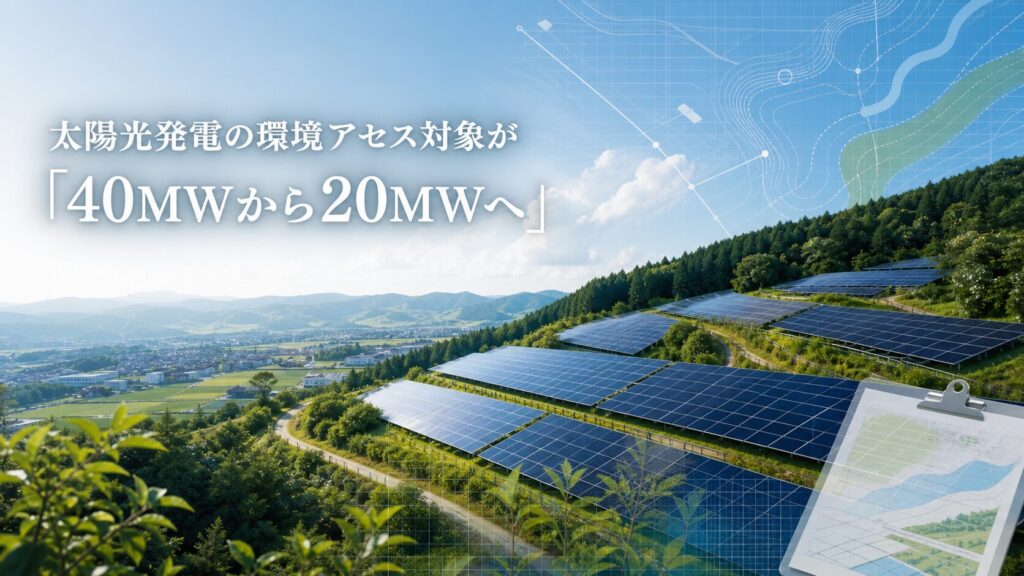
- 🔻 A draft report from a study group under Japan’s Ministry of the Environment proposes lowering the threshold for solar power generation projects subject to the Environmental Impact Assessment Act, reducing the Class-1 Project threshold from the current 40,000 kW (40MW) to 20,000 kW (20MW).
- 📊 The basis for this reduction is supported by quantitative data, including analyses of environmental dispute cases, a survey by the National Governors’ Association of Japan, and statistics on forest land development permits, all substantiating the unique characteristics of solar power generation.
- 🛠 In addition to lowering the scale threshold, the report also addresses related issues such as the revision of screening criteria, strengthening the effectiveness of reviews and guidance, and the continuity of projects (preventing project splitting).
- 🌬 On the other hand, the scale thresholds for wind power generation will remain unchanged for the time being, as it has only been a short time since the previous review of these thresholds.
✅ Audio summary of this post is available here
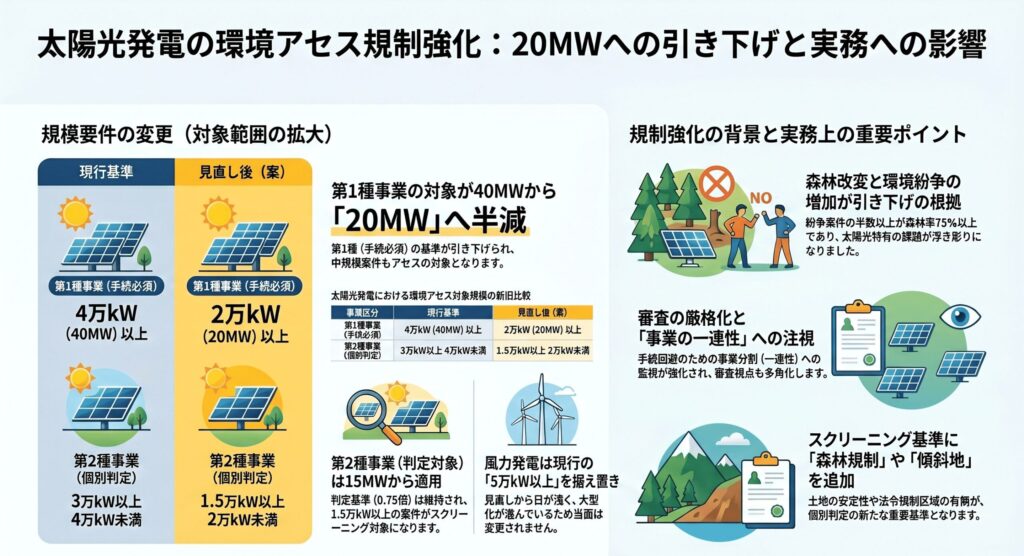
Table of Contents
Introduction
In this article, we will explain the lowering of the scale threshold for solar power generation projects subject to Environmental Impact Assessment (EIA).
Concerns regarding so-called mega solar power plants have been raised across various regions in Japan from the perspectives of natural environment, disaster prevention, and landscape preservation.
Against this backdrop, in December 2025, the Japanese government adopted the “Countermeasures Package on Large-scale Solar Power Generation Projects (Mega Solar).” As part of this package, the scope of environmental impact assessment requirements is being revised.
In June 2026, the Ministry of the Environment’s “Study Group on Environmental Impact Assessment for Solar Power Generation Projects” compiled a draft report, which proposes substantially lowering the scale threshold for solar power generation projects.
From the perspective of those involved in renewable energy projects, the expansion of the EIA’s scope is likely to bring a significant number of new projects within the procedural framework, which we believe could have considerable practical implications.
This article reviews the proposed changes, their underlying rationale, and the key practical points that project developers should keep in mind, drawing primarily on the study group’s draft report and accompanying materials.
Please note that the content discussed here represents the “direction” outlined in the draft report, and will only be finalized following future amendments to the relevant Cabinet Order and related regulations.
Background – The Mega Solar Countermeasures Package and Establishment of the Study Group
To begin, let us review the context in which this revision has emerged.
Following the introduction of the Feed-in Tariff (FIT) Program in 2012, the deployment of solar power generation in particular has rapidly expanded.
On the other hand, there have been growing instances of community concerns regarding the natural environment, safety, and landscape (Study Group on Environmental Impact Assessment for Solar Power Generation Projects – Draft Report).
In response to these circumstances, the Japanese government, since September 2025, has conducted a comprehensive review of relevant laws and regulations through inter-ministerial coordination meetings. On December 23, 2025, the “Council of Related Ministers on Large-scale Solar Power Generation Projects” adopted the “Countermeasures Package on Large-scale Solar Power Generation Projects (Mega Solar)” (Study Group on Environmental Impact Assessment for Solar Power Generation Projects – Outline).
With regard to environmental impact assessment, this countermeasures package states: “The scale of solar power generation projects subject to environmental impact assessment under the Environmental Impact Assessment Act and the Electricity Business Act shall be reviewed in order to promote environmental considerations by project developers.”
Based on this, the “Study Group on Environmental Impact Assessment for Solar Power Generation Projects” was convened starting in January 2026, with deliberations focused on the scale of solar power generation projects subject to the Act (Outline).
The draft report we introduce here was compiled at the 5th meeting (held on June 1, 2026) (Materials of the 5th Meeting).
The countermeasures package, however, is not limited to environmental assessment alone.
It also encompasses strengthening regulations under the Forest Act on forest land development permits, revising guidelines on landscape law enforcement, ensuring appropriate disposal and recycling of solar panels, and strengthening cybersecurity for solar power generation facilities – measures that span multiple ministries (Reference Materials).
The current revision of the scale threshold can be positioned as one of the pillars of this broader initiative.
Recap of the Current System – Class-1 and Class-2 Projects
Before delving into the details of the revisions, let us review the basic framework of the Environmental Impact Assessment Act. As many readers may not be experts in this field, I will explain it carefully.
Under the Environmental Impact Assessment Act, projects that are large in scale and are particularly likely to have significant environmental impacts are designated as “Class-1 Projects,” for which environmental assessment procedures are mandatory.
Projects of comparable scale to these are categorized as “Class-2 Projects,” and whether procedures are required is determined on a case-by-case basis (screening) (Draft Report).
The scale threshold for Class-1 Projects is set with 100 hectares as the baseline.
However, it is important to note that different lower limits are set for each project type based on its specific characteristics.
For example, reclamation and land-fill projects, as well as wind power generation projects, have a lower limit of 50 ha (equivalent) – smaller than the baseline of 100 ha – and waste disposal sites have a lower limit of 30 ha or more (Draft Report).
Solar power generation projects became subject to the Act in April 2020.
At that time, considering the average output for a project area of 100 ha and improvements in generation efficiency through technological innovation, Class-1 Projects were set at 40,000 kW (40MW) or more (Draft Report).
The current scale thresholds are as follows:
- Class-1 Project (procedure required). Output of 40,000 kW or more.
- Class-2 Project (case-by-case determination). Output of 30,000 kW or more, less than 40,000 kW.
Note that Class-2 Projects are limited to those whose ratio to the Class-1 Project scale is above a certain threshold.
This minimum ratio is set at 0.75 in Article 6 of the Enforcement Order of the Environmental Impact Assessment Act (Draft Report). 0.75 times 40,000 kW equals 30,000 kW, which is the current lower limit for Class-2 Projects.
What Will Change – Lowering to 20,000 kW and 15,000 kW
The direction of revision shown in the draft report is to lower the scale threshold for solar power generation projects as follows (Draft Report):
- Class-1 Project. From 40,000 kW (40MW) or more → to 20,000 kW (20MW, equivalent to 50 ha) or more.
- Class-2 Project. From 30,000 kW or more, less than 40,000 kW → to 15,000 kW (15MW) or more, less than 20,000 kW.
The minimum ratio of 0.75 for Class-2 Projects will be maintained.
This means that after lowering the Class-1 lower limit to 20,000 kW, the Class-2 lower limit will be 15,000 kW (0.75 times 20,000 kW) (Draft Report).
From a practical standpoint, the Class-1 Project lower limit will be halved from 40MW to 20MW.
Projects in the 20MW to under 40MW range, which were previously outside the assessment procedure, will be newly subject to such procedures.
This will significantly increase the need to incorporate environmental considerations from the early stages of development planning.
Why 20,000 kW? – Rationale for the Reduction
As a lawyer, I am particularly interested in the basis for the chosen figures.
The draft report presents multiple grounds for setting the threshold at 20,000 kW, and this section is where I find the primary sources particularly valuable.
Estimation of Output Equivalent to 100 ha
When solar power generation was brought under the Act in 2020, the 40,000 kW level was set based on the equivalent output for an area of 100 ha.
However, using data from facilities that have since commenced operation, the estimated power generation output equivalent to 100 ha is 35.5 MW.
Furthermore, when limited to facilities that began operation in the most recent five-year period (fiscal years 2020 – 2024), the estimate is 40.7 MW (Draft Report).
This estimate excludes values of 300 ha or more or 200 MW or more, removes outliers using the 3σ method, and performs regression analysis (Draft Report; on a personal note, the term “regression analysis” brings me back to my MBA days).
Alignment with Other Project Types
The draft report cites the following three reasons for setting the new threshold at 20,000 kW (equivalent to 50 ha) (Approach to Reviewing the Scale Threshold, Draft Report):
- Reclamation and land-fill projects and wind power generation projects already set 50 ha – smaller than the baseline 100 ha – as the lower limit for Class-1 Projects.
- The scale threshold for Class-1 Projects regarding waste disposal sites, which also have significant environmental impacts during operation, is 30 ha or more.
- When focusing on projects between 12,000 kW (equivalent to 30 ha) and less than 30,000 kW (below the current scope of the Act) where environmental disputes have arisen, the majority involve projects of 20,000 kW or more.
Data Supporting the Specific Circumstances of Solar Power Generation
The draft report identifies several characteristics of solar power generation projects, including diversity of project locations, large-scale land alterations, impacts from reflective light and on landscapes, and ease of construction (Draft Report).
The following data are presented to support these characteristics, and are particularly notable from a practical standpoint:
First is the analysis of 40 solar power generation projects in which environmental disputes have arisen.
These were extracted from newspaper reports (4 national newspapers and 45 local newspapers) published between April 1, 2020 and November 27, 2025. The main causes of disputes identified were soil-related issues, natural environment-related issues, and landscape-related issues (Draft Report).
Of the 39 projects for which the project site could be identified, 21 projects – more than half – had project areas covered by approximately 75% or more forest (Draft Report).
Furthermore, of the 36 projects for which output could be identified, 18 had outputs below 30,000 kW, indicating that issues are arising regardless of project scale (Draft Report).
Second is the survey conducted in February 2026 by the National Governors’ Association of Japan targeting all prefectures.
In response to the question regarding the unique characteristics of solar power generation projects, the answers indicating “yes, there are specific characteristics” were most frequent regarding installation location (35), reflective light impact (33), scale of forest development (30), ease of construction (25), and characteristics of project developers (24) (numbers in parentheses indicate the number of prefectures that answered “specific characteristics exist”) (Draft Report).
Third is the data on forest land development permits.
Comparing permits granted for “factories and business establishments” with those for “solar power generation facilities” between fiscal years 2019 and 2024 reveals that, while there were no permits of 50 ha or more for “factories and business establishments,” there were 16 such permits of 50 ha or more for “solar power generation facilities,” accounting for 23% of the analyzed forest land development permits by area (Draft Report).
This is quantitative data showing that solar power generation tends to involve larger-scale forest alteration than other forms of area development.
Taking these factors into consideration, the draft report concludes that it is appropriate to set the Class-1 Project scale threshold for solar power generation projects at 20,000 kW (equivalent to 50 ha) or more (Draft Report).
Rationale for Setting the Class-2 Lower Limit at 15,000 kW
For Class-2 Projects, the option of lowering the minimum ratio of 0.75 was also examined.
However, since maintaining 0.75 was considered appropriate from the perspective of consistency with provisions in other laws and regulations, and since there are few projects between 12,000 kW and under 15,000 kW where environmental disputes have arisen, there was insufficient basis for designating these as Class-2 Projects. As a result, the draft report concludes that the Class-2 Project scale threshold should be set at 15,000 kW or more (Draft Report).
Beyond the Scale Reduction – Three Additional Key Issues
The current revision is not limited to lowering the threshold.
The draft report addresses the following additional issues, which are directly relevant to practical operations and warrant attention:
Revision of Screening Criteria
The criteria for screening Class-2 Projects are also being reviewed.
Specifically, the addition of screening criteria for the presence of regulated areas under forest-related laws and the establishment of new criteria related to land stability where land alteration occurs in particularly steep terrain are being considered (Draft Report).
Strengthening the Effectiveness of Review and Guidance
In addition to revising the scale, the countermeasures package calls for “strengthening the effectiveness of environmental impact assessment through stricter review and more thorough guidance.”
In response, the Ministry of Economy, Trade and Industry has reported that effectiveness will be strengthened at each stage: environmental impact assessment, construction plan notification, and facility operation (Draft Report).
For example, during the environmental impact assessment stage, the assessment perspective will be diversified, such as by examining a wider range of surrounding facilities and areas affected by reflective light (Draft Report).
Measures for Small-Scale Projects Not Subject to the Act
Initiatives to encourage voluntary environmental considerations have also been introduced for smaller-scale projects that are not subject to the Act or local environmental impact assessment ordinances.
Specifically, the “Environmental Consideration Guidelines for Solar Power Generation” (March 2020, Ministry of the Environment) and its supplement, the “Handbook on Natural Environmental Considerations for Solar Power Generation” (March 2026, Ministry of the Environment) – which provides concrete approaches for avoiding and reducing impacts on animals, plants, and ecosystems – will be promoted, along with the use of the Environmental Assessment Database (EADAS), a geographic information system (Draft Report).
Practical Points for Project Developers
Based on the above, here are some key practical points from a developer’s perspective:
First, ensuring predictability.
The draft report notes that, in preparation for projects newly subject to Class-1 or Class-2 status, transitional measures are provided, including switching from procedures under other systems (Article 54 of the Act) and exemptions for projects already at a certain stage (Article 55 of the Act). The report emphasizes the importance of appropriate operation of these provisions to ensure predictability for developers, financial institutions, and other stakeholders in the current revision (Draft Report).
The timing at which ongoing projects come under the new criteria is a critical issue that also affects financing assumptions.
Second, the concept of project continuity.
To address cases where projects are divided to avoid assessment procedures, the “Approach to Project Continuity in Environmental Impact Assessment under the Environmental Impact Assessment Act and the Electricity Business Act for Solar Power and Wind Power Generation Facilities” (2021), jointly published by the Ministry of Economy, Trade and Industry and the Ministry of the Environment, will be re-publicized (Draft Report).
With the reduction of the scale threshold, the issue of project division will require even greater attention.
Third, the relationship with local government ordinances.
Japan’s environmental impact assessment system has worked through a combination of national law and local ordinances – with local governments imposing procedural requirements through ordinances on projects not subject to the Act, ensuring environmental considerations across both levels (Draft Report).
The scale thresholds in local ordinances vary significantly across municipalities, with criteria based on output, area, or other measures (Approach to Reviewing the Scale Threshold).
Even after the national threshold is lowered, confirming the ordinances of the municipality where the project is located remains essential.
Wind Power – To Be Maintained at Current Thresholds
Although wind power generation projects are also discussed by the same study group, their scale thresholds will be maintained at current levels for the time being.
Wind power generation projects became subject to the Act in October 2012 and their scale thresholds were revised in October 2021. Currently, Class-1 Projects are set at 50,000 kW or more, and Class-2 Projects at 37,500 kW or more, less than 50,000 kW (Draft Report).
The draft report notes that since the previous revision was relatively recent, and future wind power facilities are expected to be predominantly 50,000 kW or more, it is appropriate not to revise either the Class-1 or Class-2 scale thresholds at this time, unlike for solar power generation (Draft Report).
The fact that responses differ according to the characteristics of each project type – even within the same renewable energy category – is an important point to keep in mind when understanding the system.
Conclusion
In this article, we have reviewed the lowering of the scale threshold for environmental impact assessment of solar power generation projects, based on the draft report of the Ministry of the Environment’s study group.
To summarize the key points: Class-1 Projects will be lowered from 40,000 kW (40MW) to 20,000 kW (20MW) or more, and Class-2 Projects from 30,000 kW to 15,000 kW or more. The rationale is supported by quantitative data including dispute case analysis, the National Governors’ Association survey, and forest land development permit statistics highlighting solar-specific circumstances. Beyond the scale reduction itself, the report also addresses issues such as the revision of screening criteria, strengthening of effectiveness, and project continuity (Draft Report).
In its conclusion, the draft report notes that, with the increasing adoption of Corporate Power Purchase Agreements (Corporate PPAs), renewable energy buyers are placing greater emphasis on environmental value, and being an environmentally considered project is becoming a competitive advantage (Draft Report).
I believe that the perspective of treating environmental consideration not just as a regulatory cost but as added value built into the business will become increasingly important in renewable energy projects going forward.
The content presented in this article reflects the direction shown in the draft report of the study group, and the final content will be determined through future amendments to the Cabinet Order and related regulations.
As impacts on specific projects may vary depending on progress and location, we recommend consulting with a specialist for individual case-by-case considerations.
- [Announcement] Appointment as Substitute Director who is an Audit and Supervisory Committee Member of Mitsuuroko Group Holdings Co.,Ltd.
- [Column] The "Institutional Design" of Community-Integrated Renewable Energy - Decoding the Conditions for Successful Projects from the 20 Good Echo Cases
関連記事
-
 [Column] [ESG Strategies for Business] Vol.34 The National Carbon Market Policy and the ETS Concept—How Will the Shift from the Voluntary to the Compliance Market Unfold?
 -
[Column] [ESG Strategies for Business] Vol.33 Malaysia’s Decarbonization Policy: The Current Landscape—NETR, the National Emissions Trading Policy, and the Latest on the CCUS Act
-
[Column] The “Institutional Design” of Community-Integrated Renewable Energy – Decoding the Conditions for Successful Projects from the 20 Good Echo Cases
-
[Announcement] Appointment as Substitute Director who is an Audit and Supervisory Committee Member of Mitsuuroko Group Holdings Co.,Ltd.
-
[Column] [ESG Strategies for Business] Vol.32 Malaysia’s Anti-Bribery and Anti-Corruption Measures—Enhanced MACC Enforcement and Compliance Practices for Japanese Companies
-
[Announcement] Appointment of Attorney Mitsuru Misawa as JETRO Kuala Lumpur Platform Coordinator
-
Borderless Business Law Office Named Finalist in Two Categories at ALB Japan Law Awards 2026
-
[Column Writing] ESG Strategies for Business Success – Vol. 31: Mandatory ESG Disclosure in Malaysia