[Column] Agrivoltaics Shifts from Temporary Farmland Conversion to Municipal Certification – Reading the October 2026 Ministerial Ordinance Amendments and Public Notice from a Contract Practice Perspective
✅ In a nutshell
- 🌾 On October 9, 2026, two ministerial ordinances and one public notice concerning agrivoltaics (solar sharing) were promulgated in the Official Gazette, and the amendment to the Ordinance for Enforcement of the Agricultural Land Act will come into force on April 1, 2027.
- 🏛️ After entry into force, the prospect of municipal certification of a facility development plan under the Rural Renewable Energy Act will be a prerequisite for permission for the temporary conversion of farmland.
- 📏 Standards such as a shading rate of less than 30%, a minimum ground clearance of approximately 3 m or more, and annual sales by the farmer of JPY 500,000 or more have been set out in the national Basic Policy.
- 📝 I believe that contracts among power generation operators, farmers, and landowners now need to set out benefit sharing, removal costs, securing crop yields, and changes of farmer more concretely than before.
Table of Contents
Introduction
In this article, I will explain the institutional reform of agrivoltaics promulgated in October 2026, from the perspective of how it affects contracts between power generation operators and farmers.
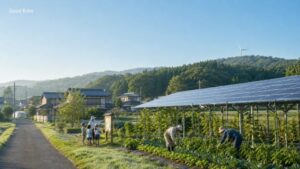
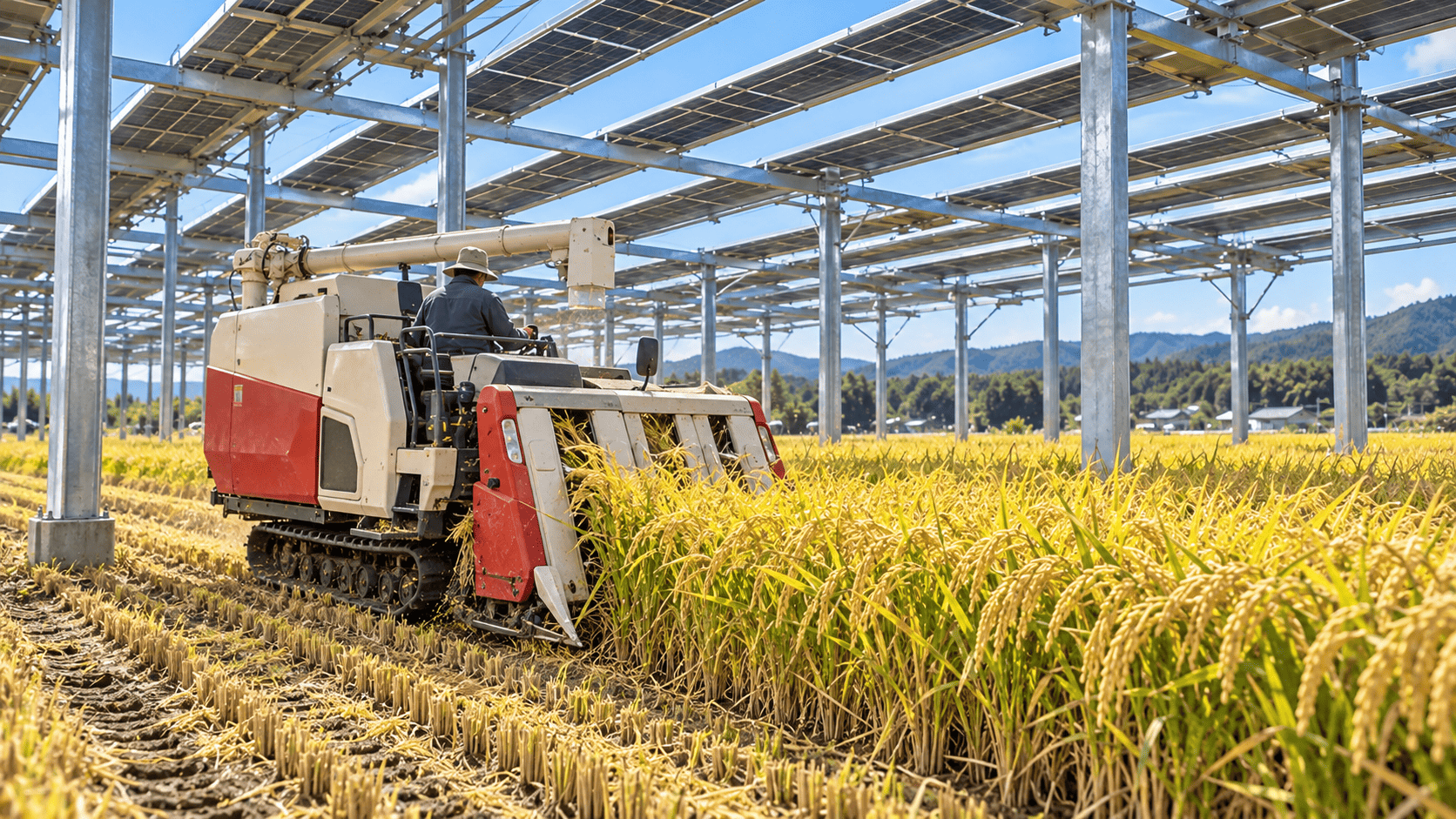
Agrivoltaics is an approach in which supports are erected on farmland and solar panels are installed above, generating power while farming continues on the land below.
Until now, it has been operated mainly through temporary conversion permission under the Agricultural Land Act.
Under this reform, plans prepared by municipalities and certification by municipalities will be placed at the center of the procedure.
Because the names of the relevant systems are long and the changes span multiple ministerial ordinances and a public notice, I suspect many people find it hard to understand what has changed.
In this article, based on the Official Gazette, the amended Basic Policy, and materials from the Ministry of Agriculture, Forestry and Fisheries (MAFF), I set out the changes and then list points to review in contracts.
Overview of the Reform
The Official Gazette of October 9, 2026 (Extra Edition No. 223) contains the following three amendments relating to agrivoltaics.
- Ministerial Ordinance Partially Amending the Ordinance for Enforcement of the Agricultural Land Act and the Ordinance for Enforcement of the Rural Renewable Energy Act (MAFF Ordinance No. 72)
- Ministerial Ordinance Partially Amending the Ministerial Ordinance on Certification, etc. of Facility Development Plans under the Rural Renewable Energy Act (MAFF/Ministry of the Environment Ordinance No. 8)
- Partial Amendment of the Basic Policy under the Rural Renewable Energy Act (MAFF/METI/Ministry of the Environment Public Notice No. 5)
The Rural Renewable Energy Act refers to the Act on Promotion of Generation of Electricity from Renewable Energy Sources Harmonized with Sound Development of Agriculture, Forestry and Fisheries.
It establishes a mechanism under which municipalities prepare basic plans for the introduction of renewable energy, and municipalities certify facility development plans prepared by operators.
The effective dates differ for each amendment.
According to the supplementary provisions of MAFF Ordinance No. 72, the amendment to the Ordinance for Enforcement of the Agricultural Land Act comes into force on April 1, 2027, while the amendment to the Ordinance for Enforcement of the Rural Renewable Energy Act has been in force since the date of promulgation.
Under its supplementary provisions, the amendment to the Ministerial Ordinance on Certification, etc. of Facility Development Plans has also been in force since the date of promulgation.
The Center of the Procedure Shifts to Municipal Certification
Under Article 47, item 6 of the Ordinance for Enforcement of the Agricultural Land Act as amended by MAFF Ordinance No. 72, where the project applied for is agrivoltaics, the absence of a prospect of certification under paragraph 3 of Article 7 of the Rural Renewable Energy Act for a facility development plan under paragraph 1 of that Article is a ground for refusing temporary conversion.
Article 57, item 6, which applies where the creation or transfer of rights is involved, is a provision to the same effect.
In addition, Article 47, item 6 also addresses, within the area of a municipality that has formulated a local government action plan under the Act on Promotion of Global Warming Countermeasures, the prospect of certification of a regional decarbonization promotion project plan under that Act.
Accordingly, after entry into force, it is considered that starting an agrivoltaics project will presuppose going through the following flow.
- The national government establishes the Basic Policy under the Rural Renewable Energy Act
- The municipality prepares a basic plan and positions agrivoltaic facilities within it
- A facility developer, such as a power generation operator, prepares a facility development plan and applies to the municipality for certification
- Upon receiving municipal certification, the developer proceeds with the procedure for temporary conversion of farmland
- The status of implementation is reported to the mayor of the municipality every year
This flow had also been presented as the draft procedure for the new system in the materials of MAFF’s Study Group on Desirable Agrivoltaics (6th meeting) held in April 2026.
On the other hand, the grounds for refusal relating to crop yield, sunlight, facility height, and the like that were set out in the pre-amendment Ordinance for Enforcement of the Agricultural Land Act (former Article 47, item 6), and the provision on application documents for agrivoltaics (former Article 30, paragraph 2), have been deleted or amended.
Standards such as crop yield have been moved to the national Basic Policy, and application documents to the Ministerial Ordinance on Certification, etc. of Facility Development Plans.
In practice, I believe the first item to confirm will be whether the municipality where the project site is located has prepared a basic plan, and how it positions agrivoltaic facilities.
In municipalities without a basic plan, it may be necessary to wait for a plan to be prepared.
Standards Set Out in the Basic Policy
The amended Basic Policy (version effective October 9, 2026, as posted by MAFF) sets out the basic principles of agrivoltaics, and the facility configurations and modes of implementation for realizing them.
When positioning agrivoltaic facilities in a basic plan, municipalities are, in principle, to state these explicitly in the basic plan.
Basic Principles
The premise of the basic principles is the continuation of appropriate farming.
The Basic Policy requires that there be no risk that the yield per unit area (unit yield) of crops cultivated on the farmland below will decrease by approximately 20% or more compared with the municipality’s average unit yield for the same crop year.
On that basis, three principles are set out: maintaining the function of farmland as the foundation of food production; improving farmers’ incomes and developing their businesses; and coexistence with and revitalization of the local community.
Standards Including Numerical Thresholds
The main standards set out in the Basic Policy are as follows.
They are organized into three categories: power generation facilities, farming, and coexistence with the local community.
| Category | Main standards |
|---|---|
| Power generation facilities | The shading rate is less than 30% (for facilities where assessment by shading rate is difficult, the reduction rate of solar radiation is less than 20% at all points in the field throughout the growing period); supports are installed so that a minimum ground clearance of approximately 3 m or more and a passage width for agricultural machinery of approximately 4 m or more are secured; and there is no risk of significantly degrading the quality of crops |
| Farming | Within the area of a regional plan, the farmer is listed in the regional plan as a person responsible for agriculture; the labor necessary for cultivation is secured; the farmer has a production and sales record of JPY 500,000 or more per year, etc.; the crop is one for which general sales channels are established; and, in principle, the crop can be harvested every year from the first year |
| Coexistence with the local community | Consultations at the council have been concluded; appropriate benefit sharing is provided by agreement from the power generation operator to the farmer (including the landowner, if different); the policy on compensation for damage to third parties is clear; the project does not impede land improvement projects and the like; and securing of removal costs is assured |
What I would like to highlight is the concept of general sales channels.
The Basic Policy states that cases where a power generation operator or the like purchases products that are generally not recognized as having market value are not included in general sales channels.
Arrangements in which a power generation operator buys the crops in order to give the appearance of farming are considered not to be permitted.
The Basic Policy also states that, according to demonstration research to date and other sources, rice, wheat, and soybeans can secure unit yields under the above shading conditions, provided that appropriate cultivation management is carried out.
Special Measures by Municipalities
The Basic Policy provides that, where the realization of the basic principles is ensured based on scientific evidence obtained by public institutions, universities, or their research institutions from the results of multi-year trial cultivation or the like, the municipality may, with advice from the national and prefectural governments, establish special treatment regarding facility configurations and modes of implementation.
The same applies where trial cultivation is conducted with a prefectural institution.
However, standards relating to coexistence with the local community are excluded from the scope of special measures.
It is considered that, while there is room for special measures for numerical standards such as the shading rate, benefit sharing, the compensation policy, and securing removal costs are positioned as requirements that cannot be dispensed with in any region.
Application Documents and Annual Reporting
The amended Ministerial Ordinance on Certification, etc. of Facility Development Plans sets out the following as attachments in the case of agrivoltaics.
- Design drawings of the agrivoltaic facilities and other necessary facilities
- Documents supporting the expected unit yield (data such as production volumes within the municipality, or prior cultivation records)
- A written pledge that the facility developer will bear the cost of removing the facilities
- A written pledge to submit a report on the status of implementation of the certified facility development plan to the mayor of the municipality every year
According to the forms published in the Official Gazette, the pledge on removal costs is to list all facility developers and the farmer of the farmland below as applicants, and its content is a pledge to bear removal costs upon completion or discontinuation of the project.
The implementation status report is in a form pledging to report by the end of February of the following year.
The fact that the form for the removal cost pledge also has the farmer listed as a signatory is closely related to contractual arrangements.
I will touch on this in more detail later.
Pre-Amendment Provisions Remain for Existing Projects for the Time Being
For projects already conducting agrivoltaics under temporary conversion permission, there are transitional measures.
Article 2, paragraph 1 of the supplementary provisions of MAFF Ordinance No. 72 provides that applications for permission made before entry into force on which no disposition has been made at the time of entry into force shall remain governed by the previous rules.
Paragraph 2 of the same Article provides that where a person who received permission before entry into force seeks to obtain permission after entry into force for the implementation of the same project, the pre-amendment provisions of Article 30, paragraph 2; Article 47, items 2-2 and 6; Article 57, items 2-2 and 6; and Article 57-4, paragraph 2, item 5 of the Ordinance for Enforcement of the Agricultural Land Act shall remain in effect for the time being.
In other words, the pre-amendment provisions will apply for the time being to re-permission for existing projects.
However, the aforementioned study group materials indicated a policy of dealing strictly with existing operators as well.
Specifically, this includes lowering the threshold for review and on-site inspection conducted by the national government together with prefectures from 4 ha to 2 ha of farmland below, clarifying the criteria for recommendations and orders, and clarifying the practice of refusing applications for re-permission by those who have received a recommendation without showing improvement.
Although these materials are at the draft stage, it should be kept in mind that the existence of transitional measures does not mean that re-permission will automatically be obtained.
According to the MAFF study group materials, temporary conversion permissions for installing agrivoltaic facilities reached 6,137 cases by FY2023, with 1,361.6 ha of farmland below.
In addition, the same materials state that, as of the end of FY2023, farming on the farmland below was impaired in 24% of cases (1,221 cases).
The figures also suggest that a certain proportion of existing projects do not meet the standards.
The period of temporary conversion is set out in the appended table of MAFF’s Guidelines on the Treatment of Agrivoltaics under the Farmland Conversion Permission System as within 10 years where a core farmer uses farmland that it owns, where idle farmland is reclaimed for use, or where Class 2 or Class 3 farmland is used, and within 3 years in other cases.
Because the permission period is short compared with the duration of the power generation business, the prospect of re-permission greatly affects the value of the project.
What to Review in Contracts
Based on the amendments discussed so far, I list below points to review in contracts among power generation operators, farmers, and landowners.
From the perspective of renewable energy project contracts, I set out points where the requirements of the system and the contractual provisions are likely to diverge.
Benefit-Sharing Provisions
The Basic Policy requires appropriate benefit sharing, by agreement, from the power generation operator to the farmer (including the landowner, if different).
It also lists the status of benefit sharing to farmers and others as an example of matters for consultation at the council.
In contracts, it would be advisable to specify concretely the method of calculating the benefit (whether linked to electricity sales revenue or a fixed amount), the timing of payment, and the treatment when power output decreases.
To enable the status of benefit sharing to be explained in reports to the municipality, it may also make things run more smoothly in practice to include an obligation to share the materials underlying the calculation.
Bearing Removal Costs
As mentioned above, the form for the removal cost pledge lists not only the facility developer but also the farmer as an applicant.
From the farmer’s perspective, this means being listed, vis-à-vis the administrative authorities, among those who bear removal costs.
I believe that, between the power generation operator and the farmer, the contract needs to make clear who ultimately bears removal costs, how they are secured through reserves or guarantees, and what happens if the power generation operator goes bankrupt.
In particular, if the premise is that the farmer will not bear removal costs, it would be advisable to put in place mechanisms to protect the farmer, such as the power generation operator’s acceptance of recourse claims or payment from reserves.
Crop Yield and Continuation of Farming
The standards in the Basic Policy require that there be no risk of unit yield decreasing by approximately 20% or more compared with the regional average.
It is important to specify who will take what corrective measures, and by when, if yields fall below the standard, and how the contract will be treated if no improvement is seen.
From the power generation operator’s perspective, the state of the farmer’s farming is directly linked to maintaining the permission and to the prospect of re-permission.
It would be advisable to include in the contract the sharing of cultivation plans, reporting of yields, and rights to conduct on-site inspections.
Change of Farmer
After entry into force, within the area of a regional plan, the farmer must be listed in the regional plan as a person responsible for agriculture.
Where the farmer changes due to aging, retirement from farming, or death, whether the new farmer meets the requirements becomes an issue.
In contracts, it would be advisable to specify the obligation to notify if the farmer becomes unable to continue farming, the method of selecting a successor farmer and the power generation operator’s involvement, and the treatment if no successor can be found.
Land Use Period
If the term of the land lease or surface right does not align with the period of the temporary conversion permission and the period of certification of the facility development plan, a situation may arise in which, if the permission or certification is not renewed, only the land rights remain.
I believe the land contract also needs to set out clearly the conditions for termination if permission or certification is not obtained, and the burden of removal and restoration in that case.
Items to Confirm When Acquiring an Existing Agrivoltaic Project
When acquiring an agrivoltaic power plant that is already in operation, in addition to the items for acquiring an ordinary solar power plant, the following points should be confirmed.
- The period of the temporary conversion permission and the history of re-permissions to date
- Whether annual reports on cultivation results and income and expenditure have been properly submitted
- How the yield of the farmland below compares with the regional average
- Whether any guidance or recommendation has been received, and if so, whether improvements were made
- Who the farmer is, and whether farming is expected to continue going forward
- How far the facility’s shading rate, height, and arrangement of supports deviate from the amended standards
- The method of securing removal costs, and the content of the contracts with the farmer and landowner
Existing projects may, for the time being, be able to obtain re-permission under the pre-amendment provisions.
However, projects with problems in their farming status carry the risk of not obtaining re-permission.
How to address the seller’s representations and warranties, price adjustments, and compensation if re-permission is not obtained in the sale and purchase agreement is considered to be important.
Conclusion
With the October 2026 amendments, agrivoltaics will move from an operation centered on temporary conversion permission for farmland to a framework premised on municipal basic plans and the certification of facility development plans.
Standards such as the shading rate, facility height, farmer requirements, benefit sharing, and securing removal costs have also been set out explicitly in the national Basic Policy.
Although the pre-amendment provisions remain for existing projects for the time being, the government has indicated a policy of dealing strictly with inappropriate projects.
Whether planning a new project or acquiring an existing one, I believe how the system’s requirements are translated into contractual provisions will determine the stability of the business.
Consultations on Agrivoltaics Contracts
Borderless Business Law Office continuously handles contracts relating to the development, acquisition, and financing of renewable energy projects.
In agrivoltaics, the interests of three parties—the power generation operator, the farmer, and the landowner—need to be reflected in contracts in line with the requirements of the system.
We accept consultations according to the stage of the project, including drafting contracts for new projects, reviewing existing contracts, and conducting checks when acquiring a power plant.
Please contact us using the inquiry form below.
*This article is a general overview based on the Official Gazette and MAFF materials published as of October 23, 2026. Procedures and requirements for individual projects need to be confirmed with the municipality where the project is located, the agricultural committee, and the relevant authorities.
関連記事
-
 [Column] If Designated as a GX Strategic Area, Will Data Centers Get Built?
-
[Column] Will Secondhand Solar Assets “Collapse in Price”? – Where Do Price Gaps That a DCF over the Remaining FIT Period Cannot Explain Come From?
-
[Column] Indonesia’s Forest Carbon Credits and the JCM – Procedures for Transfers Abroad in Light of Minister of Forestry Regulation No. 6 of 2026 and Japan’s Systems
-
[Article] Investing in Japan’s Battery Storage Business: August 2026 Guide – Market Opportunities, Revenue Strategies, Regulation and Legal Practice
-
[Column] Are Mega Solar Regulations Becoming Redundant? Reading the JFBA’s Model Ordinance on Renewable Energy Coordination from a Practical Standpoint
-
[Column] The Full Picture of the 2026 Amended Electricity Business Act and the Impact of New Decarbonization Rules on Corporate Practice
-
[Column] Issues Remaining After the Enactment of the Solar Panel Recycling Act: Cost Allocation, Delegated Legislation, Split Disposal, Reuse, and Logistics
-
[Column] The “Institutional Design” of Community-Integrated Renewable Energy – Decoding the Conditions for Successful Projects from the 20 Good Echo Cases