[Column] If Designated as a GX Strategic Area, Will Data Centers Get Built?
✅ In a nutshell
・🔌 GX Strategic Areas are a policy for considering power and telecommunications infrastructure together with industrial siting, making use of decarbonized power sources and existing industrial resources. METI’s explanation of the system is the starting point.
・🏗️ For the data center cluster type, advance and planned development of the power grid is envisaged. However, designation of an area is a separate matter from whether an individual operator can use electricity at the time and on the terms it wishes.
・💴 METI’s FAQ on the call for proposals expressly states that selection of an area alone does not determine subsidies, and that applications to individual budgetary programs are required.
・📑 Investment decisions require the contractual allocation of the power supply start date, the method of procuring decarbonized electricity, land and permits, infrastructure costs, and the burden arising from changes to plans.
Table of Contents
Introduction
In this article, I will explain what designation moves forward, and what still remains, when a business is carried out in a GX Strategic Area—particularly one designated as the data center cluster type.
I suspect many people hear the term “GX Strategic Area” and get the impression that the government will provide decarbonized power and infrastructure, and that operators simply need to move in.
However, reading METI’s application guidelines, what the government is aiming for is the formation of new industrial clusters while developing power and telecommunications infrastructure efficiently.
That objective is not the same as the government guaranteeing the land acquisition, power supply, and profitability of each individual data center.
In this article, beyond introducing the system, I will also consider the practical question of who bears the impact when something is delayed in a project involving multiple business entities.
A GX Strategic Area Is Not a Permit for Individual Projects
GX stands for Green Transformation.
The GX Strategic Area system seeks to create new industrial clusters centered on former industrial complex (kombinat) sites and decarbonized power sources located in the region.
The categories for selecting areas are the industrial complex regeneration type, the data center cluster type, and the decarbonized power utilization type.
Separately, there is also a decarbonized power regional contribution type, which targets operators rather than areas, and it is important not to confuse the two.
METI published the promising areas that passed the first-stage review, and subsequently formally designated the first round of GX Strategic Areas.
Selection as a promising area and formal designation are different stages.
Furthermore, even formal designation does not grant a blanket permit for individual construction, development, power supply, or subsidies.
This is also clear from the fact that METI’s FAQ on the call for proposals explains the call for proposals aimed at selecting areas separately from applications to individual budgetary programs.
Accordingly, operators should be cautious about explaining that subsidies or power supply have been secured merely on the basis that they are “in a designated area.”
What Is Developed First in the Data Center Cluster Type?
The application guidelines for the data center cluster type emphasize efficient development of power and telecommunications infrastructure, resilience to disasters and the like, and the use of decarbonized power sources.
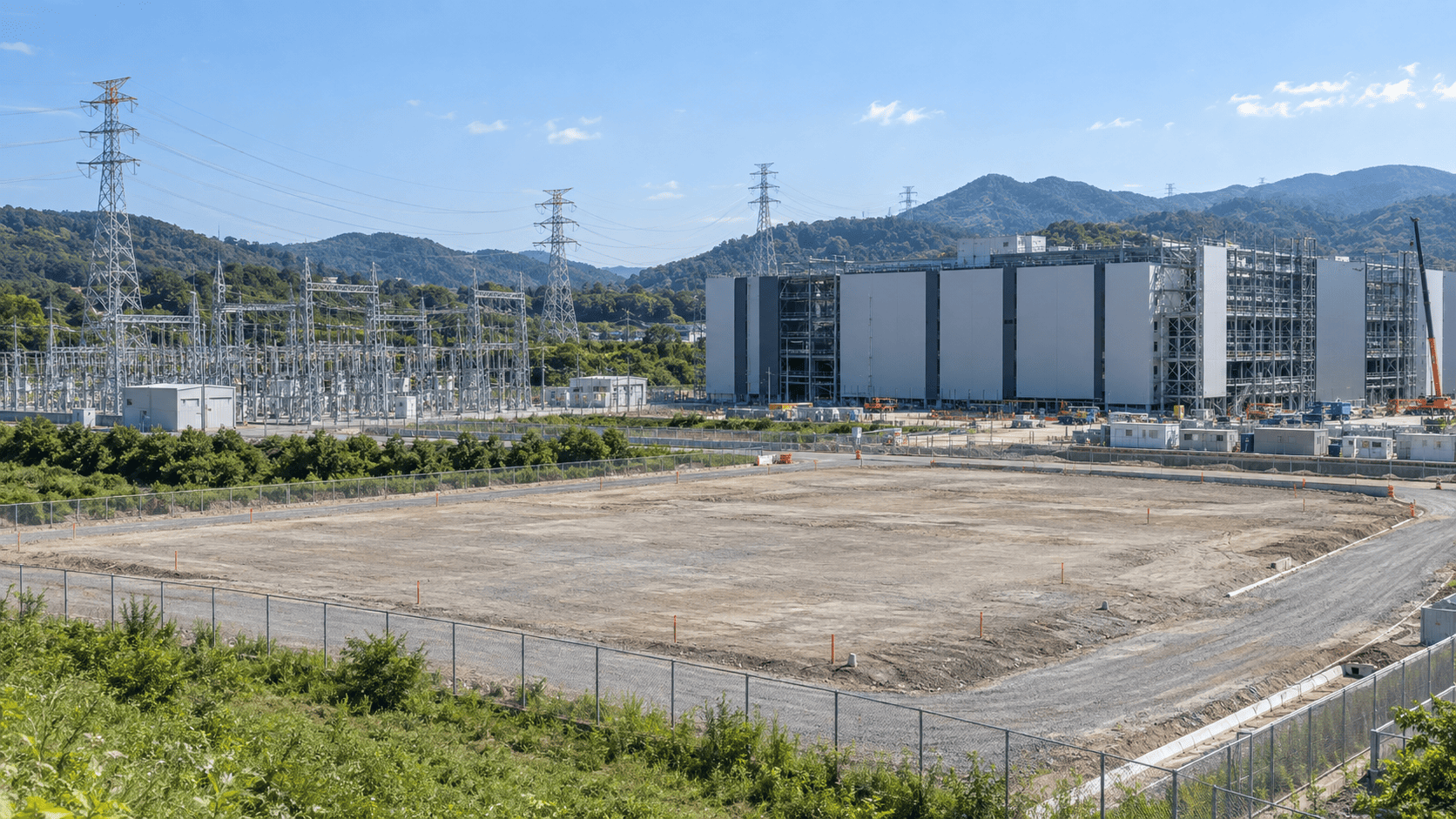
METI envisages making use of measures such as advance and planned development of the power grid for candidate areas.
I think the distinctive feature of this policy is that, rather than individual operators separately seeking infrastructure after their power demand materializes, development is considered with a view to the demand of the area as a whole.
However, the fact that grid development is “envisaged” as a matter of policy is separate from whether a particular data center can use the capacity it wants, at the location it wants, on the date it wants.
Confirmation with the relevant general transmission and distribution utility is still required regarding the demand outlook, connection point, necessary works, supply start date, and development costs.
Moreover, “being able to use electricity” and “being able to procure electricity with the desired decarbonization value” should be considered separately.
What a data center needs is not only supply capacity sufficient to operate without outages.
If the operator explains renewable energy use or emissions reductions to its customers, it must also sort out how the attributes of the procured electricity will be verified and who is entitled to claim that value.
This is not a definitive statement about the designation requirements of this system, but a practical consideration relating to contracts and disclosure in the data center business.
Four Risks That Remain After Designation
Power Capacity and Timing
Even if grid development progresses for the area as a whole, it will not necessarily match the capacity or supply start date required by an individual operator.
If an operator commits first to investment in server equipment or to launching services for customers, delays in power supply will directly affect revenue and contractual performance.
I believe the business plan should set out not only the final required capacity, but also when and how much supply is needed for each phased expansion.
Procurement of Decarbonized Power
Even if renewable energy or other decarbonized power sources exist near the area, an individual operator will not necessarily be able to use that electricity or its environmental value.
It is necessary to confirm the supplier, the consumer, the contract term, the price, fluctuations in supply volume, and the attribution of environmental value.
I think it is better not to equate “being located near decarbonized power sources” with “our data center is operated on decarbonized electricity.”
Land and Permits
Area designation does not complete the rights relating to the site, land preparation, building and environmental procedures, or coordination with the local community.
The required procedures differ depending on the land and the facilities.
In particular, where the scheduled completion of power infrastructure and the time at which the land can actually be used do not align, the sequence of investment and the burden of financing become issues.
Subsidies and Changes to Plans
METI’s FAQ on the call for proposals explains that budgetary support after area selection requires applications for individual projects, and that the support requirements of each program must be satisfied.
The same FAQ also mentions that if a plan is discontinued or changed in a way that significantly affects the overall concept, the area selection may be revoked, and that discontinuation of an individual project that received budgetary support may give rise to repayment of subsidies.
If subsidies are factored into the financial plan, it is necessary to distinguish between the stages of selection, grant decision, and payment, and to decide in advance who bears the risk of non-selection or repayment.
Who Ultimately Bears the Risk?
Under this system, local governments, transmission and distribution utilities, landowners, data center developers, operators, power suppliers, customers, and financial institutions may all be involved.
However, the involvement of many parties does not mean that risk is naturally dispersed.
Rather, because a change of plan by one party can render another party’s investment wasted, what was promised at which point in time becomes important.
For example, consider a situation in which, after a developer has acquired land and entered into a construction contract, the start of power supply is delayed beyond schedule.
The allocation of loss will vary depending on whose circumstances caused the delay, what legal significance prior explanations carry, whether the developer can extend the construction period, and whether the customer’s service start date can be postponed.
It cannot be said, merely from the fact of area designation, that the national government, the local government, or the transmission and distribution utility will naturally compensate for that loss.
The following are examples for consideration when drafting individual contracts, not a uniform allocation of responsibility set by the system.
First, decide how power supply and land acquisition will be linked to the conditions for the land sale, the start of construction, equipment orders, and loan disbursement.
Next, decide who is responsible for which works and procedures, and to what extent each party bears costs that exceed expectations.
Furthermore, set out the deadlines, extensions, termination, and treatment of costs already incurred if the start of supply or permits are delayed.
Finally, consider whether the price or scope of the business can be revised if the local government changes its plans or if subsidies are not selected or must be repaid.
These are not issues that can be resolved by a general disclaimer clause placed at the end of a contract.
Before investments become irreversible, it is necessary to align the timing of land, power, construction, and customer contracts, and to establish the conditions for proceeding at each stage.
I believe that the more a project is a GX Strategic Area project, the more carefully this sequence should be worked out at the initial basic agreement and business plan stage.
Turning Area Designation into a Viable Business
There is significance in the government selecting areas and considering infrastructure development, including the power grid, in advance.
This is because issues that are difficult for individual companies to coordinate on their own may become easier to address at the area level.
On the other hand, appreciating that significance is different from regarding the profitability and feasibility of a designated project as already confirmed.
In the data center business in particular, power capacity and supply timing, decarbonization value, land, telecommunications, and customer demand must be viewed as a whole.
I believe that only by translating the policy progress represented by designation into contracts between operators and individual procedures does the distance to commercialization actually shrink.
Conclusion
Designation as a GX Strategic Area is an important entry point for linking decarbonized power sources with industrial siting.
However, it does not finalize, all at once, the power, permits, subsidies, and customer contracts needed by each individual data center.
I think the practical core lies not in declaring that uncertainty after designation will be eliminated, but in understanding that uncertainty and designing the sequence of investment and the contractual allocation of burdens.
I intend to continue following the process from designation to the start of operation, while keeping track of how support measures and each area’s plans take concrete shape.
- [Column] [ESG Strategies for Business] Vol.37 Launch of the New 250 MW FiT Quota—FiT 2.0 Bidding Requirements and Entry Opportunities for Japanese Companies
- [Column] Will Secondhand Solar Assets "Collapse in Price"? - Where Do Price Gaps That a DCF over the Remaining FIT Period Cannot Explain Come From?
関連記事
-
 [Column] Will Secondhand Solar Assets “Collapse in Price”? – Where Do Price Gaps That a DCF over the Remaining FIT Period Cannot Explain Come From?
-
[Column] Indonesia’s Forest Carbon Credits and the JCM – Procedures for Transfers Abroad in Light of Minister of Forestry Regulation No. 6 of 2026 and Japan’s Systems
-
[Column] Agrivoltaics Shifts from Temporary Farmland Conversion to Municipal Certification – Reading the October 2026 Ministerial Ordinance Amendments and Public Notice from a Contract Practice Perspective
-
[Column] [ESG Strategies for Business] Vol.37 Launch of the New 250 MW FiT Quota—FiT 2.0 Bidding Requirements and Entry Opportunities for Japanese Companies
-
[Column] [ESG Strategies for Business] Vol.36 Malaysia’s Packaging EPR Mandate and Single-Use Plastic Regulations—The Current State of the Plastics Sustainability Roadmap
-
[Column] [ESG Strategies for Business] Vol.35 Amendments to Malaysia’s PDPA and Practical Responses for Japanese Companies—DPO Appointment, Data Breach Notification, and Cross-Border Data Transfer Guidelines
-
[Article] Investing in Japan’s Battery Storage Business: August 2026 Guide – Market Opportunities, Revenue Strategies, Regulation and Legal Practice
-
JETRO Publishes Report on Malaysia’s Carbon Market